
When you ask someone to please be on time, you are setting a clear expectation for punctuality. This phrase serves as a direct, polite reminder that a scheduled event requires everyone’s presence at a specific moment. Mastering how to communicate this effectively ensures that your professional meetings start without delays and that your time remains respected.
Choosing the right words helps you avoid sounding overly demanding while still emphasizing the importance of a strict schedule. Understanding the nuances of this request can help you maintain better relationships with colleagues and clients alike.
Whether you are organizing a high-stakes client interview or a quick internal sync, the way you phrase your expectations matters. Using the right tone prevents misunderstandings and fosters a culture of mutual respect.
You will find that clear communication regarding time commitments is a hallmark of a reliable professional. Let’s look at how to use this phrase and its alternatives in various settings.
Understanding the Meaning and Intent

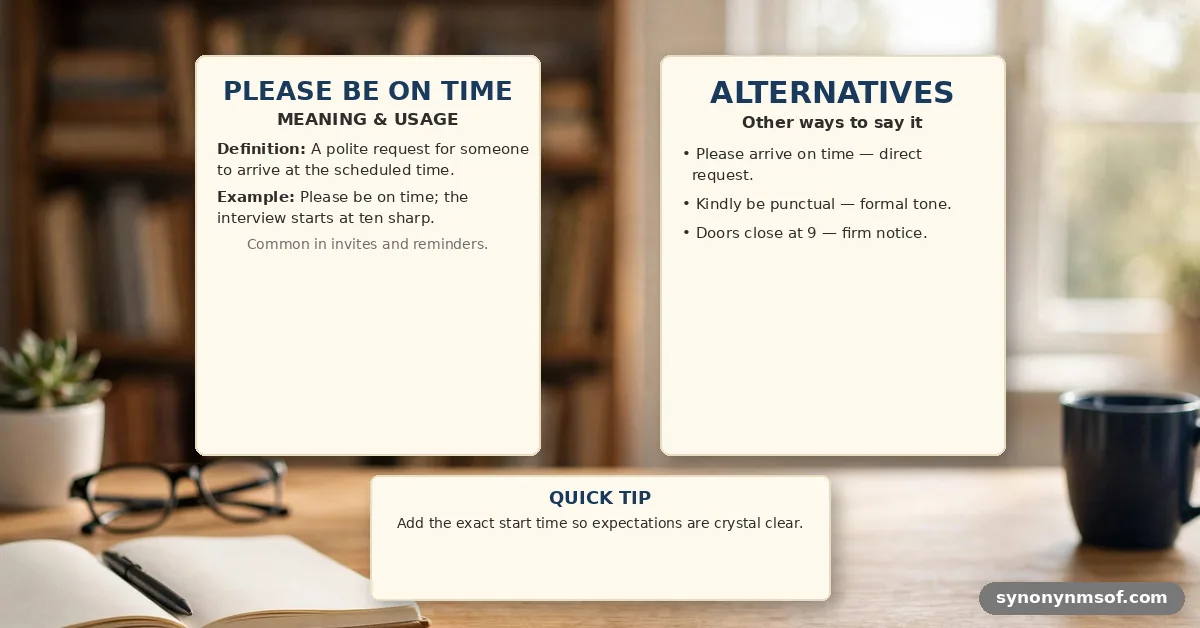
The phrase please be on time is a standard request for punctuality. It functions as an instruction that the recipient should arrive at a designated location or log into a virtual meeting by the exact start time. Unlike “in time,” which implies arriving before a deadline or with a buffer, “on time” focuses on the precise hour or minute agreed upon.
In a professional setting, this phrase signals that the schedule is tight. It suggests that the agenda is packed and that late arrivals will disrupt the flow of the discussion.
If you use it in an email, it often indicates that the meeting has a hard stop or requires full attendance to make a decision. Using it correctly shows that you value everyone’s time, including your own.
The Nuance of Professional Punctuality
Context is everything when you ask someone to be prompt. If you are sending an invitation to a casual team lunch, the phrase might sound stiff or overly formal.
However, for a formal board meeting or a job interview, it is a perfectly acceptable way to manage expectations. You should consider the power dynamic as well; a manager might use a different tone than a peer when requesting punctuality.
The goal is to frame the request around the value of the shared time. Instead of framing it as a fear of tardiness, frame it as a desire to make the most of the session.
This shifts the focus from a negative constraint to a positive collaboration. When people understand that their presence is essential, they are much more likely to prioritize being prompt.
When to Use This Phrase
Deciding when to use this specific request depends on the nature of your meeting. It is most effective when the event has a limited duration or a complex agenda.
For example, if you have a 30-minute window to solve a critical issue, every minute counts. In these cases, stating your expectations clearly at the end of an email is a standard, professional practice.
You should also use this language when coordinating with external partners or clients who may not be familiar with your internal office culture. It sets a boundary early on and prevents the awkwardness of waiting for someone to join a call. It is a proactive step that protects your schedule from the ripple effects of someone else’s delay.
- Client Interviews: Essential for maintaining a polished, organized brand image.
- Board Meetings: Necessary when multiple stakeholders are present and time is expensive.
- Project Kick-offs: Useful for ensuring all team members are present for critical instructions.
- Virtual Training Sessions: Helpful for keeping the flow of the presentation uninterrupted.
Professional Alternatives to Consider
Sometimes, you might want a softer or more formal tone than the direct request. There are many ways to communicate the need for punctuality without using the exact phrase.
These alternatives often rely on the word “kindly” or “appreciate” to adjust the sentiment. Choosing the right one depends on the specific scenario and your relationship with the recipient.
If you are writing to a superior, you might focus on the agenda rather than the person’s arrival. If you are writing to a direct report, you can be more explicit about the need for their attendance. Here are a few ways to vary your language while keeping the professional intent clear.
Softening the Request
Using phrases like “We would appreciate your prompt arrival” sounds more collaborative than a direct command. It implies that the attendee’s presence is a contribution to the meeting’s success. This is particularly useful when dealing with busy executives or high-level stakeholders who might otherwise overlook a standard invitation.
Another effective method is to mention the start time with a sense of purpose. Saying “We will begin promptly at 9:00 AM” is a subtle way of saying “please be on time” without being confrontational. It places the responsibility on the clock rather than on the person, which reduces the chance of causing offense.
Comparison of Punctuality Requests
Choosing the right phrase involves balancing the level of formality and the urgency of the situation. The table below outlines how different approaches affect the tone of your communication.
| Phrase | Tone | Best Used For |
|---|---|---|
| Please be on time | Direct, neutral | Standard meetings |
| Kindly arrive promptly | Formal, polite | Client-facing events |
| We will begin at 9:00 AM sharp | Assertive, clear | Time-sensitive projects |
| Your prompt attendance is appreciated | Very formal | Executive briefings |
| Please arrive by 10:00 AM | Action-oriented | Logistical coordination |
Managing Expectations via Email
When you send an email, the lack of vocal tone means your words carry more weight. Avoid burying the request for punctuality in the middle of a long paragraph.
It should be clear and easy to spot, ideally near the mention of the meeting time or in the final sentence. This ensures that the recipient doesn’t miss the instruction while scanning for details.
If you are coordinating a large group, consider adding a brief note about the agenda. “We have a lot to cover in this hour, so we will start right on time” explains the “why” behind the request. People are generally more cooperative when they understand that the urgency is driven by a genuine need for efficiency rather than a desire for control.
Common Mistakes to Avoid
One common mistake is using the phrase in a way that sounds passive-aggressive. For example, sending a follow-up email that says “I hope you can manage to be on time this time” is never appropriate in a work environment.
This creates unnecessary tension and damages the professional relationship. Always keep the focus on the current event rather than past behavior.
Another error is using the phrase when it isn’t actually necessary. If your meeting has a flexible start time or if you are the only two people involved, being overly insistent on punctuality can seem robotic.
Use these phrases sparingly to ensure they retain their impact. When you use them too often, they lose their meaning and can become background noise.
Cultural and Contextual Considerations
Different industries and cultures have varying standards for what constitutes being “on time.” In some high-paced sectors, five minutes late is considered a significant delay.
In other, more relaxed creative environments, a ten-minute buffer is often expected. You should adjust your language to match the norms of your specific workplace or client base.
If you are working with an international team, be mindful that “promptly” might be interpreted differently across borders. Being explicit about the time zone and the start time is often more important than the specific phrasing of your request. Clarity is the best way to avoid cultural friction and ensure everyone is aligned on the schedule.
Frequently Asked Questions
Is the phrase please be on time professional?
Yes, it is considered a professional and standard way to request punctuality. It is clear, direct, and leaves little room for misinterpretation. As long as the tone of the surrounding text is respectful, it is perfectly acceptable for most workplace communications.
What is the best way to express urgency politely?
The best way to express urgency is to explain the reason for the tight timeline. Instead of just demanding punctuality, state that you have a full agenda or a hard stop at a certain time. This makes the request feel like a shared goal rather than a personal demand.
What is the difference between at your earliest convenience and as soon as possible?
The phrase “at your earliest convenience” implies that the recipient has some flexibility in when they complete the task. In contrast, “as soon as possible” suggests that the task is urgent and should be prioritized immediately. They are not interchangeable and should be chosen based on the actual deadline.
Should I use Please be on time for a job interview?
It is generally better to use a slightly more formal approach when speaking to a candidate. You might say, “We look forward to seeing you at 10:00 AM sharp.” This conveys the importance of the time without sounding like you are giving orders to a potential employee.
Maintaining Professional Relationships
Effective communication is the cornerstone of a successful career, and knowing how to ask for punctuality is a small but vital part of that skill set. By choosing the right phrasing, you demonstrate respect for your colleagues’ time while ensuring your own objectives are met.
Remember that the goal is to create a shared understanding of expectations rather than to enforce rules for their own sake. When you frame your requests clearly and politely, you build a reputation for being organized and reliable.
Practice using these variations in your daily correspondence to see which ones fit your personal style best. Consistency in how you manage your schedule will help you cultivate a more efficient and professional environment.
If you find yourself needing to request punctuality often, look for ways to streamline your meeting processes as well. Staying mindful of your tone when you ask others to please be on time will ensure your professional relationships remain strong and productive for years to come.
SEO Title: Please Be on Time: Meaning, Usage, and Examples
Meta Description: Learn the best professional ways to say please be on time. Discover meaning, usage, and examples to keep your meetings efficient and respectful.
Suggested URL Slug: please-be-on-time-meaning-usage-examples
Primary Keyword: please be on time
Primary Keyword: please be on time
Secondary Keywords: professional ways to say please be on time, polite ways to say please be on time, punctuality in meetings, effective meeting communication