
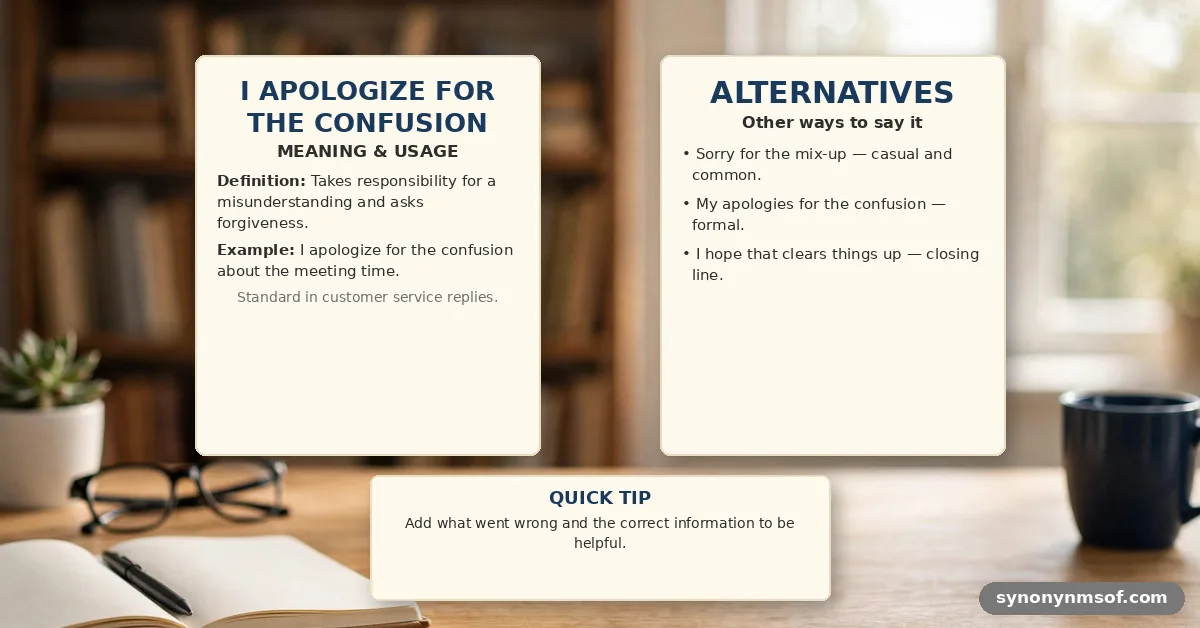

When you send a message that misses the mark, saying I apologize for the confusion helps restore clarity and professional grace. This phrase is a common tool for smoothing over miscommunications in workplace emails or client interactions. It acknowledges that a misunderstanding occurred without placing blame on either party, allowing you to move forward productively.
By mastering how to use this language effectively, you protect your reputation and ensure your team stays aligned on project goals. Understanding the subtle nuances of these words will help you choose the right tone for any situation, whether you are correcting a scheduling error or clarifying a complex set of instructions.
Understanding the Core Meaning

The phrase functions as a bridge between a mistake and a solution. When you use it, you are essentially signaling that the previous information provided was unclear or contradictory. It serves as a polite reset button for your professional correspondence.
You aren’t necessarily admitting to a major failure or incompetence when you use this language. Instead, you are taking ownership of the communication process. It shows you care about the recipient’s time and want to ensure they have the correct data to succeed.
Why Context Matters for Clarity
Using the phrase requires reading the room. If a minor typo caused a small hiccup, a simple acknowledgment is sufficient. However, if a major project deadline was missed due to poor instructions, you may need to pair your apology with a concrete plan for improvement.
The goal is to provide an explanation that doesn’t sound like an excuse. You want to validate the other person’s frustration while keeping the conversation focused on the path forward. This keeps your professional interactions moving toward positive results.
When to Use This Phrase
Timing determines how your message is received. Use this language when you realize that your previous communication created a bottleneck or a conflict. It is particularly effective during the following scenarios:
- When you sent conflicting dates or times for a meeting.
- After realizing your initial instructions were missing key attachments or details.
- When a client asks for clarification on a policy you previously explained poorly.
- During project handoffs where the documentation was not as clear as intended.
Using this phrase promptly saves time for everyone involved. It prevents the recipient from guessing your intent or acting on incorrect information. By addressing the gap early, you demonstrate respect for the other person’s workflow.
Formal Alternatives for Professional Settings
Sometimes you need a different tone to match the gravity of the situation. While the standard apology works well for most emails, higher-stakes environments might require more precise language. Consider these variations to keep your English professional and polished.
| Alternative Phrase | Best Context | Tone Level |
|---|---|---|
| Please accept my apologies for the lack of clarity. | Client-facing or senior leadership | Highly Formal |
| I regret any misunderstanding regarding the update. | Contractual or legal discussions | Formal/Neutral |
| Thank you for your patience while I clarify this. | When you need to restate instructions | Polite/Action-Oriented |
| I appreciate you flagging the inconsistency. | When a peer catches your mistake | Collaborative |
Grammar and Writing Best Practices
Using the correct grammar matters when you want to maintain authority. The word apologize is the standard American English spelling, while apologise is common in British English. Be consistent with your chosen style throughout your message.
Avoid overusing the phrase in every single email. If you find yourself apologizing for confusion constantly, it is a sign that your writing process needs a structural change. You might need to use bullet points, bold text, or clearer subject lines to improve your initial communication.
Refining Your Message Structure
When you write an apology, keep it brief. State the error, offer the correction, and move on. Do not dwell on the mistake for more than one or two sentences, as this can make you look insecure.
Focus on the recipient’s needs. Instead of saying I am sorry, say I want to ensure you have the correct information. This pivots the conversation from your past mistake to the current, helpful solution.
Common Mistakes to Avoid
One common error is sounding overly defensive. If you explain why the confusion happened in too much detail, it sounds like you are making excuses. Keep your explanation limited to facts rather than feelings.
Another mistake is failing to provide the actual fix. An apology without a resolution is just noise. Always ensure your message includes the correct document, the right link, or the updated timeline you intended to send initially.
Choosing the Right Tone
Your tone should match the relationship you have with the recipient. With a close teammate, you can be casual and direct. With a new client or a supervisor, a more formal approach is safer and more respectful.
If you are unsure of the appropriate tone, default to professional and concise. Being overly wordy often leads to more confusion, which defeats the entire purpose of your message. Stick to the facts and keep your language simple.
Frequently Asked Questions
Is saying I apologize for the confusion professional?
Yes, it is a standard and widely accepted phrase in professional writing. It effectively acknowledges a lapse in communication without being overly emotional or dramatic.
What is the best way to express urgency politely?
Instead of demanding a quick response, use phrases like I would appreciate your prompt attention to this or Please let me know if you need further details to meet the deadline. This frames the urgency as a shared goal rather than a demand.
What is the difference between at your earliest convenience and as soon as possible?
At your earliest convenience is a polite, formal request that gives the recipient autonomy. As soon as possible often implies a higher level of urgency or an immediate need, which can sound slightly more demanding in certain contexts.
How do I fix a misunderstanding without apologizing too much?
Focus on the solution. Simply say, I see my previous message was unclear, and here is the correct information. By providing the fix immediately, you show competence and move past the error quickly.
Maintaining Professional Clarity
Effective communication is the cornerstone of any successful career. By choosing your words carefully when a misunderstanding occurs, you demonstrate maturity and a commitment to quality. The goal is always to provide clarity that helps your team or client succeed.
When you do make a mistake, acknowledge it with grace and provide the necessary information to correct it. This builds trust and shows that you value precision in your work. Keep your messages focused on solutions, and you will find that even the most complex projects run more smoothly when everyone is on the same page.
Practice these habits in your daily correspondence to refine your style. Using the right phrasing allows you to recover from errors and maintain strong professional relationships.
If you find yourself needing to clarify information, remember that a direct, polite, and solution-focused approach is always the best path forward. If you have questions about specific scenarios, feel free to reach out and refine your approach further.
SEO Title: I Apologize for the Confusion: Meaning & Examples
Meta Description: Learn the best ways to use I apologize for the confusion professionally. Find formal alternatives, grammar tips, and examples to clear up misunderstandings.
Suggested URL Slug: i-apologize-for-the-confusion-meaning-examples
Primary Keyword: I apologize for the
Primary Keyword: I apologize for the confusion
Secondary Keywords: sorry confusion, confusion caused, best use, writing, apologies, grammar, english, example, sentence, apologize, formal, tone, results, phrase, casual, misunderstanding