
Using the phrase as soon as possible often feels like a standard reflex in workplace communication, yet it frequently carries unintended baggage. You might think you are simply conveying urgency, but to the recipient, it can sound demanding or vague. Understanding the nuance of this expression helps you maintain professional relationships while ensuring your requests are actually met.
By learning how to balance clarity with courtesy, you will find that people are much more responsive to your needs. This guide breaks down the true meaning of the term, how to use it without causing friction, and the best alternatives for when you need a more specific or polite approach.
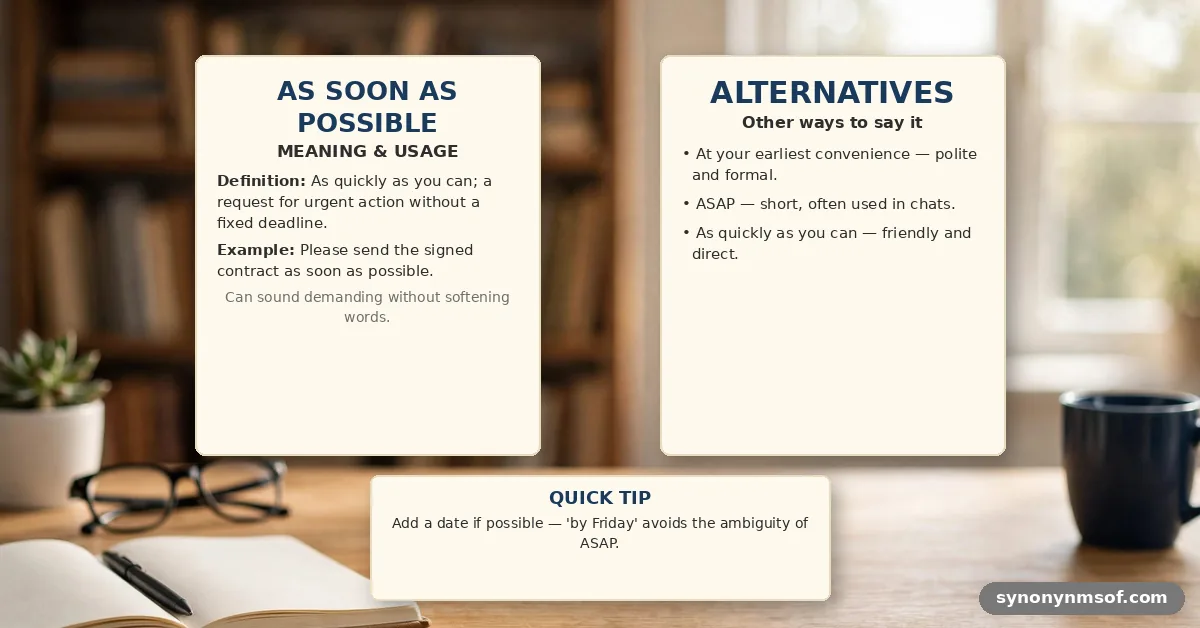
At its core, the phrase is a request for priority. It signals that the task at hand should jump to the front of the recipient’s queue. However, the lack of a defined deadline often creates a psychological disconnect between the sender and the receiver.
When you ask for something to be done as soon as possible, you are essentially outsourcing the prioritization process. You expect the other person to know exactly how urgent your request is compared to their other commitments. This ambiguity is where most communication breakdowns occur.
From the recipient’s perspective, this phrase can feel like an invisible pressure cooker. They have no clear guidance on whether you need the item in ten minutes or by the end of the week. This leads to unnecessary stress and often results in the task being delayed further as they try to guess your expectations.
The Psychology of Urgency

There is a distinct power dynamic at play when you demand immediate action. If you use this phrase too frequently, it loses its impact and starts to sound like a default setting. People eventually tune it out because it lacks the specific weight of a genuine emergency.
I once worked with a manager who used this phrase for every single email, from urgent budget reports to minor coffee run requests. Eventually, we stopped prioritizing his emails altogether because we could no longer distinguish between a crisis and a casual inquiry. When everything is an emergency, nothing is.
Consider the emotional toll on the person receiving your message. If they feel like they are constantly being put on the spot, they may begin to view your communications with apprehension. Building a culture of clear, respectful deadlines is much more effective than relying on constant, vague urgencies.
Professional Alternatives for Better Clarity
Replacing the standard phrase with more specific language is the easiest way to improve your professional communication. Clarity is a form of kindness. By giving a concrete timeframe, you respect the other person’s time and planning process.
Here are several ways to express urgency without using the tired, overused shorthand:
- Specific Timeframe: Please send this by 3:00 PM today.
- Prioritization: This is a high-priority item for the upcoming presentation.
- Collaborative Request: Could you let me know when you might realistically be able to look at this?
- Deadline-Driven: I need this finalized before our meeting on Thursday morning.
- Softened Approach: If you could fit this in sometime today, that would be greatly appreciated.
Comparing Deadline Strategies
Choosing the right phrasing depends heavily on the relationship you have with the recipient and the nature of the task. The following table illustrates how different approaches impact the perceived urgency and professional tone of your request.
| Phrase Used | Perceived Urgency | Professional Tone |
|---|---|---|
| As soon as possible | High/Uncertain | Neutral/Demanding |
| By close of business | Medium/High | Professional |
| Whenever you get a moment | Low | Polite/Casual |
| Before our 10 AM call | High/Specific | Direct/Effective |
| By end of week | Low/Medium | Respectful |
Why Specificity Wins Every Time
When you provide a date or a time, you remove the guesswork. The recipient can look at their schedule and honestly tell you if they can meet your requirement. This creates a foundation of trust rather than one of frustration.
If you don’t know when you need something, it is better to be honest about that. You might say, “I don’t have a hard deadline for this, but could you let me know when you think you can get to it?” This puts the control back in the hands of the person doing the work.
Specificity also helps you manage your own workflow. If you are waiting on a report, knowing exactly when it will arrive allows you to plan your next steps. You aren’t constantly checking your inbox, wondering if the other person has finished their part.
The Impact of Tone on Remote Teams
In remote work environments, we lose the nuance of body language and tone of voice. A text-based request for something to be done as soon as possible can easily be interpreted as a sharp command. It is vital to add a layer of warmth to your digital communication.
Try adding a simple “Thank you for your help with this” or “I know you’re busy, so let me know if this timeline works.” These small additions acknowledge the other person’s workload. They change the nature of the interaction from a demand to a collaborative effort.
Remember that your colleagues are human beings with their own competing priorities. When you express empathy for their schedule, they are much more likely to go the extra mile for you. This is the difference between a transactional workplace and one built on mutual respect.
Common Pitfalls in Professional Emailing
One of the biggest mistakes people make is using high-urgency language for non-urgent tasks. It signals that you don’t understand the scope of the projects your team is handling. This can make you appear disorganized or detached from the reality of the office.
Another pitfall is using these phrases in group emails. When you blast a request to five people with a generic “as soon as possible” tag, nobody feels responsible for the outcome. It is far better to assign the task to one person and provide a clear deadline.
Finally, avoid using these phrases as a substitute for planning. If you find yourself consistently needing things immediately, it usually points to a breakdown in your own scheduling. Better planning on your end prevents the need for an emergency on someone else’s end.
When Is Urgency Actually Appropriate?
There are definitely times when you truly need an immediate response. In those cases, don’t hide behind polite jargon. Be transparent about why the situation requires such quick action.
For example, if a client is waiting on a file, it is perfectly fine to say, “The client is on the line right now and needs this file immediately.” This gives the recipient context. They understand that the urgency is driven by external factors, not by your own lack of organization.
Use your communication tools wisely. If something is truly urgent, a quick phone call or a direct message is often better than an email. Emails can sit unread for hours, whereas a direct ping provides the immediate feedback loop you need during a crisis.
The Cultural Context of Time
It is important to recognize that different cultures have different relationships with time and urgency. In some business cultures, being direct and fast is seen as a sign of respect. In others, taking the time to build a relationship before diving into tasks is the priority.
If you are working with international teams, be mindful of these differences. A blunt “as soon as possible” might be received differently in Tokyo than it would be in New York. Taking a moment to understand your audience can save you from unintentional social blunders.
Always err on the side of being explicit about your needs while remaining polite. If you are working across time zones, include the specific time and the timezone in your request. This removes any ambiguity and shows that you have considered the logistics of the collaboration.
How to Handle Being on the Receiving End
What should you do when someone keeps sending you vague, urgent requests? You have the right to ask for clarification. Don’t feel pressured to drop everything just because someone used a high-pressure phrase.
You can reply with, “I’m currently working on X and Y. I can get to this by tomorrow morning if that works for you, or I can prioritize it over X if it’s needed sooner.” This puts the ball back in their court.
You are managing your own productivity. By pushing back respectfully, you educate the sender on how to communicate with you more effectively. Over time, they will learn to provide better instructions because they know you value clear, actionable requests.
The Role of Digital Tools
Modern project management software has largely replaced the need for urgent email blasts. Tools like Asana, Trello, or Jira allow you to assign tasks with clear due dates and priority levels. This makes the “as soon as possible” conversation largely obsolete.
When you use these tools, you are setting expectations from the start. If a task is marked as “Urgent” in a shared system, everyone on the team understands the stakes. It eliminates the need for annoying follow-up emails asking “Any update on this?”
Even if your company doesn’t use these platforms, you can create your own system. Use a shared spreadsheet or a simple document to track deliverables. It provides transparency and accountability, which are the two biggest enemies of vague, last-minute requests.
Refining Your Communication Style
Developing a professional communication style is an ongoing process. You will make mistakes, and you will occasionally be on the receiving end of a poorly worded request. The goal is to consistently move toward more clarity and less ambiguity.
Pay attention to how your colleagues respond to different types of requests. Do they react better to direct deadlines?
Do they prefer a more collaborative, “when can you do this” approach? Adapt your style to the individual, not just the task.
Communication is not just about the words you use; it is about the results you achieve. When you speak with precision, you get better results, fewer misunderstandings, and stronger relationships. It is a small change that yields massive professional dividends.
Frequently Asked Questions
Is it ever professional to use the phrase as soon as possible?
Yes, it is acceptable in casual or internal communication when the urgency is understood by all parties. However, in client-facing or formal documents, it is usually better to provide a specific date or time to maintain a professional tone.
How do I respond if a client keeps using this phrase?
The best approach is to kindly request a specific deadline. You can say, “I want to make sure I prioritize this correctly for you.
Could you let me know your desired completion date?” This forces them to define the timeline without you sounding defensive.
What is the most professional way to say you are busy?
Instead of saying you are busy, focus on your capacity. You can say, “I am currently focused on project X and Y, but I can pick this up by Wednesday.” This shows you are managing your workload effectively rather than simply being unavailable.
How many days does this phrase typically imply?
There is no standard number of days, which is precisely why the phrase is problematic. To one person, it means within the hour; to another, it means by the end of the week. Always clarify the timeline to avoid disappointment.
Why do people use this phrase if it is so vague?
Most people use it as a shortcut because they are stressed or in a hurry. They are not trying to be difficult, but they are failing to consider how the message lands on the other side. It is often a result of poor time management on the sender’s part.
Conclusion
Mastering the way you convey urgency is a subtle but powerful way to improve your professional life. While it is easy to default to as soon as possible, choosing to be more specific with your deadlines will distinguish you as a clear and thoughtful communicator. When you provide concrete timeframes, you respect the time of others and reduce the anxiety that comes with vague expectations.
Start by replacing this phrase with specific dates or collaborative questions in your next few emails. You will likely notice a significant shift in how people respond to your requests. I encourage you to experiment with these alternatives this week and see how much smoother your daily interactions become when you prioritize clarity over convenience.