
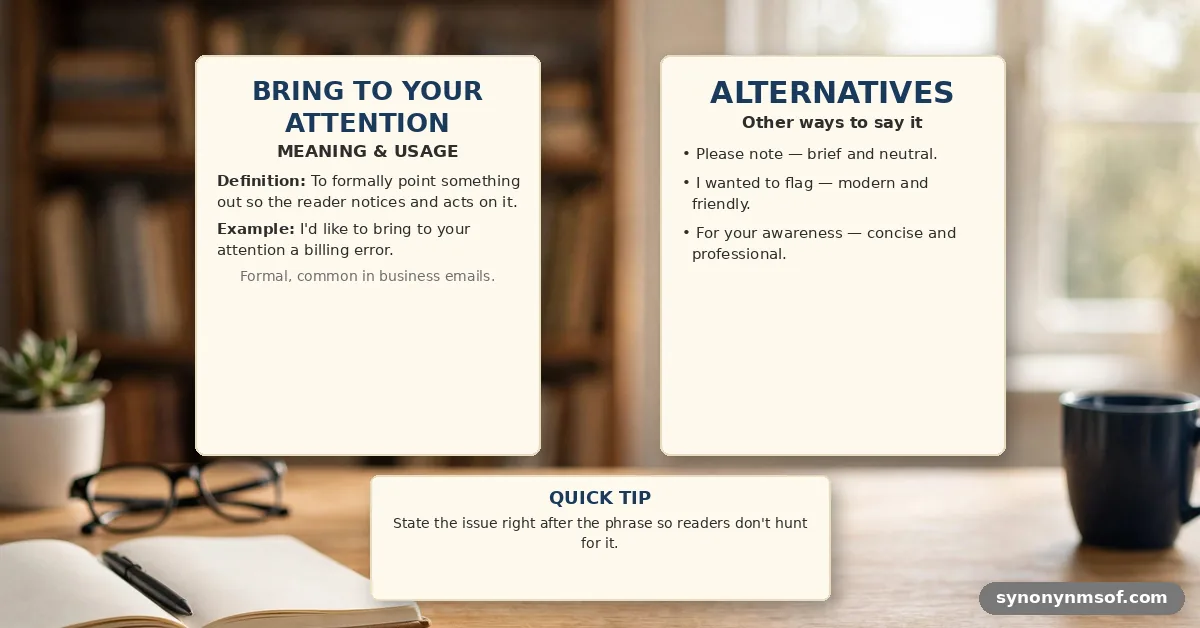

The phrase “bring to your attention” is a standard professional idiom used to highlight specific information for someone else’s review. Understanding the meaning and examples of bringing to your attention helps you communicate more effectively in workplace emails, formal reports, and verbal briefings.
When you use this expression, you are signaling that the recipient needs to prioritize or acknowledge a particular detail among a larger set of facts. This guide clarifies the nuances of this phrase and demonstrates how to deploy it across various professional scenarios.
At its core, this expression serves as a polite indicator that you have information that requires the recipient’s focus. It functions as a signpost, telling the reader, “Stop here; this part is important.” By mastering these linguistic tools, you ensure your messages are clear, professional, and actionable.
To “bring to your attention” means to make someone aware of a fact, an issue, or an opportunity that they might have otherwise missed. It is a formal way of saying, “Please look at this.” You are essentially asking the recipient to dedicate cognitive resources to a specific subject.
The phrase carries a level of professional courtesy, suggesting that the information is relevant to the recipient’s responsibilities. It is not a demand, but rather a nudge toward a topic that requires their judgment or approval. Using it appropriately establishes a tone of accountability and transparency in business correspondence.
Nuance and Tone

The tone of this phrase is neutral and objective, which makes it suitable for almost any professional context. It avoids the abruptness of saying “Read this” or “You need to see this.” By framing it as a notification, you maintain a respectful distance while ensuring the message lands with the intended impact.
Context matters significantly when you decide to use this phrasing. In a crisis, brevity is preferred, so you might opt for a more direct approach. In a routine update, however, this phrase serves as an excellent transition to the core of your message.
Common Examples in Professional Email
In a standard business environment, this phrase is frequently used to introduce attachments, highlight policy changes, or flag errors. It acts as a bridge between the pleasantries of an email and the substantive content of the message. Below are examples of how this is applied in various corporate communication channels.
If you are sending a document for review, you might write: “I am attaching the Q3 financial report to bring to your attention the variance in operational costs.” This immediately tells the recipient what they should be looking for. It prevents the reader from guessing why the document was sent in the first place.
Applying the Phrase to Feedback
When providing feedback to a manager, you might state: “I would like to bring to your attention a recurring technical issue reported by the client base.” This framing is constructive because it focuses on a specific problem rather than making a vague complaint. It invites the recipient to consider a solution rather than just dismissing the issue.
You can also use this to highlight positive developments, such as: “I want to bring to your attention the excellent performance of the engineering team this week.” This shows that you are observant and appreciate the hard work of your colleagues. It is an effective way to keep leadership informed of team successes.
Comparison of Communication Styles
Choosing the right words is critical for ensuring your message is interpreted correctly. The following table compares common phrases used to alert someone to information and their relative levels of formality and directness.
| Phrase | Formality Level | Best Used For |
|---|---|---|
| “I’d like to bring to your attention…” | High (Formal) | Managers, clients, official reports |
| “Please note that…” | Medium (Standard) | Routine updates, project memos |
| “Check out this…” | Low (Informal) | Immediate team members, Slack/Teams |
| “You should be aware of…” | Medium (Direct) | Risk warnings, compliance issues |
When to Avoid the Phrase
While the expression is useful, it can become repetitive if used too often in a single document. If every paragraph starts with “I am bringing to your attention,” your writing will sound monotonous and overly bureaucratic. Varying your sentence structure keeps the reader engaged.
Avoid using this phrase when the information is self-evident. If you are sending a file that is clearly labeled “Q4 Budget,” you do not need to say, “I am bringing this to your attention.” The context already explains why the document is there, so adding the phrase is redundant.
Managing Over-Communication
Over-using the phrase can also make you sound like you are “policing” the recipient. If you are constantly directing their focus, it may seem like you do not trust them to read the information themselves. Use it only for items that genuinely require a change in perspective or action.
Consider the hierarchy of your communication. If you are emailing a high-level executive, prioritize brevity. They likely have limited time, so get to the point immediately without too many introductory phrases.
Synonyms and Alternatives
Expanding your vocabulary allows you to tailor your message to the specific situation. If you find yourself overusing the term, consider these alternatives to maintain clarity and professionalism. Each of these carries a slightly different shade of meaning.
- “Please note:” Direct and efficient for brief instructions.
- “I wish to highlight:” Useful for emphasizing specific data points in a report.
- “For your consideration:” Suggests that the recipient has the final say.
- “I am pointing out:” More informal, best used in verbal team discussions.
- “Please be advised:” Often used in legal or official compliance contexts.
The Role of Politeness
In many cultures, adding “kindly” to the phrase—such as “I would like to bring to your kind attention”—is common. While this can be viewed as polite, it is sometimes seen as overly flowery or even sarcastic in modern, fast-paced business environments. Use this version only if you are certain it fits the cultural context of your recipient.
A simple “I would like to bring to your attention” is usually sufficient to convey respect. Adding extra words often dilutes the impact of the message. Focus on the clarity of the information you are providing rather than the complexity of the phrasing.
Professional Courtesy

If you are delivering bad news, the phrase can act as a cushion. It signals to the recipient that they should prepare themselves for something that might require their immediate intervention. This is a common tactic in crisis management or project recovery.
Always balance the delivery of the information with a potential solution. Simply pointing out a problem is rarely enough to be considered “professional.” By bringing an issue to someone’s attention, you are also implicitly expected to offer a suggestion for how to handle it.
Integrating the Phrase in Reports
In formal reports, you can use the phrase to draw the reader’s eye to specific figures or conclusions. This is particularly effective in executive summaries. You might write: “We bring to your attention the 15% increase in overhead, which suggests a need for stricter procurement policies.”
This approach helps the reader synthesize complex data. It shows that you have performed the analysis and are now highlighting the most important takeaway. It is the difference between dumping raw data and providing actionable insight.
Structuring Executive Summaries
When drafting a summary, keep your highlighted points to a minimum. If you bring five different things to their attention, they will likely remember none of them. Focus on the one or two critical items that necessitate a strategic decision.
Use clear formatting to support your text. A bolded sentence or a call-out box can work just as well as the phrase itself. Often, the best way to “bring something to their attention” is through visual hierarchy rather than wordy sentences.
The Importance of Timing
The timing of your communication is just as important as the phrasing. Bringing a non-urgent matter to someone’s attention during a high-stress project deadline is likely to result in the message being ignored. Choose your moments wisely to ensure your input is received.
If the matter is urgent, use a more direct subject line. Instead of “Update,” use “Action Required: Project X Variance.” This accomplishes the goal of bringing the matter to their attention before they even open the email.
Managing Expectations
When you bring a matter to someone’s attention, set an expectation for what happens next. If you need a response, state that clearly. For example: “I am bringing this to your attention for your review and approval by Friday.”
Leaving the recipient wondering what they should do with the information creates friction. Always close the loop. If the information is for their awareness only, explicitly state: “This is for your awareness only; no action is required on your part.”
Grammar and Usage Tips
The phrase is grammatically straightforward, but common errors can arise in complex sentences. Ensure the subject and verb agree. For instance, “I am bringing these issues to your attention” is correct, whereas “I am bringing this issues” is obviously incorrect.
Keep the phrase active. “I am bringing this to your attention” is much stronger than “This is being brought to your attention.”
Passive voice makes the sender sound disconnected from the information. Use active voice to show that you are taking ownership of the communication.
Punctuation and Flow
Use a colon if you are using the phrase to introduce a list. “I would like to bring to your attention the following items:” followed by a bulleted list is a clear and effective structure. This keeps your writing clean and easy to scan.
Avoid ending the sentence with the phrase if it leaves the thought incomplete. “These are the errors I bring to your attention” is fine, but “There are many things I would like to bring to your attention” is a bit vague. Be specific about what you are identifying.
Biblical Perspectives on Attention
The concept of directing focus toward important matters is found throughout various texts, including the Bible. Proverbs 4:20 says, “My son, attend to my words; incline thine ear unto my sayings.” This verse emphasizes the necessity of paying close attention to wisdom and guidance.
In a professional sense, this mirrors the idea of focusing on the most critical information. Just as the verse suggests prioritizing certain words, you must learn to filter through the noise of daily business. This ensures that you are always focusing on the most impactful data points.
FAQ
What is another way to say “bring to your attention”?
You can use phrases like “I would like to highlight,” “Please note,” “I wish to draw your focus to,” or “For your review.” The best alternative depends on the formality of the situation and your relationship with the recipient.
Is “bring to your attention” formal?
Yes, it is considered a formal and professional expression. It is appropriate for emails to managers, clients, or stakeholders, as well as for inclusion in official reports or proposals.
When should I use this phrase?
Use it when you need to ensure the recipient notices a specific, important piece of information that might otherwise be overlooked. It is best used for highlights, corrections, or urgent matters that require a shift in perspective.
Can I use this phrase in a text message?
While grammatically correct, it is often too formal for text messaging or instant messaging platforms like Slack or Teams. In those environments, you might prefer a more direct approach, such as “Heads up on this:” or “Take a look at this.”
What does it mean if someone asks me to “bring it to their attention”?
This simply means they want to be kept in the loop regarding a specific topic. They are asking you to notify them whenever there is an update or an issue related to that subject so they can stay informed.
Conclusion
Mastering the use of professional language is a vital skill for anyone looking to advance in their career. Understanding the nuances of when and how to use the phrase “bring to your attention” allows you to communicate with confidence and clarity.
By focusing on the importance of the information rather than the volume of your emails, you ensure your message is heard. Remember that the goal is to facilitate action and understanding for your colleagues and clients.
As you continue to refine your communication style, look for opportunities to be concise and purposeful. Whether you are drafting a status report or providing feedback to a team member, clear language is your greatest asset.
Try implementing these tips in your next email to experience the difference firsthand. Bringing relevant data to the forefront of your discussions is a simple yet powerful way to elevate your professional presence.