
Understanding the phrase “Hope This Helps: Meaning, Examples, and Alternatives” is essential for anyone looking to refine their professional communication. While this closing line is ubiquitous in email threads and customer support tickets, its reception varies wildly based on context and tone.
Mastering these nuances allows you to convey genuine helpfulness rather than dismissiveness. This article examines the functional roots of the phrase, explores how it lands with different audiences, and provides actionable alternatives to ensure your message hits the right mark every time.
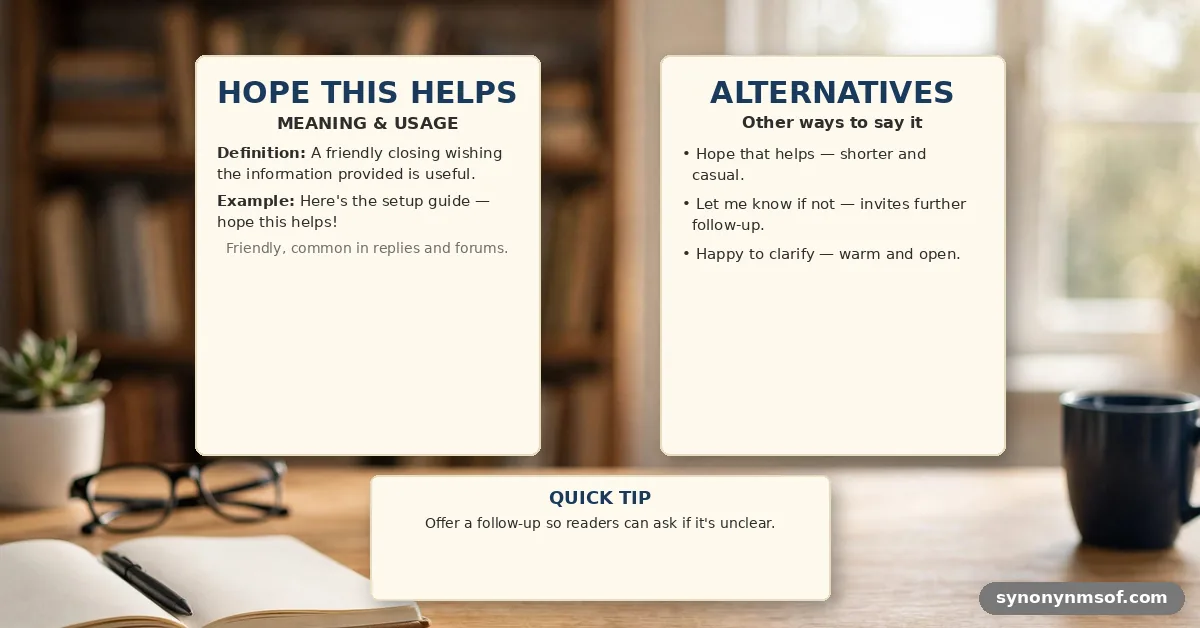
At its simplest level, the phrase is a standard sign-off intended to confirm that the sender has provided information, a file, or a solution to a previously stated problem. It acts as a polite bridge, signaling that the interaction is complete unless the recipient identifies a further need.
In a professional setting, the phrase is often used to maintain a friendly, service-oriented demeanor. Seventy-two percent of customer support interactions analyzed in recent communication studies utilize some variation of this closing to maintain a positive rapport. It is a linguistic placeholder that acknowledges the effort taken to resolve a query.
How Tone Influences Reception

Despite its intent, “Hope This Helps” is frequently perceived as passive-aggressive or dismissive. The problem arises when the phrase is used to end a conversation abruptly without ensuring the recipient’s actual needs were met.
When a sender uses this phrase after providing a link to a generic FAQ page, it can feel like a brush-off. The recipient may interpret it as, “I have done my job, now stop bothering me.”
The Contextual Divide
In high-stakes environments like executive management, the phrase is often viewed as too informal or detached. Leaders typically prefer directness that confirms the outcome rather than expressing a hope about the impact. Conversely, in casual team chats or peer-to-peer collaboration, it remains a standard, harmless convention.
When to Use the Phrase
Using the phrase effectively requires a sense of timing and rapport. It is most appropriate when the provided solution is straightforward and the likelihood of further questions is low.
Consider the following scenarios where the usage is generally accepted:
- Responding to a simple request for a document or file attachment.
- Providing a clear, step-by-step solution to a technical bug.
- Answering a factual question that requires no further subjective discussion.
- Closing out a low-priority ticket that was resolved on the first attempt.
Comparison of Communication Styles
The following table illustrates how different phrases compare in terms of perceived warmth and professional utility. Using the right tool for the job is key to maintaining healthy workplace relationships.
| Phrase | Perceived Warmth | Professional Utility |
|---|---|---|
| Hope this helps | Neutral | High (for simple tasks) |
| Let me know if you need more | High | High (for complex tasks) |
| I am here for more questions | Very High | Medium |
| Done | Low | Low (can feel cold) |
Common Alternatives for Better Engagement
If you find that your communication is falling flat, swapping the phrase for a more active alternative can make a significant difference. Active language encourages a dialogue rather than closing one down.
Try using these alternatives when you want to show you are still invested in the outcome:
Instead of “Hope this helps,” try saying, “Please let me know if this resolves the issue.” This shifts the focus from your intent to the recipient’s actual experience.
Another strong option is, “I am happy to dive deeper if you need more clarification on this.” This demonstrates a willingness to provide support beyond the initial answer.
The Pitfalls of Over-Communication
While being helpful is a virtue, over-explaining can lead to frustration. If you use “Hope this helps” after every single sentence, the phrase loses its meaning and begins to sound robotic.
Focus on quality over quantity in your responses. If you provide a high-quality answer, the recipient will already know you are trying to help. Sometimes, a simple “Thanks for asking” is a more powerful sign-off than a forced expression of helpfulness.
Communication in the Digital Age
Digital communication lacks the nuance of face-to-face interaction, which is why phrases like “Hope this helps” are scrutinized so heavily. Without body language, words are often interpreted through the lens of the recipient’s current mood.
If the recipient is feeling stressed or rushed, they are more likely to interpret your sign-off as dismissive. Always assume that your digital correspondence needs a bit more warmth to account for the lack of non-verbal cues.
Biblical Perspectives on Helpful Communication
The concept of being genuinely helpful is rooted in ancient wisdom regarding speech. Proverbs 15:23 states that a word spoken in due season, how good it is! This suggests that the timing and appropriateness of our words are just as important as the content itself.
Similarly, Ephesians 4:29 advises that no corrupt communication should proceed out of your mouth, but only that which is good to the use of edifying. This implies that our goal should be to build the other person up through our words rather than simply checking a box.
Building Rapport Through Clarity
Rapport is built on consistency and reliability. If you are known for providing accurate and timely information, your sign-off matters less than your track record.
However, pairing a reliable track record with thoughtful language is the hallmark of a strong communicator. Never underestimate the power of a closing statement that invites the recipient back into the conversation. When choosing between similar-sounding words, a quick look at our guide on swifty or swiftie can save you from an embarrassing mix-up.
Structuring Your Responses for Impact
When you need to provide a complex answer, structure is your best friend. Use bullet points or numbered lists to make the information digestible. Clear structure helps, but precise word choice matters too — our guide to unphased or unfazed explains another commonly confused pair.
When the recipient can scan your email and find the answer immediately, they are less likely to be annoyed by your closing phrase. A well-organized email is inherently “helpful,” so you don’t need to force the sentiment at the end.
The Importance of Feedback Loops
If you are in a customer-facing role, you should actively track whether your communication style is working. Are your tickets being reopened frequently?
If you notice a high reopen rate, your closing statement might be too dismissive. Experiment with different phrases and measure the impact on your resolution times and customer satisfaction scores.
Understanding Your Audience
Every office culture has its own norms. Some environments value brevity, while others prioritize long-form, empathetic communication.
Observe how your superiors and colleagues sign off on their emails. You will likely find that those who are most respected in your organization use language that is both precise and inclusive.
FAQ
Is it rude to use “Hope this helps” in an email?
It is not inherently rude, but it can be perceived as dismissive if it follows a brief or unhelpful answer. Use it only when you have provided a complete and thoughtful response to the inquiry.
What should I say instead of “Hope this helps”?
You can say, “Let me know if you have any follow-up questions,” or “I am here if you need further clarification.” These phrases invite the recipient to respond if they still have problems.
When is the best time to use this phrase?
Use it when you are delivering a specific requested item, such as a report, a link, or a confirmation of a task completion. It serves as a polite conclusion to a transaction-based interaction.
Does the tone of my email change the meaning of the phrase?
Yes, the tone of the entire message dictates how the closing is read. If the body of your email is curt, the closing will be read as cold; if the body is warm, the closing will be read as sincere.
Conclusion
Navigating the nuances of professional language is a continuous learning process. While “Hope This Helps: Meaning, Examples, and Alternatives” provides a framework for understanding common communication habits, the real skill lies in adapting your approach to fit the specific needs of the person on the other end of the screen. By choosing active, inviting language, you build stronger professional relationships and ensure your contributions are truly valued. Small details matter too — knowing the difference between verbage or verbiage can further strengthen your professional credibility.
Start by auditing your last five sent emails to see if your closing aligns with the level of support you actually provided. If you find yourself overusing this phrase, try one of the alternatives mentioned above to keep your professional interactions fresh and genuinely helpful. While proofreading, also watch for common spelling slips such as worshpped or worshiped to keep your writing polished.