
Finding the right tone in professional correspondence is difficult, and knowing when to use the phrase “it would be greatly appreciated: better ways to say it” can fundamentally change how your colleagues perceive your requests. While this specific construction is common, it often sounds passive or overly formal, which can lead to misinterpretations of your actual urgency or intent. By choosing more direct, active alternatives, you can ensure your message is clear, respectful, and highly effective.
The best way to replace this phrase is to focus on specific action and genuine gratitude. Instead of using a static, passive construction, try stating exactly what you need followed by a sincere thank you.
For instance, “Please send the report by Friday; I appreciate your help” is far more effective than “It would be greatly appreciated if the report could be sent by Friday.” This shift removes the ambiguity and puts the human element back into your digital communication.
Passive voice often obscures the person responsible for a task. When you say “It would be greatly appreciated if the files were uploaded,” you are technically not asking anyone in particular to do the work. This lack of clarity can cause delays in high-pressure environments like project management or team coordination.
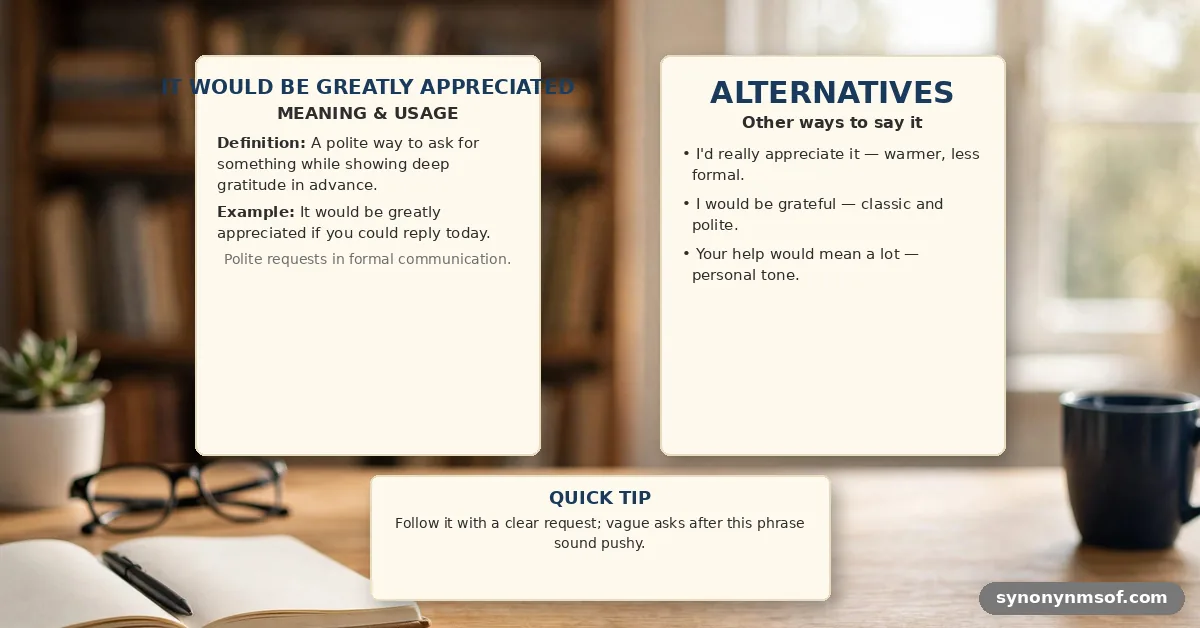
Direct requests are always better for clarity. They assign responsibility and set a clear timeline. Consider the following alternatives when you need to get a task done without sounding demanding:
- “Could you please upload those files by 3:00 PM today?”
- “I would be grateful if you could review this draft by tomorrow morning.”
- “Please let me know if you have the capacity to handle this request.”
- “Your help with this project is vital to our deadline.”
- “I appreciate your effort in getting this finished on time.”
Why Directness Wins
Direct language respects the reader’s time. When you use “it would be greatly appreciated,” you are forcing the reader to guess the urgency of your request. A direct question allows them to assess their own schedule and provide a realistic answer immediately.
Proverbs 15:23 in the World English Bible notes that a word spoken in the right time is good. Applying this wisdom to email means knowing when to be brief. If the request is simple, state it clearly and move on.
Understanding Professional Tone
Professionalism is not about using the longest words or the most passive sentence structures. It is about being clear and respectful. Using “it would be greatly appreciated: better ways to say it” often leads to a tone that feels robotic or detached.
Contrast the following approaches to see how tone changes the impact of a request:
| Passive Approach | Direct/Professional Approach |
|---|---|
| It would be greatly appreciated if you could assist. | Could you please assist with this task? |
| It would be greatly appreciated if feedback were provided. | Please share your feedback by Friday. |
| It would be greatly appreciated if you could arrive early. | Please arrive by 8:45 AM for the briefing. |
When Passive Language Actually Works
There are rare instances where softening a request is necessary. If you are dealing with a sensitive situation or a high-ranking stakeholder, you might want to use a more cautious tone. However, even then, there are better options than the standard passive phrase.
Instead of relying on “it would be greatly appreciated,” try using phrases that acknowledge the other person’s workload. You might say, “I know you have a full schedule, but I would value your input on this.” This acknowledges their time while keeping the request clear.
Context is everything. If you are writing to a client you have known for ten years, you can be much more direct than if you are writing to a new partner. The goal is to avoid the “corporate speak” that often clutters modern inboxes.
The Impact of Specificity
One of the biggest problems with “it would be greatly appreciated” is that it lacks a deadline. Without a specific date or time, the reader often pushes the task to the bottom of their list. Being specific changes the dynamic immediately.
Always pair your request with a timeframe. If you need something by the end of the day, say so. If you need it by next Tuesday, include that date in the first sentence of your email.
Specificity reduces back-and-forth communication. When you define the “when” and the “what,” you eliminate the need for the recipient to ask clarifying questions. This saves time for everyone involved and creates a more efficient workflow.
Removing Filler from Emails
Filler phrases are the enemy of professional communication. “It would be greatly appreciated: better ways to say it” is essentially a filler phrase that serves to delay the actual point of the email. Every word in your email should serve a purpose.
Look at your recent sent folder for phrases like “I was wondering if,” “I just wanted to check,” or “It would be greatly appreciated.” If you remove these, you will often find your emails become 30% shorter and much more readable. People appreciate brevity.
Writing concisely is a sign of respect. It shows that you value the reader’s time and have put effort into crafting a clear, actionable message. If you find yourself using these phrases often, try starting your drafts with the action item first.
Building Rapport Through Gratitude
Gratitude is a powerful tool in business. However, it should be genuine and specific rather than a throwaway line. Using “I appreciate your help with the X project” is much stronger than a general “it would be greatly appreciated.”
When you thank someone for a specific contribution, it validates their work. It shows that you are paying attention to what they are doing. This builds stronger professional relationships than any generic polite phrase ever could.
Ecclesiastes 10:12 suggests that the words of a wise man’s mouth are gracious. Graciousness comes from acknowledging the specific efforts of others. Use your emails to highlight what went well and why you are thankful for the recipient’s input.
Handling Urgent Requests
When something is truly urgent, “it would be greatly appreciated” is the wrong tool. It sounds too casual for a time-sensitive issue. You need to be firm but polite when the situation demands immediate action.
Use “I need this by” or “Please prioritize this” to signal importance. If you are worried about sounding rude, follow the request with a brief explanation of why the urgency exists. “I need this by 2:00 PM because the client is reviewing it at 3:00 PM” is perfectly acceptable.
Most colleagues prefer to know the “why” behind an urgent request. It helps them understand the stakes and prioritize their own work accordingly. Transparency is always more professional than passive-aggressive politeness.
The Psychology of Requesting
Humans are wired to respond better to clear expectations. When you use vague language, you create cognitive load for the reader. They have to decode what you want and when you want it.
By using direct, actionable language, you reduce that load. You make it easy for them to say yes or to negotiate the timeline. This is the foundation of effective professional communication in any field.
Think about the last time someone sent you a clear, direct request. You likely felt relieved that you didn’t have to guess what they needed. Aim to provide that same relief to your colleagues in every interaction.
Writing for Global Teams
If you work with international teams, simple and direct English is essential. Idioms and complex passive constructions like “it would be greatly appreciated” can be confusing to non-native speakers. They may not understand the implication of the request.
Stick to standard, unambiguous grammar. Use clear verbs and specific nouns. This ensures that your instructions are understood the first time, regardless of the recipient’s primary language or cultural background.
Global teams thrive on clarity. Avoid local slang or overly formal structures that don’t translate well. A straightforward “Please complete the task by Wednesday” is universally understood and respected.
Developing Your Own Style
You don’t have to sound like a robot to be professional. You can develop a style that is both warm and direct. Find the balance that works for your role and your company culture.
Start by experimenting with one or two of the alternatives mentioned here. See how your colleagues respond. You will likely find that people are more responsive when they know exactly what you need.
Consistency is key to establishing your professional voice. If you move from being vague to being clear, people will eventually come to rely on your instructions. That is a hallmark of a leader in any organization.
Common Mistakes to Avoid
Avoid using “it would be greatly appreciated” when you are actually angry or frustrated. It often comes across as sarcastic or condescending in those situations. If you are upset, take a break before you write the email.
Never hide a difficult request behind a wall of polite phrases. If you are asking for something that you know will be a burden, acknowledge the difficulty. “I realize this is a heavy lift, but I would appreciate your help” is honest and respectful.
Review your drafts for “fluff” words. If you can delete a word without changing the meaning of the sentence, do it. Your emails will be punchier and more effective as a result of this simple editing process.
FAQ
Is “it would be greatly appreciated” rude?
It is not necessarily rude, but it can be seen as passive-aggressive or overly formal. In many professional contexts, it is simply inefficient because it lacks the necessary clarity and urgency that a direct request provides.
What is a better way to ask for a favor?
A better way is to be direct about what you need and why you are asking. Use phrases like “Could you please help me with X?” or “I would be grateful if you could look at Y,” and always include a specific timeline for when you need the task completed.
How do I ask for feedback without being passive?
Ask for specific feedback rather than general input. Instead of saying “I would appreciate your thoughts,” try “Could you please review the budget section of this proposal and let me know if the figures look accurate by Thursday?”
When should I use formal language in emails?
Use formal language when communicating with external stakeholders, legal counsel, or senior leadership if the company culture dictates a traditional tone. Even then, formality should not come at the expense of clarity. You can remain formal while still being direct and concise.
Conclusion
Refining how you communicate is a continuous process of stripping away unnecessary phrases to reveal the core of your message. While “it would be greatly appreciated: better ways to say it” remains a common search for those looking to improve their emails, the answer is always to favor directness and specificity over passive politeness. By clearly stating your needs and providing a reasonable deadline, you show respect for your colleagues and ensure your requests are handled efficiently.
Start by auditing your next few emails and replacing vague, passive structures with clear, actionable sentences. You will likely find that your communication becomes more effective, and your professional relationships grow stronger as a result. Keep practicing, and you will soon find the right voice for every situation.