
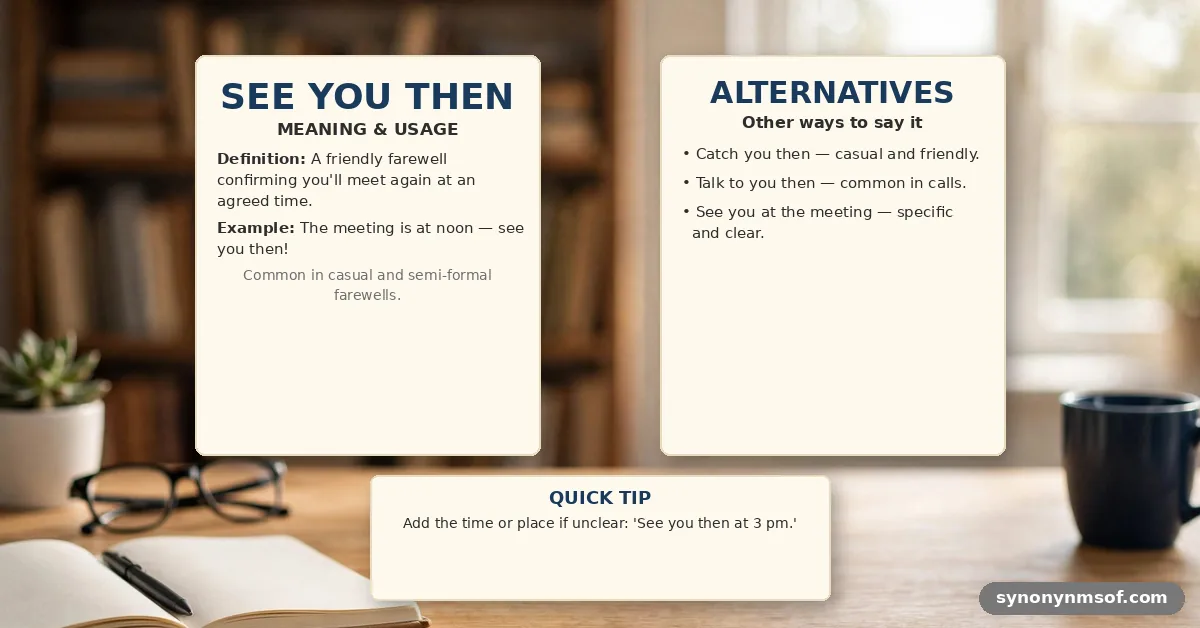

Understanding the phrase “see you then” involves recognizing it as a common English idiom used to confirm a scheduled appointment or meeting time. When you explore the meaning, examples, and alternatives of “see you then,” you gain the confidence to use this expression effectively in both casual and professional settings.
It essentially functions as a verbal handshake, signaling that two parties have reached a mutual agreement on when and where they will connect. This guide provides the clarity you need to master this standard closing statement in your daily communications.
The phrase “see you then” is a declarative statement used to acknowledge a previously agreed-upon time. Its primary purpose is to solidify a plan and bring a conversation to a close. By saying it, you are confirming that you understand the schedule and are prepared to meet at the designated hour.
It is grammatically correct and widely accepted in nearly every English-speaking culture. You will find it most often in emails, text messages, and spoken goodbyes where a specific time has already been established.
At its simplest level, “see you then” is a shorthand way of saying, “I acknowledge the time we have set, and I look forward to our meeting at that moment.” It acts as a bridge between the negotiation of a time and the actual event. Without this confirmation, plans can often feel tentative or unresolved to the other party.
The word “then” in this context refers specifically to the time or date mentioned immediately prior. If you say, “Let’s meet at 3:00 PM,” and the other person responds, “See you then,” they are explicitly referencing the 3:00 PM slot. It is a highly efficient way to end a logistical discussion without repeating the details.
The Grammatical Context
You might wonder if “then” is the correct choice compared to “there.” The word “then” refers to time, while “there” refers to a place. It’s just as easy to mix up other similar word pairs, such as lier or liar.
If you are confirming a location, “see you there” is the correct phrase. If you are confirming a time, “see you then” is the standard choice.
Grammar experts at Merriam-Webster categorize “then” as an adverb that signifies “at that time.” Using it in your closing confirms that you are aligned with the temporal aspect of the appointment. Mixing these up can cause confusion, so keeping the distinction clear is helpful for effective communication.
Common Examples in Daily Use

You can use this phrase in a variety of contexts, ranging from informal chats with friends to structured business meetings. The tone remains professional and polite regardless of the setting, making it a versatile tool in your vocabulary. Here are three common scenarios where this phrase fits perfectly:
- Professional scheduling: A colleague emails, “Can we sync at 10:00 AM on Tuesday?” You reply, “Yes, that works for me. See you then.”
- Casual social plans: A friend says, “I’ll pick you up at 7:00 PM for the movie.” You respond, “Great, see you then!”
- Service appointments: A technician tells you they will arrive between 1:00 PM and 3:00 PM. You acknowledge with, “Understood, see you then.”
Effective Alternatives for Variety
Sometimes you may want to vary your language to sound more specific or to add a personal touch. While “see you then” is perfectly acceptable, using alternatives can help you express enthusiasm or provide extra clarity. Depending on the situation, you might choose an option that emphasizes the location, the duration, or the excitement of the upcoming meeting.
| Context | Alternative Phrase | Best Usage |
|---|---|---|
| Formal | “I look forward to meeting you at that time.” | New clients or interviews. |
| Casual | “Talk soon!” | Friends and close colleagues. |
| Location-based | “See you there.” | When the time is already known. |
| Enthusiastic | “Can’t wait to catch up then.” | Social reunions. |
Responding to the Phrase
If someone says “see you then” to you, a simple nod or a brief affirmative response is usually sufficient. You do not need to overthink your reply, as the goal is to close the loop on the conversation. A polite “See you,” “Sounds good,” or “Talk to you then” works perfectly in almost every case.
If you feel the need to be more formal, repeating the time is a safe bet. For instance, replying with “Yes, see you at 2:00 PM” removes any ambiguity. This is particularly useful in business settings where precision is highly valued to avoid missed connections or scheduling conflicts.
Professional vs. Casual Applications
In a formal office environment, your language should prioritize clarity and brevity. “See you then” is acceptable, but you might pair it with a professional closing like “Best regards” or “Sincerely.” It shows that you respect the other person’s time and are organized in your approach to scheduling.
When you are in a casual environment, you have more freedom to be expressive. Adding an exclamation point or a follow-up sentence like “Really looking forward to it” warms up the interaction. This makes the tone feel more welcoming and less like a cold administrative transaction. Expressive writing still needs correct spelling — for instance, getting lazer or laser right.
Avoiding Common Misunderstandings
One common mistake is using “see you then” when a time has not been firmly established. If the other person says “I’ll try to be there sometime after lunch,” replying with “see you then” can sound dismissive or overly confident. It is better to confirm the specific time first before using the closing phrase.
Another issue arises when people confuse the phrase with “see you there.” If you are meeting at a specific coffee shop, saying “see you then” confirms the time, but not the place. Always ensure the context of your conversation matches the specific adverb you are using to close the deal.
The Importance of Temporal Clarity
Clear communication regarding time is the bedrock of productivity. When you use phrases like “see you then,” you are effectively minimizing the mental load on the other person. They do not have to wonder if you have internalized the schedule, as your confirmation provides immediate reassurance.
Proverbs 27:1 reminds us that we do not know what a day may bring forth, which is why confirming plans is so vital. By being precise with your language, you honor the other person’s schedule. This builds trust and makes future planning much easier for everyone involved.
Handling Scheduling Changes
If plans change after you have already said “see you then,” you must communicate the update immediately. A simple follow-up message is enough to correct the course. You might write, “Actually, I have a conflict at that time; can we move it to 4:00 PM instead?”
Do not be afraid to adjust the plan if necessary. Using the phrase “see you then” is a commitment, but it is not a binding contract. Honesty about your availability is always preferred over showing up late or missing the meeting entirely.
Cultural Nuances in English
While “see you then” is standard in American and British English, other cultures may have different ways of confirming appointments. In some high-context cultures, the confirmation might be more subtle or indirect. However, in global business, this phrase is universally understood and rarely leads to offense.
If you are communicating with non-native speakers, keep your language simple. “See you then” is excellent because it uses basic, high-frequency vocabulary. It is unlikely to be misinterpreted, making it a reliable choice for international correspondence.
Digital Etiquette and Messaging
In the age of instant messaging, “see you then” is often truncated to “see ya” or just an emoji. While these are fine for close friends, avoid them in professional Slack or Teams channels. Stick to the full phrase to maintain a level of decorum that is appropriate for the workplace. Even in instant messages, spelling matters — watch out for slip-ups like messege or message.
When sending a calendar invite, you don’t even need to say “see you then” in the email body. The calendar entry itself serves as the confirmation. Use the phrase only when you are having a conversation, either written or spoken, to provide that final verbal seal on the plan.
FAQ
Is it correct to say “see you then” in a job interview?
Yes, it is perfectly acceptable and professional to use this phrase when finalizing an interview time. It shows that you are organized and attentive to the scheduling details provided by the recruiter.
What should I say if I don’t know the time yet?
If the time is still up in the air, avoid using “see you then” as it will sound premature. Instead, say something like “Let me know what time works best for you, and we can go from there.”
Can I use “see you then” for a recurring meeting?
It is more common to use it for a one-time event. For recurring meetings, people often say “See you next week” or “See you at our regular time,” which provides more specific context for the repeat nature of the appointment.
Is “see you then” too informal for a boss?
It is generally fine for most workplace dynamics, including with a manager. If you want to be extra cautious, you can add a professional closing such as “See you then, and I’ll have the report ready.”
Conclusion
Mastering the use of “see you then” is a small but significant step toward becoming a more effective communicator. By understanding the meaning, examples, and alternatives, you ensure that your scheduling confirmations are always clear, polite, and professional. Whether you are finalizing a casual coffee date or a high-stakes business meeting, this phrase provides the necessary closure to keep your plans moving forward smoothly. Mastering tricky word forms like octopuses or octopi is part of becoming a stronger writer.
Remember that the best communication is always simple and direct, leaving no room for uncertainty between you and your peers. As you continue to refine your daily interactions, keep these tips in mind to maintain clarity and build stronger connections in every conversation you hold.