
“See you tomorrow” is one of the most common goodbye phrases in English. We use it at work, in school, with friends, family, and even clients. Because it’s so familiar, most people never think twice before saying it.
Yet, this simple expression can communicate much more than just a plan to meet the next day.
Depending on your tone and the situation, “see you tomorrow” can sound warm, professional, caring, enthusiastic, romantic, or simply routine. That’s why knowing when to use it—and when to choose a better alternative—can make your conversations feel more natural and engaging.
Whether you’re writing an email, ending a business meeting, texting a friend, or saying goodbye to someone special, choosing the right words helps leave a positive impression.
In this guide, you’ll learn:
- What “see you tomorrow” really means
- When it’s appropriate to use
- 30+ professional and casual alternatives
- Email and workplace examples
- Common mistakes to avoid
- Frequently asked questions
Let’s get started.
What Does “See You Tomorrow” Mean?
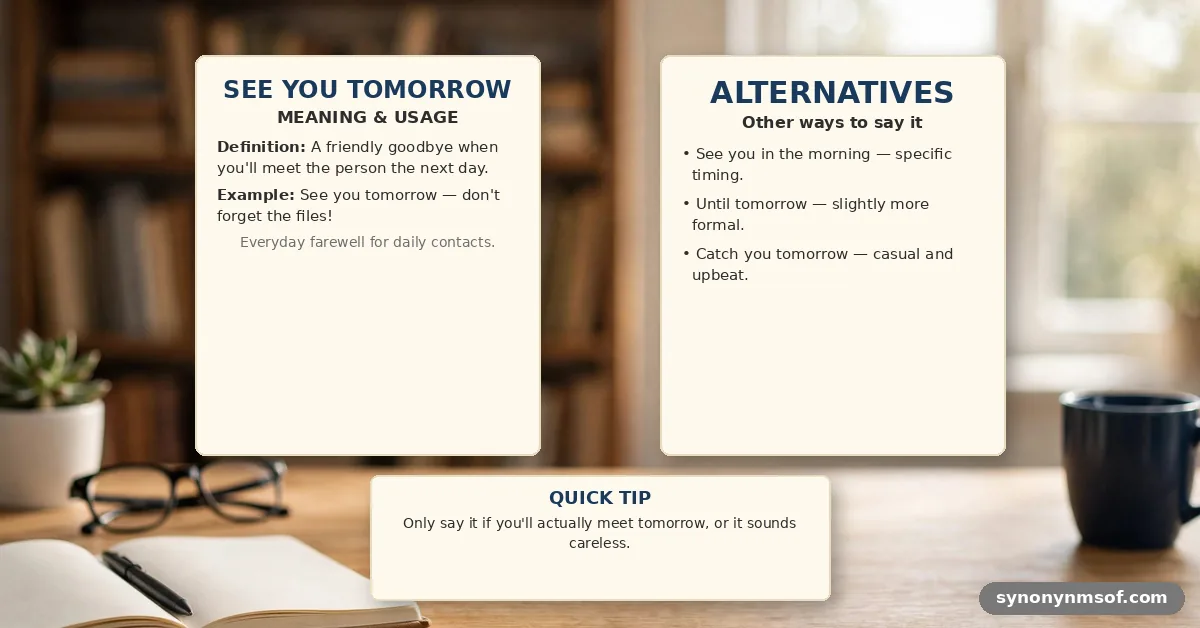
At its simplest, “see you tomorrow” means:
I expect to meet you tomorrow.
However, native English speakers often use it to communicate much more than a future meeting.
It can also express:
- Continuity
- Reliability
- Friendship
- Professional courtesy
- Emotional connection
- Confidence that you’ll meet again
Unlike saying “goodbye,” this phrase assumes your relationship continues beyond today.
That’s one reason it feels warmer and more personal.
See Also: 35+ Professional Ways to Say “I Was Referred to You By” in 2026
When Should You Use “See You Tomorrow”?
The phrase works naturally whenever you already know you’ll meet someone the following day.
Common situations include:
- Leaving the office
- Ending a classroom session
- Finishing a meeting
- Saying goodbye after dinner
- Ending a video call
- Leaving a family gathering
- Sending a quick text before bed
Because it’s simple and familiar, it’s appropriate in both personal and professional conversations.
Is “See You Tomorrow” Professional?
Yes.
In fact, it’s one of the most widely accepted closing phrases in business communication.
You can comfortably use it with:
- Coworkers
- Managers
- Clients
- Teachers
- Students
- Business partners
However, if you’re writing a formal email or speaking with an important client, a slightly more polished alternative may sound better.
For example:
- Looking forward to tomorrow’s meeting.
- I’ll speak with you tomorrow.
- I look forward to seeing you tomorrow.
- I’ll see you at tomorrow’s presentation.
Why This Simple Phrase Feels So Comforting
Humans naturally appreciate routine and consistency.
When someone says:
“See you tomorrow.”
They’re also saying:
- We’ll continue this tomorrow.
- Everything is okay.
- I’ll be here.
- Our conversation isn’t over.
That’s why parents say it to children, teachers say it to students, coworkers say it after busy workdays, and couples often say it before ending the evening.
The phrase creates reassurance without requiring many words.
See Also: 28 Better Alternatives of “Thanks for the Heads Up”
30+ Other Ways to Say “See You Tomorrow”
Here are more natural alternatives you can use depending on the situation.
| Alternative | Best Used For |
|---|---|
| I’ll see you tomorrow | Everyday conversations |
| See you then | Meetings and appointments |
| Talk to you tomorrow | Phone calls and texting |
| Speak with you tomorrow | Professional communication |
| Catch you tomorrow | Friends and coworkers |
| Catch up tomorrow | Casual workplace conversations |
| Until tomorrow | Friendly goodbyes |
| Looking forward to tomorrow | Professional emails |
| Looking forward to seeing you tomorrow | Business meetings |
| We’ll connect tomorrow | Remote teams |
| See you in the morning | Morning meetings |
| See you tomorrow morning | Workplace |
| See you tomorrow afternoon | Scheduled appointments |
| See you tomorrow evening | Personal plans |
| Bright and early tomorrow | Friendly tone |
| Have a great evening—see you tomorrow | Workplace |
| Rest well, see you tomorrow | Caring message |
| Can’t wait to see you tomorrow | Romantic |
| Tomorrow it is | Casual |
| Have a good night, see you tomorrow | Friends and family |
| Until we meet tomorrow | Warm farewell |
| See you first thing tomorrow | Office settings |
| I’ll catch up with you tomorrow | Colleagues |
| Let’s continue tomorrow | Projects and discussions |
| We’ll finish this tomorrow | Teamwork |
| Thanks, see you tomorrow | Everyday work |
| Have a safe trip home, see you tomorrow | Coworkers |
| Looking forward to our meeting tomorrow | Professional emails |
| I’ll be seeing you tomorrow | Friendly conversation |
| See you tomorrow at the office | Workplace |
| Have a wonderful evening | Formal alternative |
| Until then | Flexible goodbye |
| We’ll talk again tomorrow | Calls and virtual meetings |
| See you tomorrow—take care | Friendly and warm |
| Have a restful night, see you tomorrow | Family and friends |
Workplace Examples
After a Team Meeting
Great work today, everyone. See you tomorrow morning.
To a Client
Thank you for your time today. I look forward to seeing you tomorrow at 10:00 AM.
Before Leaving the Office
Have a great evening. See you tomorrow.
After a Project Discussion
Let’s review the remaining tasks tomorrow. See you then.
Email Examples
Professional
Hi Sarah,
Thank you for today’s productive discussion.
I appreciate your insights and look forward to tomorrow’s meeting.
Have a wonderful evening.
Best regards,
James
Friendly
Hi Alex,
Everything looks good on my end.
See you tomorrow!
Thanks again.
Casual Ways to Say “See You Tomorrow”
When speaking with friends or family, these alternatives often sound even more natural.
- Catch you tomorrow!
- Talk tomorrow!
- See you in the morning!
- Tomorrow then!
- Rest well!
- Sleep well, see you tomorrow!
- Can’t wait for tomorrow!
- Have a good night!
- Until tomorrow!
- See you bright and early!
Common Mistakes to Avoid
1. Using it when tomorrow isn’t certain
Avoid saying:
See you tomorrow.
If the plans aren’t confirmed.
Instead say:
Hopefully I’ll see you tomorrow.
2. Being too formal with friends
Instead of:
I look forward to our meeting tomorrow.
Simply say:
See you tomorrow!
3. Being too casual with clients
Instead of:
Catch you tomorrow!
Choose:
Looking forward to tomorrow’s meeting.
4. Forgetting tone
The exact same words can sound completely different depending on your voice and punctuation.
Compare:
- See you tomorrow.
- See you tomorrow!
- See you tomorrow 😊
Each creates a different feeling.
Why Tone Matters More Than Words
Communication isn’t only about vocabulary.
People also notice:
- Facial expressions
- Voice
- Timing
- Relationship
- Context
A warm smile combined with:
“See you tomorrow!”
Feels welcoming.
The same words spoken without emotion may feel distant.
That’s why delivery often matters more than the phrase itself.
When You Should Use a Different Phrase
Sometimes another expression works better.
| Situation | Better Alternative |
|---|---|
| Virtual meeting | Talk to you tomorrow |
| Phone call | Speak with you tomorrow |
| Formal email | Looking forward to tomorrow’s meeting |
| Uncertain plans | Hopefully I’ll see you tomorrow |
| Long goodbye | Take care tonight |
| Remote work | We’ll connect tomorrow |
FAQs
Is “see you tomorrow” professional?
Yes. It’s appropriate for most workplace conversations, meetings, schools, and business settings.
What can I say instead of “see you tomorrow”?
Some excellent alternatives include:
- See you then
- Talk to you tomorrow
- Catch you tomorrow
- Looking forward to tomorrow
- Speak with you tomorrow
- Until tomorrow
Is “see you tomorrow” formal or informal?
It’s generally neutral, making it suitable for both casual conversations and many professional situations.
Can I use “see you tomorrow” in an email?
Absolutely. It’s commonly used in business emails, especially when you have a meeting scheduled for the next day.
What’s a more formal version of “see you tomorrow”?
You could say:
- I look forward to seeing you tomorrow.
- Looking forward to tomorrow’s meeting.
- I’ll speak with you tomorrow.
Is “see you tomorrow” friendly?
Yes. Most native English speakers consider it warm, polite, and friendly.
Can “see you tomorrow” sound romantic?
Yes. Between partners, it often conveys affection, excitement, and reassurance.
What’s the difference between “see you tomorrow” and “talk to you tomorrow”?
“See you tomorrow” usually implies meeting in person, while “talk to you tomorrow” could refer to a phone call, video meeting, or text conversation.
Is it okay to text “see you tomorrow”?
Definitely. It’s one of the most common goodbye messages used in texting.
Why do goodbye phrases matter?
The way conversations end often shapes the final impression people remember. A thoughtful farewell can strengthen relationships and make interactions feel more positive.
Conclusion
Although “see you tomorrow” is a simple phrase, it carries far more meaning than most people realize. It doesn’t just confirm a future meeting—it also communicates trust, familiarity, and the expectation that your relationship will continue.
In everyday conversations, it’s perfectly natural. In professional settings, it’s polite and appropriate. And in personal relationships, it can even express warmth and reassurance.
Still, using the same phrase repeatedly can become repetitive. Learning a variety of alternatives allows you to match your words to the situation, whether you’re speaking to a colleague, client, friend, or loved one.
The best communication isn’t about using complicated vocabulary. It’s about choosing words that fit the moment and make people feel comfortable.
Sometimes, a simple “See you tomorrow!” is exactly what someone needs to hear.