
Have you ever finished writing an email and paused for a moment, wondering how to end it politely? Chances are you’ve typed “Please let me know if you need anything else.”
It’s one of the most common closing phrases in professional communication—and for good reason. Whether you’re replying to a client, helping a coworker, following up with a customer, or finishing a project update, this simple sentence shows that you’re available, supportive, and willing to help.
However, because it’s used so often, it can sometimes sound repetitive or overly scripted. While there’s nothing wrong with the phrase itself, using a fresh alternative can make your emails feel warmer, more personal, and more genuine.
In this guide, you’ll learn exactly what “please let me know if you need anything else” means, when to use it, and discover 28 professional alternatives complete with tone, usage tips, and practical examples you can start using today.
What Does “Please Let Me Know If You Need Anything Else” Mean?
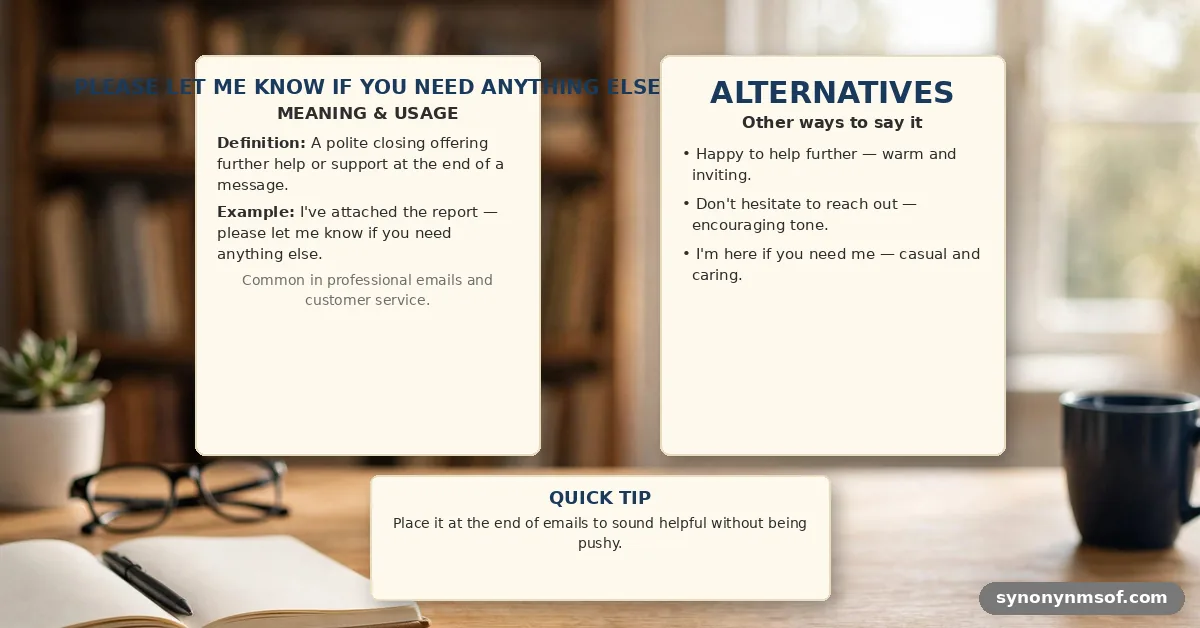
In simple words, “please let me know if you need anything else” means:
“I’m available to help if you have more questions, need additional information, or require further assistance.”
It’s a polite way of keeping the conversation open instead of ending it abruptly.
Rather than saying goodbye immediately, you’re reassuring the other person that they can contact you again whenever they need more support.
People commonly use this phrase in:
- Business emails
- Customer support messages
- Workplace communication
- Client follow-ups
- Team conversations
- Freelance projects
- Administrative emails
- Professional networking
The phrase communicates professionalism, kindness, and a willingness to continue helping.
Is “Please Let Me Know If You Need Anything Else” Professional?
Absolutely.
It’s considered one of the safest and most professional email closings because it shows:
- Courtesy
- Cooperation
- Availability
- Respect
- Customer focus
- Teamwork
That’s why you’ll often see it used by customer service representatives, managers, HR professionals, teachers, consultants, freelancers, and business owners.
The only downside is that frequent use can make it sound generic. Rotating between different expressions helps your communication feel more natural and authentic.
When Should You Use This Phrase?
This phrase works well when you’ve already provided assistance and want to leave the door open for additional questions.
Common situations include:
- Sending completed work
- Responding to customer inquiries
- Following up after a meeting
- Answering questions
- Delivering project updates
- Providing technical support
- Completing onboarding
- Sharing important documents
Quick Comparison Table
| Alternative | Tone | Best Used For |
| Feel free to reach out anytime | Warm | Customer support |
| I’m happy to help further | Friendly | Workplace emails |
| Don’t hesitate to contact me | Formal | Business communication |
| I’m here if you need anything | Caring | Team communication |
| Let me know how I can help | Supportive | Clients |
| Reach out if questions come up | Conversational | Ongoing projects |
| Happy to assist further | Professional | Administrative work |
| Please feel free to ask | Polite | General emails |
28 Other Ways to Say “Please Let Me Know If You Need Anything Else”
1. Feel Free to Reach Out Anytime
Tone: Warm and approachable
Usage: Ideal when encouraging future communication.
Example:
“Feel free to reach out anytime if additional questions come up.”
2. I’m Happy to Help Further
Tone: Friendly and supportive
Usage: Great after providing assistance.
Example:
“I’m happy to help further if anything else comes to mind.”
3. Don’t Hesitate to Contact Me
Tone: Formal
Usage: Best for business emails and professional correspondence.
Example:
“Don’t hesitate to contact me if you require further information.”
4. Let Me Know How I Can Help
Tone: Helpful
Usage: Works well with coworkers and clients.
Example:
“Let me know how I can help as your project moves forward.”
5. I’m Here If You Need Anything
Tone: Caring
Usage: More personal and reassuring.
Example:
“I’m here if you need anything during the onboarding process.”
6. Reach Out If Any Questions Come Up
Tone: Conversational
Usage: Perfect after explaining instructions.
Example:
“Reach out if any questions come up while reviewing the documents.”
7. Happy to Assist Further
Tone: Professional
Usage: Excellent for customer service.
Example:
“We’re happy to assist further whenever needed.”
8. Please Feel Free to Ask
Tone: Polite
Usage: Encourages questions naturally.
Example:
“Please feel free to ask if you’d like additional clarification.”
9. Keep Me Posted
Tone: Casual Professional
Usage: Great for collaborative projects.
Example:
“Keep me posted if anything changes.”
10. Let Me Know If You Have Any Questions
Tone: Neutral
Usage: One of the most versatile alternatives.
Example:
“Let me know if you have any questions about the proposal.”
11. I’m Always Happy to Help
Tone: Friendly
Usage: Builds rapport.
Example:
“I’m always happy to help whenever you need assistance.”
12. Please Reach Out If You Need Support
Tone: Supportive
Usage: Excellent for onboarding and training.
Example:
“Please reach out if you need support during your first week.”
13. Let Me Know If I Can Be of Assistance
Tone: Formal
Usage: Suitable for executive communication.
Example:
“Let me know if I can be of assistance moving forward.”
14. I’d Be Glad to Help
Tone: Friendly
Usage: Adds warmth.
Example:
“I’d be glad to help with any additional revisions.”
15. If Anything Comes Up, Just Let Me Know
Tone: Casual Professional
Usage: Ideal for teammates.
Example:
“If anything comes up, just let me know.”
16. You Can Always Contact Me
Tone: Reassuring
Usage: Great for long-term clients.
Example:
“You can always contact me if new questions arise.”
17. I’m Available If Needed
Tone: Professional
Usage: Short and direct.
Example:
“I’m available if needed throughout the project.”
18. Please Keep in Touch
Tone: Friendly
Usage: Excellent after meetings.
Example:
“Please keep in touch if you’d like to discuss this further.”
19. Let Me Know If There’s Anything More I Can Do
Tone: Supportive
Usage: Shows genuine willingness.
Example:
“Let me know if there’s anything more I can do to assist.”
20. I’m Only an Email Away
Tone: Warm
Usage: Friendly business communication.
Example:
“I’m only an email away if you need further assistance.”
21. I’d Be Happy to Answer Any Questions
Tone: Helpful
Usage: After presentations or meetings.
Example:
“I’d be happy to answer any questions you may have.”
22. Please Don’t Hesitate to Reach Out
Tone: Professional
Usage: Formal emails.
Example:
“Please don’t hesitate to reach out if anything needs clarification.”
23. I’m Available to Assist
Tone: Formal
Usage: Corporate communication.
Example:
“I’m available to assist with any future requirements.”
24. Let Me Know If You Need More Information
Tone: Informative
Usage: Documentation and reports.
Example:
“Let me know if you need more information before making your decision.”
25. I’m Happy to Answer Any Follow-Up Questions
Tone: Friendly Professional
Usage: Great after meetings.
Example:
“I’m happy to answer any follow-up questions.”
26. Please Let Me Know How Else I Can Help
Tone: Warm
Usage: Customer service and client relationships.
Example:
“Please let me know how else I can help throughout the process.”
27. I’m Here to Support You
Tone: Encouraging
Usage: Mentoring and leadership.
Example:
“I’m here to support you every step of the way.”
28. If You Need Anything Further, Just Ask
Tone: Friendly and Direct
Usage: Everyday professional communication.
Example:
“If you need anything further, just ask—I’ll be happy to help.”
When “Please Let Me Know If You Need Anything Else” Works Best
Although there are many excellent alternatives, the original phrase is still a strong choice in many professional situations. It’s polite, clear, and universally understood.
Here are some of the best times to use it.
1. After Answering a Customer’s Question
Once you’ve resolved a customer’s issue or answered their inquiry, ending with this phrase reassures them that your support doesn’t stop there.
Example
Your account has been updated successfully. Please let me know if you need anything else.
2. After Sending Requested Information
Whether you’re sharing documents, reports, or instructions, this phrase lets the recipient know you’re available if they need further clarification.
Example
I’ve attached the revised proposal for your review. Please let me know if you need anything else.
3. During Project Collaboration
When working with teammates or clients, offering continued support strengthens collaboration.
Example
Everything from today’s meeting has been updated. Please let me know if you need anything else before we move forward.
4. In Client Follow-Up Emails
Clients appreciate knowing they can come back with additional questions without feeling like they’re interrupting.
Example
Thank you for choosing our services. Please let me know if you need anything else as you begin using the platform.
5. After Solving a Technical Problem
Technical issues often lead to follow-up questions. Ending with a supportive message encourages continued communication.
Example
The issue has now been resolved. Please let me know if you need anything else or notice any further problems.
Why This Phrase Builds Trust
Professional communication isn’t only about sharing information.
It’s also about making people feel supported.
When someone reads,
“Please let me know if you need anything else.”
they subconsciously hear,
- I’m available.
- You’re not bothering me.
- Your questions are welcome.
- I’m willing to help.
- Our conversation doesn’t have to end here.
That sense of openness often leaves a better impression than the information itself.
Why the Phrase Sometimes Sounds Robotic
If the phrase is so useful, why do some people say it feels impersonal?
The answer is simple: overuse.
Many companies include it in:
- Automated email templates
- Customer service macros
- AI-generated responses
- Generic follow-up emails
- Help desk replies
As a result, readers may recognize it as a standard closing rather than a genuine offer of help.
For example:
Your request has been completed. Please let me know if you need anything else.
There’s nothing wrong with this sentence—but it doesn’t feel particularly personal.
A small adjustment can make it warmer.
Instead of:
Please let me know if you need anything else.
Try:
If any questions come up later, I’d be happy to help.
The message stays professional while sounding more conversational.
How to Sound More Genuine
Small changes can make a big difference.
Instead of relying on the same closing every time, personalize your response based on the situation.
Generic
Please let me know if you need anything else.
Better
If you have any questions after reviewing the document, feel free to reach out.
More Personal
I know this process can feel a little overwhelming, so don’t hesitate to get in touch if anything comes up.
Notice how the last version acknowledges the reader’s situation. That extra touch makes your message feel more thoughtful and human.
Tips for Writing Better Email Closings
A strong closing leaves readers with a positive impression.
Here are a few simple tips:
Match Your Tone to the Situation
Formal emails may call for:
- Don’t hesitate to contact me.
- Please feel free to reach out.
Friendly conversations can use:
- I’m here if you need anything.
- Happy to help anytime.
Be Specific When Possible
Instead of saying:
Let me know if you need anything.
Try:
Let me know if you’d like me to review the presentation before Friday.
Specific offers feel much more sincere.
Avoid Repeating the Same Phrase
If every email ends exactly the same way, your communication can begin to feel automated.
Rotating between a few alternatives keeps your writing fresh.
Keep It Natural
Professional doesn’t mean robotic.
Simple language often sounds more confident than overly formal wording.
Professional Email Example
Subject: Updated Project Files
Hi Sarah,
I’ve attached the revised project files along with the updated timeline we discussed during yesterday’s meeting.
The requested changes have been completed, and everything is ready for your review.
If any questions come up while you’re looking through the documents, I’d be happy to help. Please let me know if you need anything else or if you’d like any additional revisions.
I look forward to hearing your feedback.
Best regards,
[Your Name]
Customer Service Email Example
Hi James,
Thank you for contacting our support team.
I’ve successfully updated your account settings, and the requested changes should now be visible.
If you experience any issues or have additional questions, feel free to reach out anytime. I’ll be happy to assist further.
Have a wonderful day!
Workplace Email Example
Hi Emily,
I’ve completed the report and uploaded the latest version to our shared folder.
Please review it whenever you have time.
If there’s anything more you’d like me to update before tomorrow’s meeting, just let me know.
Thanks!
Common Mistakes to Avoid
1. Using the Same Closing in Every Email
Repetition makes your writing sound like a template.
Instead, rotate between several alternatives.
2. Sounding Too Corporate
Compare these two endings.
Too Corporate
Please let me know if you require any further assistance regarding the aforementioned matter.
Better
Feel free to reach out if you have any questions.
The second version is easier to read and sounds more natural.
3. Offering Help Without Meaning It
Avoid adding supportive language simply because it’s expected.
Readers can often tell whether the offer feels genuine.
4. Being Too Vague
Instead of saying:
Let me know if you need anything.
Try something more specific.
If you’d like another review before submitting your application, I’d be happy to take a look.
Specificity increases credibility.
5. Ignoring Emotional Context
Someone dealing with a difficult situation may appreciate a warmer response.
Compare these two examples.
Standard
Please let me know if you need anything else.
Empathetic
I understand this has been frustrating. If anything else comes up, I’ll be here to help.
The second version acknowledges the person’s experience and creates a stronger connection.
Why Warm Communication Matters
Modern business communication is changing.
Years ago, professionalism often meant sounding formal and distant.
Today, people value communication that is:
- Friendly
- Respectful
- Authentic
- Empathetic
- Easy to understand
That doesn’t mean abandoning professionalism.
It means combining professionalism with genuine kindness.
Even a single sentence at the end of an email can strengthen relationships with coworkers, clients, and customers.
Frequently Asked Questions
What does “please let me know if you need anything else” mean?
It means you’re offering continued help or support if the other person has additional questions, requests, or concerns.
Is “please let me know if you need anything else” professional?
Yes. It’s widely accepted in business emails, customer service, workplace communication, and client correspondence.
Is the phrase too formal?
Not at all. It’s polite and professional, although some people prefer warmer alternatives in casual conversations.
Can I use this phrase in customer service emails?
Absolutely. It’s one of the most common ways to reassure customers that you’re available to provide additional assistance.
What are the best alternatives?
Some of the best options include:
- Feel free to reach out anytime.
- I’m happy to help further.
- Don’t hesitate to contact me.
- I’m here if you need anything.
- Let me know how I can help.
Why does this phrase sometimes sound robotic?
Because it’s frequently used in templates, automated replies, and scripted emails. Personalizing your closing can make it sound more sincere.
Is it appropriate for internal workplace emails?
Yes. It’s suitable for managers, coworkers, HR professionals, and team communication.
How can I sound more natural?
Use conversational language, tailor your message to the recipient, and mention specific ways you can help instead of relying on generic phrases.
Should I use a different closing every time?
Not necessarily, but varying your closings occasionally helps your communication feel less repetitive and more authentic.
What’s the difference between “Don’t hesitate to contact me” and “Please let me know if you need anything else”?
“Don’t hesitate to contact me” is slightly more formal, while “Please let me know if you need anything else” feels a bit warmer and focuses on offering continued assistance.
Can this phrase improve customer relationships?
Yes. Supportive language helps customers feel valued, encourages follow-up communication, and contributes to a more positive overall experience.
What’s the most important tip for sounding genuine?
Be specific, write naturally, and make sure your offer to help is sincere. Readers respond best to communication that feels personal rather than copied from a template.
Conclusion
The phrase “please let me know if you need anything else” has remained popular because it’s polite, professional, and reassuring. It tells the recipient that you’re available to continue helping, making it an excellent choice for emails, customer service interactions, workplace communication, and client follow-ups.
That said, using the same closing repeatedly can make your writing feel predictable. Mixing in thoughtful alternatives like “I’m happy to help further,” “Feel free to reach out anytime,” or “I’m here if you need anything” adds variety while maintaining a professional tone.
Ultimately, the best communication isn’t just about delivering information—it’s about making people feel heard, respected, and supported. A simple, genuine closing can leave a lasting positive impression and strengthen both professional and personal relationships.
Whether you stick with the original phrase or choose one of the 28 alternatives in this guide, aim for clarity, warmth, and authenticity. Those small details often make the biggest difference.