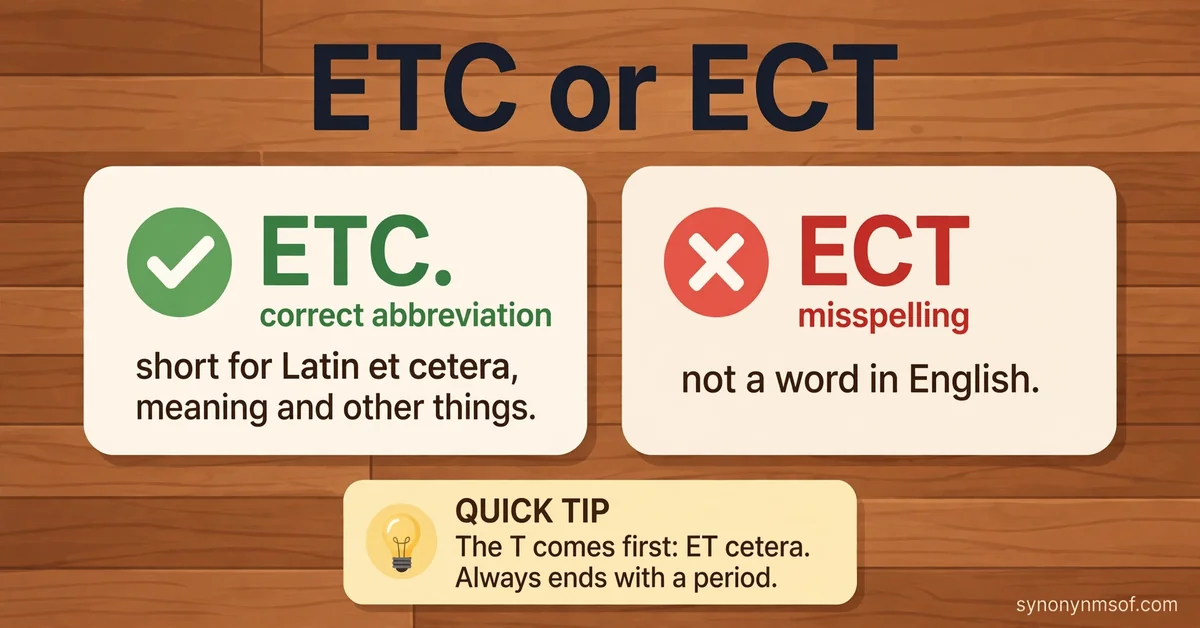

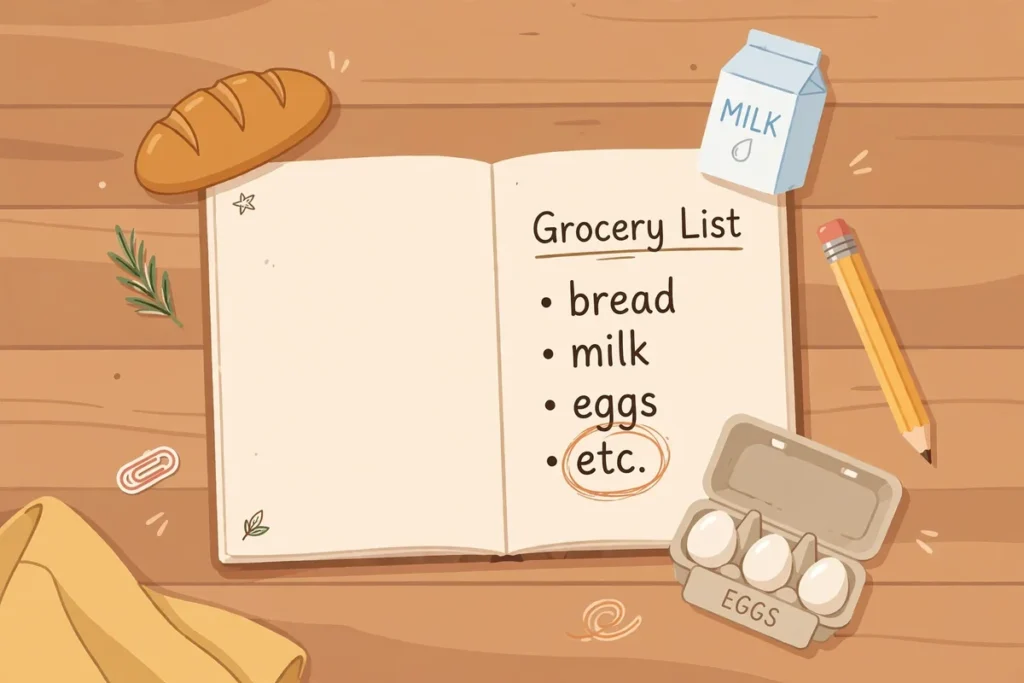
Etc or ect? It is a tiny question about three little letters, and yet it appears in emails, essays, reports, and text messages every single day. You are finishing a list — “bread, milk, eggs…” — and your fingers hesitate. Is it “etc.” or “ect.”? The two look almost identical, they sound almost identical in fast speech, and one of them is completely wrong. That near-invisible difference is exactly why this mix-up is so common.
The confusion has a very human origin: most people pronounce the full word as “ek-setera” rather than the dictionary’s “et-setera.” When you say “ek-setera” in your head, your fingers naturally type “ect.” It feels logical. It is also, unfortunately, always a mistake. The correct abbreviation is “etc.” — short for the Latin phrase et cetera, meaning “and other similar things.” “Ect” is not a word, not an abbreviation, and not recognized anywhere in standard English.
This guide settles the matter completely and goes well beyond the spelling. You will learn what “etc.” really means and where it came from, why “ect” keeps appearing, exactly how to punctuate “etc.” (the period rules surprise most people), a side-by-side comparison table, real examples from everyday life, business, and academic writing, the style rules professionals follow, the most common mistakes to avoid, genuinely tricky edge cases, and clear answers to the five questions people ask most.
What Does “Etc.” Mean?
“Etc.” is the abbreviation of the Latin phrase et cetera, which means “and the rest,” “and so forth,” or “and other similar things.” It sits at the end of a list to signal that the list continues with similar items you have chosen not to name. “I bought bread, milk, eggs, etc.” tells the reader there were more groceries, but listing every single one would be tedious. The word does the polite work of saying “you get the idea” without saying it.
The Latin breaks down neatly: et means “and,” and cetera means “the rest” or “other things.” English has been borrowing this phrase since the Middle Ages, when Latin was the language of scholarship across Europe. Like many Latin survivors in English — e.g., i.e., vs., a.m. — it stuck around because it was useful, and the abbreviation stuck because the full phrase is a mouthful.
“Etc.” belongs to a specific job: closing an incomplete list of similar things. “The toolbox held hammers, screwdrivers, wrenches, etc.” works because the unnamed items are clearly more tools. The abbreviation promises the reader that the missing items resemble the named ones — it is not a license to trail off vaguely, but a compact way of saying “and others like these.”
How “Etc.” Functions in a Sentence
Grammatically, “etc.” behaves like the final item in a list. It usually follows a comma after the last named item: “apples, oranges, bananas, etc.” It can appear mid-sentence (“I packed shirts, socks, chargers, etc., for the trip”) or at the end (“I packed shirts, socks, chargers, etc.”). Wherever it lands, it always carries its period — the period is part of the abbreviation, not sentence punctuation, though at the end of a sentence the two merge into one.
When “Etc.” Is the Right Choice
Use “etc.” when you have named at least two items, the remaining items are obvious or unimportant, and your reader will easily grasp the category. Shopping lists, packing lists, meeting agendas, casual descriptions — these are its natural habitat. “We discussed budgets, timelines, staffing, etc.” in meeting notes is perfectly at home. The abbreviation saves space and respects the reader’s intelligence: they know what “etc.” implies.
Why “Ect” Is Wrong
“Ect” is simply a misspelling. It is not an alternative abbreviation, not a British variant, not an informal option — it appears in no dictionary and follows from no Latin root. The entire existence of “ect” traces back to one cause: the widespread mispronunciation of et cetera as “ek-setera” (sometimes spelled “excetera”). When people hear or say “ek-setera,” the letters E-C-T feel like the natural abbreviation, and the error writes itself.
This is a textbook case of spelling by ear going wrong. English is full of words whose pronunciation misleads the spelling — but with “etc.,” the stakes are small and the fix is trivial. If you were wondering why your spellchecker keeps flagging “ect,” now you know: it is correcting a phonetic guess back to the Latin original. The “t” comes first because et (“and”) comes first.
It is worth noting how invisible this error can be. In fast reading, “ect.” and “etc.” look nearly identical — the eye slides right past the transposed letters. That is why the mistake survives in published text more than it should, and why proofreading specifically for it is a professional habit worth building.
“Ect” vs “Etc.”: The Only Difference That Matters
There is exactly one difference between the two: one is right and one is wrong. “Etc.” abbreviates et cetera and is correct everywhere. “Ect” abbreviates nothing and is correct nowhere. On the other hand, the persistence of “ect” tells us something interesting about how pronunciation shapes spelling — it is the same force behind “could of” for “could’ve” and “expresso” for “espresso.” Recognizing the pattern helps you catch the whole family of ear-spelling errors.
Etc. vs Ect.: Comparison at a Glance
| Feature | Etc. | Ect. |
|---|---|---|
| Correct? | Yes — the standard abbreviation | No — always a misspelling |
| Stands for | Latin et cetera (“and other things”) | Nothing — no such word or phrase |
| In dictionaries | Yes | No |
| Pronunciation link | Matches et cetera (“et-setera”) | Matches the mispronunciation (“ek-setera”) |
| Punctuation | Always ends with a period | N/A — not a valid term |
| British vs American | Correct in both | Wrong in both |
| Spellchecker reaction | Accepted | Flagged as an error |
| Formal writing | Acceptable (with style caveats) | Never acceptable |
| Memory hook | Et cetera — the “t” comes first, like “and” comes first | — |
| Example | “Bring plates, cups, napkins, etc.” | “Bring plates, cups, napkins, ect.” ❌ |
How to Punctuate “Etc.” Correctly
The period is the part most people get wrong even when the spelling is right. These are the rules, and they are simpler than they look.
Rule 1: “Etc.” always ends with a period. The period marks the abbreviation — it is part of the word, not optional decoration. “We saw lions, tigers, etc” without the period is incomplete. Write “etc.” every time.
Rule 2: At the end of a sentence, use only one period. The abbreviation’s period doubles as the sentence’s final period. “We saw lions, tigers, etc.” is correct; “etc..” with two periods is wrong. One dot does both jobs.
Rule 3: Mid-sentence, follow “etc.” with a comma if the sentence continues. “We saw lions, tigers, etc., and then headed home.” The comma after the period looks odd to beginners, but it is standard — the period belongs to the abbreviation, and the comma belongs to the sentence.
Rule 4: “Etc.” needs a comma before it in a list. “We saw lions, tigers etc.” is missing the comma before the abbreviation. The standard form is “lions, tigers, etc.” — the comma sets off the abbreviation as the list’s final element.
Rule 5: Do not pair “etc.” with a final “and.” “Lions, tigers, and etc.” is redundant — et already means “and,” so you would be writing “and and the rest.” End the list cleanly: “lions, tigers, etc.”
Style Rules Professionals Follow
Beyond spelling and punctuation, there is an etiquette to “etc.” — the unwritten rules that separate polished writing from sloppy writing.
List at least two items before “etc.” A single item plus “etc.” gives the reader nothing to generalize from. “We swept, etc.” is unhelpful; “we swept, mopped, and polished, etc.” lets the reader infer the category. The abbreviation needs a pattern to extend.
Never use “etc.” after “such as” or “for example.” These phrases already announce an incomplete list, so adding “etc.” is redundant: “such as apples, oranges, etc.” says “for example” twice. Write “such as apples and oranges” and stop, or use “etc.” without the introductory phrase.
Do not write “etc., etc.” Doubling the abbreviation is a speech habit (“etcetera, etcetera”) that looks sloppy in writing. One “etc.” does the job. In dialogue or very casual writing it can suggest a trailing-off tone, but in standard prose, never double it.
Prefer alternatives in formal writing. Many academic and professional style guides discourage “etc.” in formal prose, finding it vague or lazy. Alternatives include “and so on,” “among others,” “and the like” — or simply finishing the list or restructuring the sentence. “The study examined lions, tigers, and similar species” is stronger than “lions, tigers, etc.” in a research paper. In business emails and everyday writing, though, “etc.” is completely acceptable.
Do not use “etc.” for people. Listing people and finishing with “etc.” can read as dismissive — “John, Sarah, etc.” suggests the unnamed people do not matter. For people, use “and others” or name everyone. This is a tone rule rather than a grammar rule, but it matters in professional settings.
Usage Examples Across Contexts
Everyday Conversation and Messages
“I need to grab bread, milk, eggs, etc. from the store.” “The kids packed swimsuits, sunscreen, towels, etc. for the beach.” In texts and casual speech, “etc.” (often typed without its period in the fastest messages, though the period is technically required) keeps lists short and friendly. You will also hear the doubled spoken form — “we ate, swam, relaxed, etcetera, etcetera” — which is fine in speech but should stay out of writing.
Work and Business Writing
“The agenda covers budgets, timelines, staffing, etc.” “Please bring your laptop, charger, notebook, etc. to the workshop.” “Our services include design, development, testing, etc.” Business writing uses “etc.” freely in emails, notes, and internal documents. In client-facing proposals, consider whether a complete list or a phrase like “among others” would look more polished — the abbreviation is correct, but the alternative sometimes carries more weight.
Academic and Formal Writing
Formal writing treats “etc.” with caution. It appears in citations (“Smith, Jones, etc.” is better rendered as “Smith et al.”), and sparingly in prose. A thesis might write “the samples included sandstone, limestone, shale, etc.” in a methods section, but a careful editor would likely prefer the list completed or closed with “and similar sedimentary rocks.” The rule of thumb: the more formal the document, the more you should spell out your meaning instead of abbreviating it.
“Etc.” and Its Latin Cousins
“Etc.” is not the only Latin abbreviation doing daily work in English, and seeing the family together helps each member make sense. E.g. (exempli gratia, “for example”) introduces examples: “citrus fruits, e.g., oranges and lemons.” I.e. (id est, “that is”) clarifies or restates: “the capital, i.e., Paris.” Et al. (et alii, “and others”) credits multiple people: “Smith et al. published the study.” Vs. (versus, “against”) sets up opposition. And etc. (et cetera, “and the rest”) closes a list of things.
Notice the division of labor: “e.g.” opens a list of examples, “i.e.” renames something, “et al.” handles people, and “etc.” closes a list of things. Mixing them up is a common academic error — “etc.” for authors, or “et al.” for objects. Keep each abbreviation in its lane and your writing gains a quiet precision that readers notice.
All of them share “etc.’s” punctuation habits: each ends with a period (or two, in the case of “e.g.” and “i.e.”), and each merges its final period with the sentence’s end mark. Learn the punctuation once for “etc.” and you have learned it for the whole Latin family.
Common Mistakes to Avoid
Mistake 1: Writing “ect.” instead of “etc.” The headline error. “Bread, milk, eggs, ect.” is always wrong. The abbreviation follows the Latin word order — et (“and”) first — so the “t” comes before the “c.” Every time.
Mistake 2: Dropping the period. “Bread, milk, eggs, etc” is incomplete. The period is part of the abbreviation and is never optional (except that it merges with the sentence’s final period at the end of a sentence). “Etc” without the dot is as unfinished as “Mr” without one.
Mistake 3: Using two periods at the end of a sentence. “We bought bread, milk, eggs, etc..” doubles the dot. The abbreviation’s period serves as the sentence period — one period, two jobs. This is the most common punctuation error with “etc.”
Mistake 4: Using “etc.” after a single item. “We swept, etc.” tells the reader nothing. The abbreviation extends a pattern, so it needs at least two items to establish one: “we swept, mopped, polished, etc.”
Mistake 5: Pairing “etc.” with “such as” or “for example.” “Such as apples, oranges, etc.” is redundant — both phrases announce incompleteness. Drop one: “such as apples and oranges” or “apples, oranges, etc.”
Mistake 6: Writing “and etc.” Since et means “and,” this literally reads “and and the rest.” End the list without the extra conjunction: “apples, oranges, etc.”
Mistake 7: Doubling it — “etc., etc.” A speech habit that looks careless in writing. One “etc.” is always enough. If you want a trailing-off effect in dialogue, use an ellipsis instead.
Mistake 8: Using “etc.” for people. “John, Sarah, etc. attended” can sound dismissive. For lists of people, write “John, Sarah, and others” or name everyone. Save “etc.” for things.
Tricky Cases and Edge Cases
“Etc.” at the start of a sentence. Avoid it. Abbreviations that belong at the ends of lists should not open sentences — restructure instead. If you absolutely must, capitalize it as “Etc.” — but rewriting is always better.
“Etc.” in questions and exclamations. The abbreviation’s period still comes first, then the sentence mark: “Did you buy bread, milk, eggs, etc.?” and “You bought bread, milk, eggs, etc.!” The period-plus-mark combination looks unusual but is correct.
“Etc.” vs “et al.” Both are Latin abbreviations, but they do different jobs. “Etc.” (et cetera) is for things; “et al.” (et alii, “and others”) is for people — used in citations for multiple authors (“Smith et al.”). Never use “etc.” for authors or “et al.” for groceries.
“Etc.” vs “and so on” / “and so forth.” These English phrases are the natural translations of et cetera and are often better in formal writing. “And so on” is slightly more conversational; “and so forth” slightly more formal. All three are correct — choose by register.
The spoken “etcetera, etcetera.” In speech, doubling the word suggests “you know the rest” with a casual, sometimes dismissive tone. It is standard in conversation and dialogue but has no place in formal writing. Transcribing speech? Keep it. Drafting a report? Cut it.
“Etcetera” spelled out. Writing the full word “etcetera” instead of the abbreviation is always acceptable and sometimes preferable in formal prose. Just spell it correctly — “etcetera,” not “excetera” — and pronounce it “et-setera” if you want to match the spelling.
“Etc.” in headlines and titles. Style guides generally avoid abbreviations in headlines, and “etc.” is no exception. A headline should be complete and punchy; trailing off with “etc.” weakens it. Finish the thought or cut the list.
Capitalization: “etc.” is lowercase. Unless it starts a sentence (which it should not), “etc.” is always lowercase, even in titles. It is not a proper noun and takes no capital.
Frequently Asked Questions
Is it “etc.” or “ect.”?
“Etc.” is correct — always. It abbreviates the Latin et cetera (“and other things”), so the “t” comes first, matching et (“and”). “Ect.” is a common misspelling caused by the widespread mispronunciation “ek-setera.” No dictionary recognizes “ect” as a word.
What does “etc.” stand for?
“Etc.” stands for et cetera, Latin for “and the rest” or “and other similar things.” Et means “and” and cetera means “the rest.” It is used at the end of a list to indicate that similar items continue without naming them all.
Does “etc.” need a period?
Yes — always. The period is part of the abbreviation, not optional punctuation. If “etc.” ends the sentence, its period doubles as the sentence’s final period, so you write only one: “We bought apples, oranges, etc.” — never “etc..”
Can I use “etc.” in formal or academic writing?
Sparingly. “Etc.” is grammatically correct in formal writing, but many style guides consider it vague and prefer alternatives like “and so on,” “among others,” or a completed list. In business emails and everyday writing it is perfectly acceptable; in theses and formal reports, spell out your meaning when you can.
Why do so many people write “ect” instead of “etc”?
Because of pronunciation. Most people say “ek-setera” instead of the dictionary’s “et-setera,” and the mispronunciation makes “ect” feel like the logical abbreviation. It is a phonetic spelling error — the same kind behind “could of” for “could’ve.” Remembering the Latin et cetera (with et first) fixes it permanently.
Conclusion
Etc or ect is one of the simplest questions in this whole confusing-words series, and the answer is absolute: “etc.” is correct, “ect.” is a misspelling, and there are no exceptions, variants, or informal allowances. The abbreviation comes from the Latin et cetera — “and other things” — and the “t” comes first because et (“and”) comes first. The widespread “ek-setera” pronunciation explains the error without excusing it.
But spelling is only the entry point. Using “etc.” well means punctuating it correctly — always with its period, never with two — giving it at least two list items to extend, keeping it away from “such as” and “and,” and choosing stronger alternatives in the most formal writing. Master those small habits, and three little letters will never embarrass you again.
Explore more on Synonynmsof.