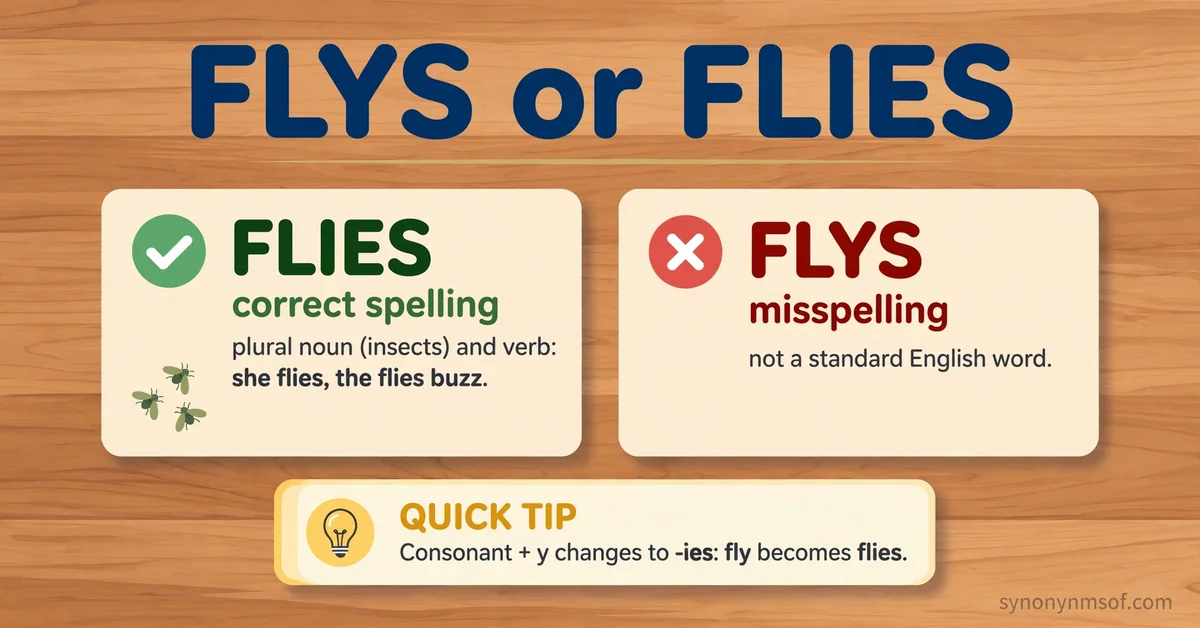

Flys or flies? If you have ever typed “flys” and felt a flicker of doubt, you are in good company. It is one of the most common spelling traps in English, and it catches students, professionals, and native speakers alike. The word looks like it should be simple — just add an “s” to “fly,” the way you add an “s” to “run” or “walk.” But English has other plans, and those plans involve one of its oldest spelling rules.
Here is the short answer, and it is refreshingly absolute: “flies” is always correct, and “flys” is always a misspelling — in modern English, for both the noun and the verb. “Flies” is the plural of the noun “fly” (the insect), and it is also the third-person singular of the verb “fly” (“she flies”). “Flys” appears in no dictionary as a standard word. Once you learn the single spelling rule behind this, you will not only fix this pair — you will fix dozens of words like it, from “babies” to “tries” to “cities.”
This guide explains everything in plain language: what “flies” means as a noun and as a verb, the consonant-plus-y spelling rule that governs it, a side-by-side comparison table, real examples from everyday life, work, and academic writing, the mistakes that keep producing “flys,” the genuinely tricky edge cases (including the famous “the flies fly” puzzle), and clear answers to the five questions people ask most.
Why “Flys” Is Wrong: The Spelling Rule
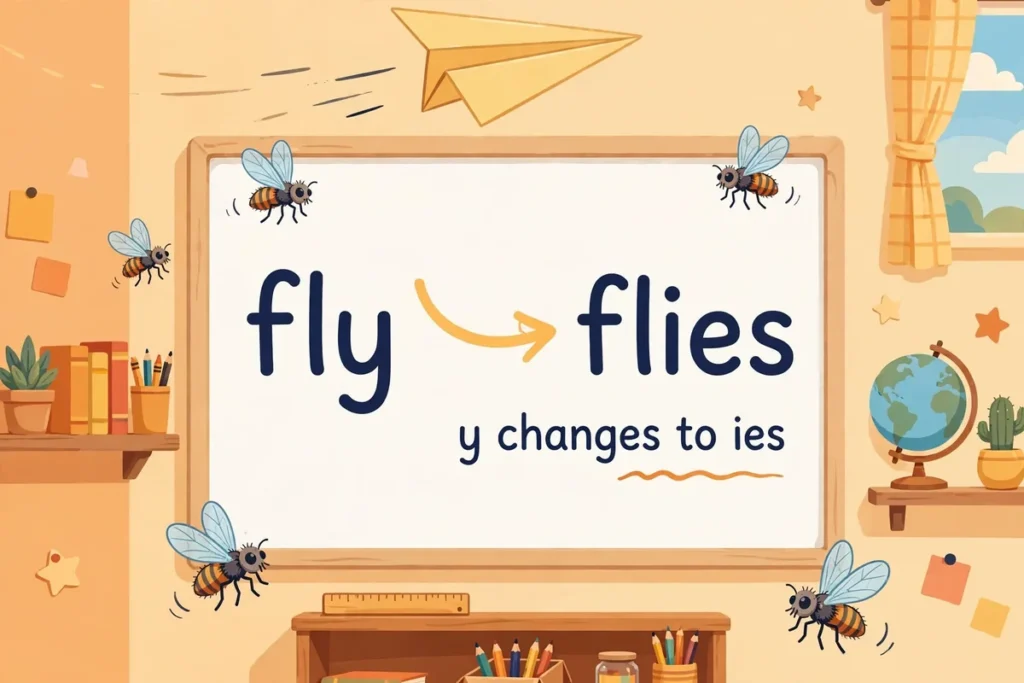
English has a firm, simple rule for words ending in a consonant plus “y”: change the “y” to “i” and add “-es.” Fly becomes flies. Baby becomes babies. City becomes cities. Try becomes tries. Reply becomes replies. The “y” cannot survive next to a new ending — it transforms into “i” first. “Flys” breaks this rule by bolting an “s” directly onto the “y,” and that is why every dictionary, spellchecker, and style guide rejects it.
The mistake is completely understandable. Most English plurals and third-person verbs are formed by simply adding “s”: cat to cats, run to runs, play to plays. So the brain generalizes — fly should become flys. But “fly” belongs to the consonant-plus-y family, where the pattern is different. Compare it with its neighbor: “play” ends in a vowel plus “y,” so it keeps the “y” and just adds “s” (plays). “Fly” ends in a consonant plus “y” (the “l”), so the “y” must change. That one-letter difference in the base word — vowel versus consonant before the “y” — decides everything.
This rule is not a quirk or an exception; it is one of the most regular patterns in English spelling, applying to hundreds of words without fail. Learn it once, and “flys” will look as wrong to you as “babys” or “citys” — because it is exactly the same kind of wrong.
A Brief History of “Flys”
Was “flys” ever correct? Almost. Historical records show “flys” appearing as a plural in the 1800s — notably as the plural of “fly” meaning a type of light horse-drawn carriage — but it has been obsolete for well over a century. In contemporary English, “flys” survives only as a typo, a brand name, or a username. No modern dictionary lists it as a standard spelling for the insect or the verb. The language voted, and “flies” won unanimously.
The Consonant + Y vs Vowel + Y Test
Whenever you are unsure, run this ten-second test. Look at the letter before the final “y.” If it is a consonant (fly, baby, city, story, party), change “y” to “i” and add “-es”: flies, babies, cities, stories, parties. If it is a vowel (play, toy, boy, day, key), just add “s”: plays, toys, boys, days, keys. Two families, two behaviors, no exceptions in standard spelling. “Fly” has an “l” before its “y” — a consonant — so it belongs firmly in the first family.
What “Flies” Means as a Noun
As a noun, “flies” is the plural of “fly” — the small winged insect. “A fly landed on the table” becomes “several flies landed on the table.” The word covers the whole buzzing family: houseflies, fruit flies, horseflies, black flies. “The picnic was ruined by flies.” “Fruit flies gathered around the bananas.” In every one of these sentences, “flies” names more than one insect, and no other spelling will do.
The noun “fly” has a few other meanings worth knowing, and their plurals are “flies” too. In baseball, a “fly” (short for “fly ball”) is a ball hit high into the air — “he hit two flies to center field.” The “fly” of a pair of trousers is the flap covering the zipper — and while you rarely pluralize it, “flies” would be the form. A “fly” was also once a light carriage, and historically its plural was sometimes “flys” — the one genuine historical sighting of the misspelling, now long obsolete.
Flies in Science and Everyday Talk
Science writing uses “flies” constantly: “Fruit flies are a model organism in genetics.” “The study tracked how flies navigate toward light.” Everyday speech does too: “Close the door — you’re letting the flies in!” “These flies are driving me crazy.” Whether the register is a research paper or a kitchen complaint, the spelling never changes.
What “Flies” Means as a Verb
As a verb, “flies” is the third-person singular present tense of “fly” — used with he, she, it, and any singular noun. “She flies to Chicago every month.” “The bird flies south for winter.” “Time flies when you’re having fun.” The base verb “fly” means to move through the air, to travel by aircraft, or (figuratively) to pass quickly or flee. Add a singular third-person subject, and the verb must become “flies” — never “flys.”
The full conjugation shows the pattern clearly. I fly, you fly, we fly, they fly — but he flies, she flies, it flies. The “-es” ending appears only in that one slot, which is exactly why it trips people up: you use the base form “fly” most of the time, and the special form only with singular third-person subjects. “The pilot flys the plane” is wrong for the same reason “the pilots flys the planes” would be doubly wrong — the verb must agree with its subject in both number and spelling.
“Flies” in Idioms and Figurative Use
Some of the most famous phrases in English run on this exact verb form. “Time flies when you’re having fun.” “Rumors fly, but this one really flies.” “He flies off the handle at the slightest provocation” (meaning he loses his temper). “The flag flies at half-mast.” In each idiom, the verb is doing figurative work — time does not literally grow wings — but the spelling rule holds firm regardless of meaning.
Flys vs Flies: Comparison at a Glance
| Feature | Flys | Flies |
|---|---|---|
| Standard modern spelling? | No — a misspelling | Yes — the only correct form |
| As plural noun (insects) | Wrong (“the flys are here” ❌) | Correct (“the flies are here” ✅) |
| As verb, 3rd person singular | Wrong (“she flys” ❌) | Correct (“she flies” ✅) |
| In dictionaries | Not listed as a standard word | Listed for both noun and verb |
| Follows the consonant+y rule? | No — breaks it | Yes — y changes to “i,” add “-es” |
| Historical use | Obsolete 19th-century plural of “fly” (carriage) | Standard for centuries |
| Spellchecker reaction | Flagged as an error | Accepted |
| British vs American | Wrong in both | Correct in both |
| Memory hook | — | Think “babies, cities, tries” — same family |
| Example | — | “Time flies.” / “The flies buzz.” |
The Spelling Rule in Full: Words Like “Fly”
“Flies” is not an isolated case — it is one member of a huge, well-behaved family. Mastering the family rule fixes this word and dozens of others permanently.
Consonant + y → change y to i, add -es:
fly → flies, baby → babies, city → cities, story → stories, party → parties, lady → ladies, body → bodies, try → tries, cry → cries, dry → dries, reply → replies, apply → applies, carry → carries, worry → worries, study → studies, hurry → hurries.
Vowel + y → just add -s:
play → plays, toy → toys, boy → boys, day → days, key → keys, monkey → monkeys, tray → trays, enjoy → enjoys, buy → buys, guy → guys.
Notice the beautiful symmetry: the letter before the “y” decides, every time. This is one of the rare English spelling rules with essentially no exceptions, which makes it one of the highest-value rules a learner can memorize. If “flys” ever tempts you again, line it up next to “babys” and “citys” — words you would never write — and the error becomes obvious.
Usage Examples Across Contexts
Everyday Conversation
“He flies home for the holidays every year.” “There are too many flies in this kitchen.” “Time flies — I can’t believe it’s December already.” “She flies through her homework in twenty minutes.” Everyday speech leans heavily on the verb form, especially in idioms, while the noun form appears whenever insects are the topic.
Work and Business Writing
Professional writing needs the spelling exactly right, because errors here are visible. “Our CEO flies to the regional office monthly.” “The new software release flies through testing.” “The report on fruit flies was published last quarter.” In business, “flys” in an email or presentation reads as careless — the kind of small slip that quietly undermines credibility.
Academic and Formal Writing
Formal prose uses both forms with precision. A biology paper: “The experiment measured how flies respond to ultraviolet light.” A history essay: “News of the victory flies across the continent within days.” An aviation manual: “The aircraft flies at a cruising altitude of 35,000 feet.” Academic style guides treat “flys” as simply wrong — there is no register, however informal, where it is acceptable in standard writing.
“Flies” Inside Compound Words
The consonant-plus-y rule keeps working even when “fly” is hiding inside a longer word. A housefly becomes houseflies: “houseflies gathered on the windowsill.” A fruit fly becomes fruit flies: “fruit flies invaded the kitchen.” The same holds for dragonflies, butterflies, horseflies, blackflies, sandflies, and tsetse flies. In every case, the final “y” changes to “i” and “-es” is added — the compound does not protect the “y” from the rule.
This is a useful consistency check. If you ever doubt “flies,” test it against “butterflies” — a word no one misspells as “butterflys.” The two words follow the identical pattern because they share the identical ending. “Dragonflys” looks as wrong as “flys” for exactly the same reason: it is the same error wearing a longer word.
Compound or standalone, noun or verb, the principle never wavers. Once the pattern clicks for “butterflies,” it clicks for “flies” too — and from there, the whole consonant-plus-y family falls into line.
Common Mistakes to Avoid
Mistake 1: Writing “flys” as the plural of the insect. “The flys are everywhere” is the classic error. The plural of the noun is “flies”: “The flies are everywhere.” On the other hand, once you see the consonant-plus-y pattern, the correct form becomes automatic.
Mistake 2: Writing “flys” as the verb. “She flys to London every week” breaks the same rule in verb form. Third-person singular needs “flies”: “She flies to London every week.” The subject-verb pair must match: singular subject, “-ies” verb.
Mistake 3: Forgetting the rule with other consonant+y words. Writers who fix “flies” sometimes still write “trys,” “replys,” or “studys.” The rule is universal: try → tries, reply → replies, study → studies. Fix the family, not just the one word.
Mistake 4: Overcorrecting vowel+y words. After learning the rule, some writers change “y” to “i” everywhere and produce “plaies” or “toies.” Do not — vowel-plus-y words simply add “s”: plays, toys, boys, days. Check the letter before the “y” every time.
Mistake 5: Confusing “flies” the noun with “flies” the verb. “The flies flies south” looks absurd but is actually grammatical: the insects (noun) fly (verb) south — “the flies fly south” with a plural subject. With a singular insect it would be “the fly flies south.” The same spelling does two jobs, so let the subject tell you which job it is doing.
Mistake 6: Writing “fly’s” when you mean “flies.” The apostrophe form “fly’s” is a possessive or contraction (“the fly’s wings,” “the fly’s gone”), never a plural or verb. Apostrophes never form plurals in standard English — “fly’s” for “flies” is always wrong.
Mistake 7: Trusting autocorrect blindly. Most spellcheckers catch “flys,” but some mobile keyboards and informal tools let it through, especially in all-caps or stylized text. This shows why knowing the rule matters more than relying on software — tools assist, but they do not replace knowledge.
Tricky Cases and Edge Cases
“Flys” as a brand or proper name. You may encounter “Flys” in brand names, usernames, or stylized titles. Proper names play by their own rules — a company can spell its name however it likes. But a brand’s stylized spelling does not make “flys” correct in ordinary English prose.
The historical “flys” (carriage plural). In the 1800s, “flys” appeared as the plural of “fly” meaning a light horse-drawn carriage. This usage is extinct. If you meet it in very old texts, recognize it as a fossil — not a model for modern writing.
Noun-verb ambiguity: “the flies fly.” English delights in sentences where “flies” does double duty. “The flies fly at dawn” (insects move through air at dawn) is perfectly grammatical. “Fruit flies like a banana” is the famous linguist’s joke — it can mean insects enjoy bananas, or that banana-shaped objects travel through the air. Context, as always, is the only guide.
“Fly” as a noun meaning zipper flap. “The fly on his trousers is open” uses “fly” as a singular noun. Its plural would be “flies,” though you will rarely need it. The point stands: the consonant-plus-y rule covers every meaning of the word.
“Flying” and “flew”: related forms. The present participle is “flying” (the “y” stays before “-ing”: fly → flying) and the past tense is “flew” (an irregular change). Only the third-person singular and the plural use “flies.” Do not let the other forms confuse the issue.
“Flys” in song lyrics and slang. Informal writing sometimes uses “flys” deliberately for style or rhyme. Stylistic rule-breaking is a writer’s choice, not a spelling standard — and in any context where correctness counts (school, work, publishing), “flies” is the only option.
Teaching the rule to children. The most effective classroom trick is the word-family sort: have learners physically sort words into “consonant+y” and “vowel+y” columns, then generate the plurals. “Fly” lands in the first column next to “baby” and “city,” and “flies” follows naturally. Pattern recognition beats memorization every time.
Quick Self-Test
Try these five sentences — each one tests the rule in a slightly different way. (Answers: all “flies.”)
1. The baby ___ when the airplane takes off. (cries — same family as flies)
2. She ___ to Berlin twice a month for work.
3. The farmer counted the ___ on the cattle.
4. Time ___ when you’re having fun.
5. He ___ his kite higher than anyone on the beach.
If you answered “flies” five times, the pattern is locked in. Notice how sentence 1 works as a check: “cries” and “flies” are built the same way, so if “crys” looks wrong to you, “flys” should look equally wrong. That cross-check is the fastest way to proofread any consonant-plus-y word.
Frequently Asked Questions
Is “flys” ever correct?
No — not in modern standard English. “Flys” is always a misspelling of “flies,” whether you mean the plural noun (insects) or the third-person singular verb (“she flies”). The only historical exception is an obsolete 19th-century plural of “fly” meaning a horse-drawn carriage, which no one uses today.
What is the plural of “fly” (the insect)?
“Flies.” The noun “fly” ends in a consonant plus “y,” so the “y” changes to “i” and “-es” is added: one fly, two flies. This follows the same pattern as baby → babies and city → cities.
Do you say “he flys” or “he flies”?
“He flies.” The verb “fly” in the third-person singular present tense becomes “flies”: he flies, she flies, it flies. “Flys” is never the correct verb form — the consonant-plus-y rule applies to verbs exactly as it does to nouns.
Why do people write “flys” so often?
Because the default English pattern is to add “s” (cats, runs, plays), so the brain generalizes it to “fly.” The error comes from applying the common rule instead of the consonant-plus-y rule. It is one of the most frequent spelling mistakes in English, which is exactly why it is worth learning properly.
How can I remember: flies or flys?
Use the family test: line “fly” up with “baby” and “city.” You would never write “babys” or “citys,” and “flys” is the same kind of error. Or remember the famous idiom — it is “time flies,” never “time flys.” One correct example, memorized cold, anchors the whole rule.
Final Thoughts
Flys or flies is one of those questions with a beautifully simple answer: “flies” is always right, and “flys” is always wrong — in modern English, in every register, on both sides of the Atlantic. The confusion comes from a good instinct misapplied: most English words do form their plural or third-person verb by adding “s,” but “fly” belongs to the consonant-plus-y family, where the “y” changes to “i” before “-es” is added. One rule, learned once, settles it forever.
The deeper lesson is the real prize. That same rule governs babies, cities, stories, tries, replies, and hundreds more words — so the two minutes you spend mastering “flies” pay off across your entire vocabulary. Remember the family test, keep “time flies” as your anchor example, and let spellcheck be your backup rather than your teacher. Do that, and this particular spelling trap will never catch you again.
Explore more on Synonynmsof.