
There are few word pairs that cause as much confusion as flyer or flier. They look nearly identical, sound exactly the same, and for the most part, they mean exactly the same thing. Whether you are handing out paper advertisements, boarding a plane, or writing about someone who flies often, you have probably stopped mid-sentence and wondered which spelling to use. It is a small difference — just a single letter — but it can make your writing feel inconsistent or uncertain.
The short answer is that both spellings are correct. “Flyer” and “flier” are two spellings of the same word, which can refer to a person or thing that flies, and most commonly to a printed advertisement or handbill. In modern usage, “flyer” is the more popular and widely accepted spelling for almost every meaning, while “flier” survives in certain traditions, style guides, and fixed expressions. That said, knowing exactly when each spelling is expected will make your writing cleaner and more confident.
In this guide, you will learn what “flyer” and “flier” each mean, how the difference between them works in practice, what major style guides recommend, how usage differs between British and American English, and how to handle tricky cases like “frequent flyer,” “high flier,” and “take a flier.” By the end, you will never have to guess again.

What Does “Flyer” Mean?
“Flyer” is the standard, most widely used spelling of the word. It functions as a noun, and it carries a few related meanings that all trace back to the idea of flying or of something distributed quickly, like something carried on the wind. In modern English, it is the default spelling that most readers expect to see, which is why most dictionaries list it first.
The Paper Handbill or Advertisement
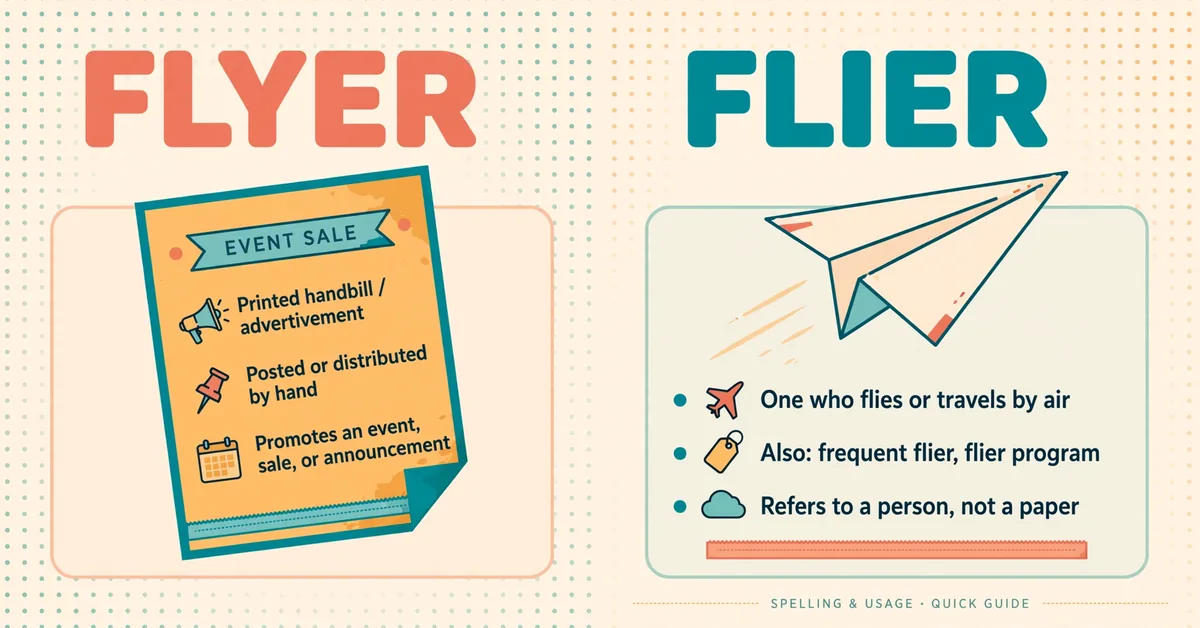
The most common meaning of “flyer” today is a printed sheet of paper used to advertise an event, a sale, a business, or a cause. Flyers are handed out on streets, slipped under windshield wipers, pinned to community boards, or included in mailboxes. This is the spelling that is universally accepted for this meaning, and dictionaries on both sides of the Atlantic agree on it.
Examples:
- We printed 500 flyers to promote the charity bake sale.
- Someone left a flyer for a local pizza place on my windshield.
- The band handed out flyers outside the concert venue.
When you are writing about a leaflet, brochure, or promotional handout, always use “flyer” with a “y.” No major style guide disagrees on this point, so it is the one case where there is no real debate.
The Person or Thing That Flies
“Flyer” also refers to a person, animal, or object that flies. A passenger on an airplane is a flyer, a bird is a flyer, and a child running around with a toy airplane is a flyer too. This meaning applies broadly, and in American English especially, “flyer” is now the dominant spelling even for this sense.
Examples:
- She is a nervous flyer and always grips the armrest during takeoff.
- The albatross is one of the most powerful flyers in the animal kingdom.
- He built a wooden flyer for his son to play with in the park.
In compound terms like “frequent flyer,” this is also the spelling most people recognize, since airline loyalty programs almost universally use it. Because it is so familiar to readers, using “flyer” for the person-who-flies meaning is a safe and natural choice in everyday writing.
What Does “Flier” Mean?
“Flier” is an alternate spelling of “flyer.” It carries the same definitions — a person or thing that flies, and by extension a printed handbill — but it is used far less often in modern writing. Its existence is largely historical and stylistic: at one point, it was a more common variant, and it still survives in certain publications, industries, and fixed expressions. It is never wrong to use it for the person-who-flies meaning, but it will often look old-fashioned or unusual to readers.
An Alternate Spelling With the Same Meanings
Grammatically, “flier” comes from a natural pattern in English. When a word ends in “y” and you add a suffix like “-er,” the “y” typically changes to “i,” as in “try” becoming “trier.” So “fly” plus “-er” can logically become “flier.” This is the reasoning behind the spelling, and it explains why some editors and publications have historically preferred it for the person who flies.
However, language does not always follow logic. Because “flyer” became the standard spelling for the printed handbill — by far the word’s most common use — the “y” spelling spread to the other meanings as well. Today, “flyer” dominates in both British and American English for nearly every sense of the word.
Where “Flier” Still Shows Up
Although “flier” is much less common today, it has not disappeared entirely. You will still encounter it in a few specific places. Some American publications, particularly in aviation and military writing, prefer “flier” for a pilot or aviator. The expression “take a flier,” meaning to take a risk, has traditionally used the “i” spelling. And some older American style traditions favored “flier” as the standard for the person-who-flies meaning.
Examples:
- The Navy flier completed hundreds of missions during her career.
- The company decided to take a flier on the untested product.
If you come across “flier” in a newspaper or book, it is not a typo. It is simply the less common variant, kept alive by tradition and house style.
The Difference Between “Flyer” and “Flier”
So what is the actual difference between “flyer” and “flier”? In terms of meaning, there is almost none. Both are correct spellings of the same word, and in most sentences they are completely interchangeable. The difference is really about convention: which spelling your readers expect, which one your style guide prefers, and which one matches the region or industry you are writing for.
Person Versus Paper: What the Style Guides Say
Some style guides try to split the two spellings by meaning. The most well-known approach, used by the Associated Press (AP) style, is to use “flier” for a person who flies and “flyer” for the paper handbill. The idea is simple: one spelling for the person, one for the paper. On the other hand, this is a recommendation, not a rule of grammar, and it is not followed universally. This shows how flexible the pair really is — even the guides that suggest a split admit that both spellings are technically acceptable.
If you are writing for a publication that follows AP style, the person-versus-paper split is worth following. In journalism, you might write “frequent flier” for a traveler and “advertising flyer” for the handbill. But if you are writing anywhere else — a blog, a business document, a school essay — using “flyer” for both meanings is perfectly fine and will look natural to almost every reader.
British Versus American Usage
Regional habits add another layer to the flyer or flier question. In British English, “flyer” is the standard spelling for every meaning of the word. British publications, dictionaries, and everyday writers overwhelmingly use the “y” spelling, and “flier” is rarely seen outside of quoted American text.
American English is where things get more mixed. Some American dictionaries and publications prefer “flier” for the person who flies, following the older tradition. In practice, however, the “y” spelling is far more common even in the United States, especially for the handbill. Google Ngram data has consistently shown “flyer” to be the more frequent spelling in American published writing over recent decades. So while “flier” is the more traditionally American option for the person-who-flies sense, “flyer” wins on overall popularity in both countries.
Flyer vs. Flier: A Quick Comparison
The table below sums up how the two spellings compare across the most important factors.
| Feature | Flyer | Flier |
|---|---|---|
| Overall popularity | Much more common | Much less common |
| Printed handbill or advertisement | The standard spelling | Rarely used |
| Person or thing that flies | Widely accepted, the safer choice | Correct, but traditional or formal |
| British English | Standard for all meanings | Very rarely seen |
| American English | Dominant in practice | Preferred by some publications and style guides |
| Idioms and fixed phrases | “High flyer,” “frequent flyer” | “Take a flier” |
| Best choice when unsure | Yes — use this one | Only for specific traditions or expressions |
Using “Flyer” and “Flier” in Everyday Writing
Knowing the definitions is only half the job. The other half is choosing the right spelling naturally in different kinds of writing. Here is how the flyer or flier choice plays out in everyday conversation, professional writing, and formal work.
Everyday Conversation and Informal Writing
In texts, emails, social media posts, and casual conversation, “flyer” is the spelling everyone expects. If you tell a friend you saw a flyer for a concert, or you describe yourself as a nervous flyer, the “y” spelling will look completely normal. Using “flier” in a casual message might make the reader pause, since it is simply unfamiliar to most people today.
Examples:
- Did you get the flyer about the neighborhood cleanup?
- I am a terrible flyer — I hate turbulence.
- We are printing flyers for the garage sale this weekend.
For informal writing, the advice is easy: always use “flyer.” There is no casual context in which “flier” is the better choice.
Work and Business Writing
In business documents, “flyer” is the recommended spelling. Marketing teams produce flyers, event coordinators distribute flyers, and human resources teams talk about frequent flyer programs. Because business writing values clarity and familiarity, the standard spelling wins here.
Examples:
- The marketing team designed a new flyer for the product launch.
- Please send me the flyer draft before Friday.
- Her frequent flyer miles covered the entire business trip.
The one business context where “flier” might appear is in aviation or defense writing, where the older tradition of “flier” for a pilot still has some life. If you work in that industry, check your company’s house style first.
Formal and Academic Writing
In academic essays, research papers, and formal reports, either spelling is acceptable, but “flyer” is still the safer default. Unless your instructor or publisher specifies a style guide that favors “flier” for the person-who-flies meaning — such as AP style in journalism — there is no reason to use the less common spelling. Formal writing should not draw attention to itself, and “flyer” blends in seamlessly.
Examples:
- The study examined how printed flyers influence voter turnout.
- Early aviation flyers faced extraordinary risks.
If you are writing for an American journalism class or a news outlet, a condition where the AP person-versus-paper split applies, then use “flier” for a pilot or passenger. Otherwise, stick with “flyer.”
Common Mistakes to Avoid
Even though both spellings are correct, there are a few traps that catch writers out.
Treating “flier” as a typo. If your spell checker underlines “flier,” it may be because your software is set to British English, where “flyer” is the only standard form. “Flier” is a legitimate alternate spelling, not an error — but in most contexts, the spell checker is nudging you toward the better choice anyway.
Using “flier” for the handbill. The one place “flier” almost never belongs is the printed advertisement. Nobody writes “advertising flier” in modern usage, and doing so will look strange to readers. For the paper leaflet, always use “flyer.”
Mixing spellings in one document. Pick one spelling for the person-who-flies meaning and stay consistent throughout your document. Switching between “flyer” and “flier” from paragraph to paragraph looks careless, even though both are correct.
Overcorrecting to “flier” in compounds. Phrases like “frequent flyer,” “high flyer,” and “night flyer” are firmly established with the “y” spelling. Changing them to “frequent flier” in casual writing does not make you more correct — it just makes the text look unfamiliar.
Assuming one is always wrong. The biggest mistake is the belief that one spelling is a mistake. They are variants of the same word. Confidence comes from knowing the conventions, not from memorizing a false rule.
Tricky Cases and Edge Cases
Some uses of flyer or flier deserve special attention because they follow their own habits.
The Plurals: “Flyers” Versus “Fliers”
The plurals follow the same pattern as the singulars. “Flyers” is the standard plural for printed handbills — “we handed out hundreds of flyers.” For people who fly, both “flyers” and “fliers” are used, with “flyers” being far more common in everyday writing. An aviation publication following the AP tradition might write “fliers” for pilots, but a travel blog would write “frequent flyers.” When in doubt, use “flyers.”
“Frequent Flyer” Versus “Frequent Flier”
Airline loyalty programs have settled this one decisively: it is “frequent flyer.” The term describes a person who flies often with an airline and earns miles or points. Because the phrase is a branded, fixed term used by airlines worldwide, the “y” spelling is essentially locked in. Writing “frequent flier” is not wrong in a dictionary sense, but it will look unfamiliar to anyone who has ever joined a mileage program.
“High Flyer” Versus “High Flier”
A “high flyer” (also written as one word, “highflyer”) is a person who is ambitious and successful, or a stock whose price is rising rapidly. The “y” spelling is the most common in modern writing, though “high flier” and “highflier” are also accepted. Like “frequent flyer,” the “y” version is the one most readers will recognize instantly.
“Take a Flier” — The Idiom That Keeps the “I” Spelling Alive
The one fixed expression where “flier” is genuinely the expected spelling is “take a flier,” which means to take a chance or accept a risk. “He took a flier on the startup” means he gambled on it. AP style favors the “i” spelling here, and many dictionaries list it this way. “Take a flyer” is also acceptable and widely understood, but if you want to write the idiom in its most traditional form, use “take a flier.”
“Flyer” as a Part of Spinning Machinery
There is one obscure meaning that belongs only to the “y” spelling: in textile work, a “flyer” is a part of a spinning machine that twists yarn into thread. The term comes from the part’s rapid motion, which resembles flying. You will almost never need this meaning outside of a discussion about spinning or weaving, but it is worth knowing because “flier” is never used for it. If you are writing about textile equipment, “flyer” is the only correct spelling.
“Night Flyer” and Other Compounds
Compounds built on this word almost always use the “y” spelling: “night flyer,” “high flyer,” “frequent flyer,” and “day flyer” (a term for a bird active during the day, as opposed to a night flyer). Because these are fixed, familiar phrases, changing them to “flier” would confuse readers rather than impress them. When a compound is already established with “flyer,” leave it alone.
Frequently Asked Questions
Is it “flyer” or “flier”?
Both spellings are correct. “Flyer” is the more common and widely accepted spelling for all meanings of the word, including a printed handbill and a person who flies. “Flier” is an alternate spelling that is correct but much less common, surviving mainly in certain publications, aviation writing, and the idiom “take a flier.”
Which spelling should I use for a paper advertisement?
Always use “flyer” with a “y” for a paper advertisement, leaflet, or handbill. This is the one meaning where there is no debate: every major dictionary and style guide agrees on “flyer” for the printed promotional sheet. “Flier” is never the expected spelling here.
Is “flier” a misspelling of “flyer”?
No. “Flier” is a legitimate alternate spelling of the same word, not a typo. It is recognized by major dictionaries in both British and American English. Some American publications and style guides, including AP, actually prefer “flier” for a person who flies. It simply appears less often in modern writing than “flyer.”
Do Americans and Brits spell it differently?
In British English, “flyer” is the standard spelling for every meaning, and “flier” is rarely used. In American English, the picture is more mixed: some publications and style guides prefer “flier” for the person who flies, but in practice “flyer” is far more common even in the United States, especially for the handbill. Overall, “flyer” dominates on both sides of the Atlantic.
How do you spell the plural — “flyers” or “fliers”?
For printed handbills, the plural is always “flyers.” For people who fly, both “flyers” and “fliers” are correct, but “flyers” is much more common in everyday writing. Fixed terms like “frequent flyers” use the “y” spelling. Use “fliers” only if you are following a style tradition, such as AP style in aviation writing, that calls for it.
Conclusion
The flyer or flier question has a reassuringly simple answer: both are correct, but “flyer” is the spelling you want almost everywhere. Use it for the paper handbill, for the person who flies, and for fixed phrases like “frequent flyer” and “high flyer,” and your writing will look natural to nearly every reader. Save “flier” for the specific traditions that expect it — certain American publications, aviation writing, and the idiom “take a flier” — and you will always be on solid ground.
Like many English spelling pairs, this one is less about right and wrong and more about convention and audience. Once you know that “flyer” is the modern default and “flier” is the traditional variant, the confusion disappears. Pick your spelling, stay consistent, and get back to writing.
Explore more on Synonynmsof.