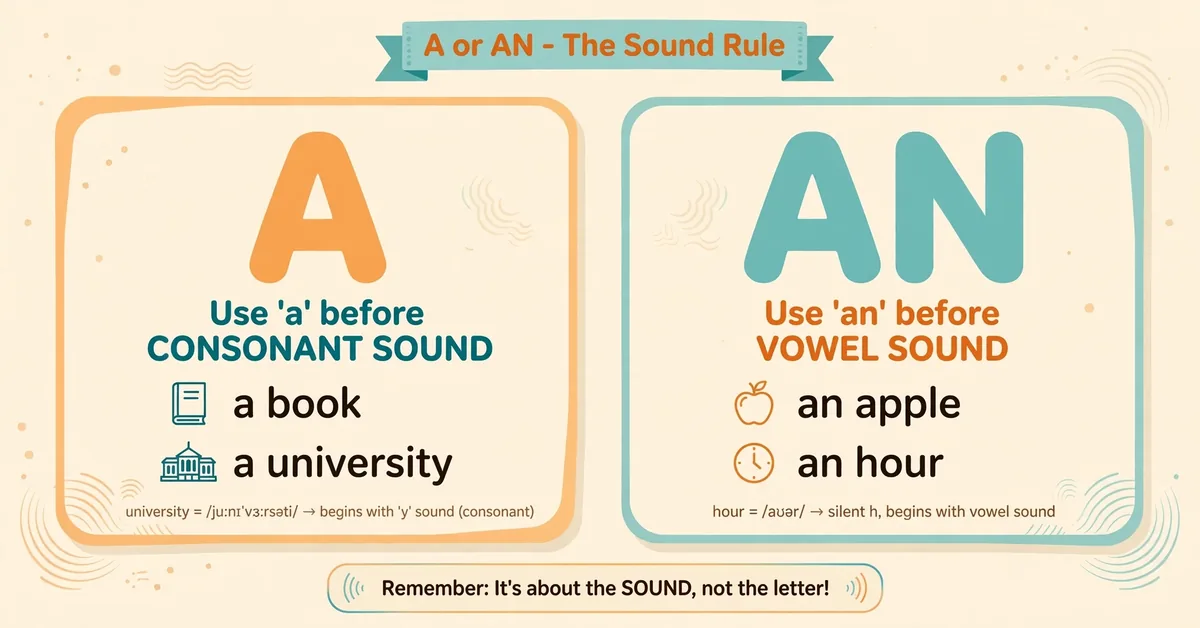

Every English speaker has hit this small fork in the road at least once: do I write “a” or “an” before the next word? It looks like a tiny choice, but it trips up learners, native speakers, and even experienced writers. The good news is that the rule behind it is one of the simplest in English grammar — and once you truly understand it, you will rarely get it wrong again. This guide breaks the choice down from the ground up, with clear examples, a comparison table, and the tricky edge cases that textbooks often skip.
At first glance, the rule seems to be about letters: “a” goes before consonants, “an” goes before vowels. But that version of the rule is wrong, or at least incomplete, and it is responsible for most of the confusion. The real rule is about sounds, not spelling. You say “an hour” even though “hour” starts with the consonant letter h, because the h is silent and the word starts with a vowel sound. You say “a university” even though it starts with the vowel letter u, because the word begins with a “y” consonant sound. Keep that single idea — sounds, not letters — in your head and everything else falls into place.
In this article, you will learn exactly what “a” and “an” mean, how to choose between them in a fraction of a second, how they behave across everyday conversation, business writing, and formal academic work, and how to handle the edge cases: u-words, silent-h words, acronyms like “an FBI agent,” numbers, and the famous “a historic” versus “an historic” debate. By the end, you will have a reliable instinct for one of English’s most-used grammatical choices.
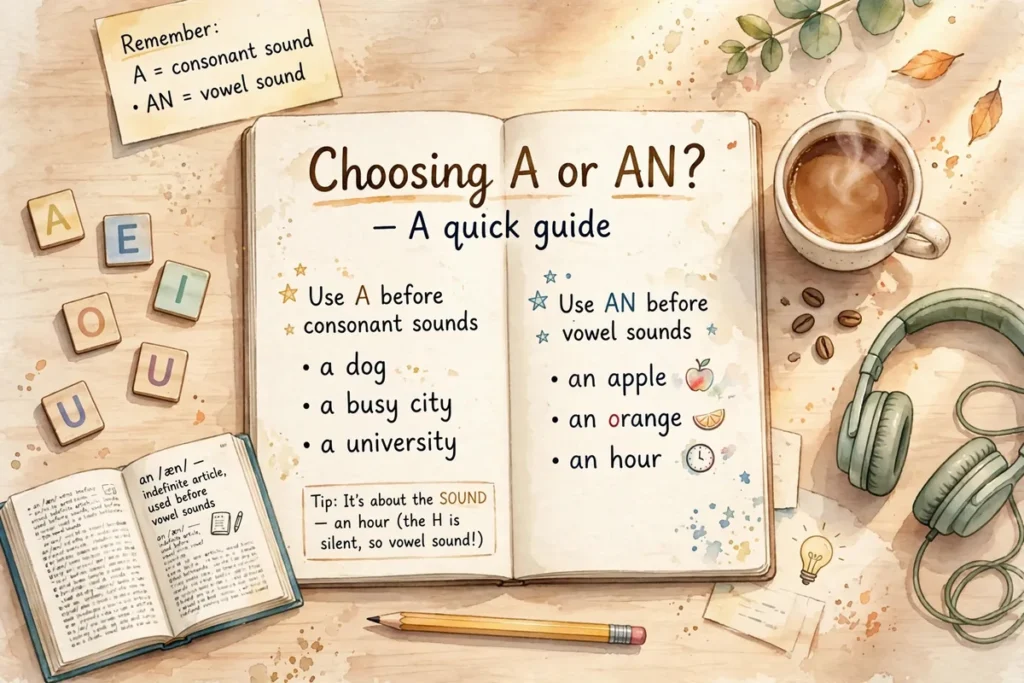
The Meaning and Use of “A”
“A” is the indefinite article — a small word that comes before a singular countable noun when you are talking about one thing, but not any specific one. Saying “a dog” means some dog, any dog, one dog of many. It is the opposite of “the,” which points to something definite: “the dog” means the specific dog we both know about. The word “a” comes from the Old English word for “one,” and it still carries that sense of singularity. When you say “a friend called me,” you mean one friend — you are just not saying which one.
The form “a” is used before words that begin with a consonant sound. Notice the emphasis: sound, not letter. Most of the time the two agree, so the simple version works: “a book,” “a car,” “a house,” “a question,” “a friend.” These are all straightforward because the word after “a” clearly begins with a consonant sound. Native speakers produce these pairings automatically, and learners usually master them quickly because they match the spelling they expect.
Where “a” gets interesting is in the cases where spelling lies. Because the letter u can begin with a “y” consonant sound — as in “university,” “uniform,” “European,” or “one” (which starts with a “w” sound) — those words take “a”: “a university degree,” “a uniform policy,” “a European city,” “a one-time offer.” Your ear knows this even when your spelling brain protests. If you say “an university” out loud, it sounds clumsy; “a university” flows. That feeling of flow is not a coincidence — it is the entire reason the two forms exist, as we will see next.
The Meaning and Use of “An”
“An” is not a different word from “a” — it is the same indefinite article wearing a different outfit. It means exactly the same thing: one, unspecified, singular. The only difference is that “an” is used before words that begin with a vowel sound: “an apple,” “an idea,” “an orange,” “an umbrella,” “an evening.” Whenever you swap between “a” and “an,” the meaning stays identical; only the sound changes. This is why grammar books call them two forms of one article rather than two separate words.
The job of “an” is pure pronunciation. English dislikes two vowel sounds crashing into each other with nothing between them. Try saying “a apple” quickly and you will notice your mouth inserting a tiny extra sound — almost a little “n” — just to glide from one vowel to the next. The “n” in “an” is that glide made official. This shows why the choice exists at all: it is a kindness to the speaker’s mouth, not an arbitrary rule someone invented to torment students.
Like “a,” the form “an” follows sound, not spelling. Words that begin with a silent h start with a vowel sound, so they take “an”: “an hour,” “an honest person,” “an heir to the throne.” Acronyms pronounced letter by letter follow the sound of the letter’s name: “an MBA” (the letter m starts with an “e” sound), “an FBI agent” (the letter f starts with an “e” sound), “an HR policy.” Once you hear it as a pronunciation helper, choosing “an” becomes automatic — you simply listen to the first sound of the next word.
The Difference Between “A” and “An”
Strip away all the examples and the difference between “a” and “an” is exactly one thing: the sound that follows. Use “a” when the next word starts with a consonant sound; use “an” when it starts with a vowel sound. Same meaning, same grammar, same job in the sentence — the choice is entirely about what your mouth does next. There is no difference in formality, no difference in politeness, no hidden nuance. They are two doors into the same room, and the shape of the next word decides which door you walk through.
This is worth stressing because many learners waste energy looking for a meaning difference that does not exist. “A hotel” and “an hotel” would mean precisely the same thing; only one of them sounds right in modern English (more on the “historic” debate later). Likewise, “a interesting book” and “an interesting book” describe the same book — the first one is simply wrong because “interesting” begins with a vowel sound. When in doubt, do not ask what the words mean; ask what the next word sounds like.
The sound rule also explains why the choice can change when pronunciation changes. A British speaker who drops the h in “herb” might say “an herb,” while an American who pronounces it says “a herb” — both are correct in their own accent, because each follows the sound. This is the rule working as designed: it tracks your speech, not a spelling list. Master the habit of listening to the first sound, and the exceptions turn out not to be exceptions at all.
A or An at a Glance: Comparison Table
| Feature | “A” | “An” |
|---|---|---|
| Meaning | One, unspecified thing | One, unspecified thing (identical) |
| Used before | Consonant sounds | Vowel sounds |
| Decided by | Pronunciation, not spelling | Pronunciation, not spelling |
| Classic examples | a book, a car, a dog, a question | an apple, an egg, an idea, an orange |
| Vowel-letter exceptions | a university, a European, a one-time offer (y- and w-sounds) | an hour, an honest man (silent h) |
| Acronyms | a FAQ (pronounced “fack”), a NATO ally | an MBA, an FBI agent, an HR policy |
| Purpose | Smooth pronunciation before consonant sounds | Smooth pronunciation before vowel sounds |
| Difference in formality | None — fully interchangeable in meaning | None — fully interchangeable in meaning |
Using “A or An” in Everyday Conversation
In daily speech, the a/an choice happens at full speed, and native speakers get it right without thinking because their ears lead. You will hear “a” and “an” hundreds of times a day: “I need a pen,” “She bought an old bike,” “We watched a movie,” “He is an engineer.” In conversation the rule is doing its real work — keeping speech flowing smoothly — and nobody is checking spelling. This is why the say-it-out-loud test is the most reliable tool you own: if you are unsure on paper, speak the phrase and trust your ear.
Everyday English also shows how articles work with first mentions. When you introduce something new into a conversation, you use “a” or “an”: “I saw a great café yesterday.” Once it is known, you switch to “the”: “The café was on Fifth Street.” This first-mention habit is automatic for native speakers, but it is worth noticing because it is one of the main jobs “a” and “an” do — they signal “this is new information.” Pair that with the sound rule and you have the complete everyday system.
Casual speech forgives the occasional slip, but in writing the correct article marks you as a careful user of English.
Using “A or An” at Work and in Business Writing
Professional writing exposes article mistakes faster than conversation does, because the reader’s eye catches what the ear forgives. In emails, reports, and proposals, the correct choice signals care: “Please find attached an updated invoice,” “We are hiring a junior designer,” “This is a unique opportunity for both teams,” “The launch will take an hour, not a day.” Each of these follows the sound rule, and getting them right is part of writing that looks competent.
Business English is also full of acronyms and initialisms, which is where many professionals stumble. Say the letters out loud and listen to the first sound: “an MBA,” “an HR meeting,” “a FAQ page” (if you pronounce FAQ as “fack”) — but “an F-A-Q page” if you spell it out, because the letter f starts with a vowel sound. The same logic covers “an NDA,” “a B2B client” (b starts with a consonant sound), and “an SQL database” for speakers who say “ess-que-el.” When you are unsure, the pronunciation test never fails: say it, listen, choose.
Job descriptions and résumés deserve special attention because they are scanned quickly and judged hard. “Seeking a motivated analyst,” “an organized self-starter,” “a US-based contractor” (u pronounced “you”), “an 8-hour workday” (eight starts with a vowel sound). Notice how numbers follow the same rule — it is the sound of “eight,” not the digit, that calls for “an.” A résumé with three article errors may still get you the interview, but a clean one never has to overcome them.
Using “A or An” in Formal and Academic Writing
In academic and formal contexts, the stakes for correctness rise while the rule itself stays exactly the same. Scholarly writing uses “a” and “an” with the same sound-based logic: “an empirical study,” “a theoretical framework,” “an 11th-century manuscript,” “a one-sided debate.” Formality does not change the grammar; it only raises the cost of getting it wrong, since academic readers are trained to notice small errors.
There is one famous formal-writing wrinkle: the phrase “an historic.” Traditional British style once favored “an” before unstressed h-words like “historic,” “hotel,” and “humble,” because the h was lightly pronounced. Modern style guides — including the Chicago Manual of Style and most university guides — now recommend “a historic occasion,” since the h is clearly pronounced. On the other hand, you will still see “an historic” in older texts and some formal British writing, and it is not considered an error there — just old-fashioned. For current academic writing, “a historic” is the safe choice.
Another academic habit worth noting: writers in formal registers sometimes pair articles with Latinate and Greek-derived terms where the first sound is not obvious from spelling. “A eulogy” (y-sound), “an heir apparent” (silent h), “a pseudo-random sample” (p-sound), “an X-ray” (the letter x starts with an “e” sound). The rule never bends for fancy vocabulary — say the word, catch the first sound, and the article chooses itself.
Common Mistakes to Avoid
Mistake 1: Choosing by spelling instead of sound. This is the big one. “An university” and “a hour” are both wrong, and both come from looking at the first letter instead of hearing the first sound. Fix it with the pronunciation test: say “university” — it starts with “you,” a consonant sound, so “a university.” Say “hour” — it starts with “ow,” a vowel sound, so “an hour.” Sound first, always.
Mistake 2: Using “an” before every h-word. Only silent-h words take “an”: “an hour,” “an honest answer,” “an heir.” Regular h-words keep “a”: “a house,” “a happy day,” “a history lesson,” “a hotel room.” The h in these words is fully pronounced, so it is a consonant sound. When you meet a new h-word, pronounce it — if you hear the h, use “a.”
Mistake 3: Dropping the article before job titles. English requires the article: “She is an architect,” not “She is architect.” This error is common among speakers whose first language does not use articles. The choice between “a” and “an” still follows the sound rule — “a teacher,” “an engineer,” “a doctor,” “an artist” — but the first step is remembering to include one at all.
Mistake 4: Repeating “a/an” errors with adjectives. The article agrees with the word directly after it, not the noun at the end. “An old car” is correct because “old” starts with a vowel sound; “a red apple” is correct because “red” starts with a consonant sound, even though “apple” is a vowel word. Learners who memorize “an apple” sometimes write “a red apple” correctly by luck — but the rule is about the adjective, so check the word the article actually touches.
Tricky Cases and Edge Cases
U-Words: When “U” Sounds Like “Y”
Words beginning with u are the classic trap. When u is pronounced like “you” (/juː/), it is a consonant sound and takes “a”: “a university,” “a uniform,” “a unique design,” “a useful tool,” “a united team,” “a user manual.” But when u keeps its pure vowel sound — as in “umbrella,” “uncle,” “under,” “upset” — it takes “an”: “an umbrella,” “an uncle,” “an urgent message.” The spelling is identical in structure; only the pronunciation differs. If you can start the word with “you,” it is “a”; if you cannot, it is “an.”
H-Words: Silent, Pronounced, and the “Historic” Debate
English h-words fall into three groups. Silent-h words take “an”: “an hour,” “an honest mistake,” “an heir,” “an honor” (American spelling; British “honour” likewise). Fully pronounced h-words take “a”: “a horse,” “a hat,” “a hospital,” “a human.” Then there is the debated middle group — “historic,” “historical,” “hotel,” “humble” — where the h is pronounced but was once whispered. Traditional style allowed “an historic,” and you will still encounter it, but modern usage overwhelmingly prefers “a historic day,” “a hotel,” “a humble suggestion.” When in doubt, pronounce the h firmly and use “a.”
Acronyms and Initialisms: Listen to the Letter Names
Acronyms follow the sound of how you say them, not what they stand for. Initialisms read letter by letter take the article matching the letter’s name: “an FBI agent” (eff starts with a vowel sound), “an MBA program” (em), “an HR department” (aitch), “an LED screen” (el), “an X-ray” (ex). Acronyms pronounced as words follow the word’s first sound: “a NATO summit” (n-sound), “a FAQ section” when said as “fack” — but “an FAQ section” when spelled out as “eff-ay-cue.” Teachers hear the question “I was wondering which one to use before acronyms” constantly — the answer is always the same: say it out loud and follow the first sound. I was wondering how many professionals get this wrong in emails every day, and the honest answer is: a lot, until they learn the letter-name trick.
Numbers, Times, and Measurements
Numbers obey the sound rule like everything else. “An 8-hour shift” (eight starts with a vowel sound), “a one-day sale” (one starts with a w-sound), “an 11% increase” (eleven), “a 100-page report” (one hundred), “an MBA” we covered, and “a 5-star review” (five). Fractions and times work the same way: “an hour and a half,” “a half-hour break” (half starts with h). The digit or numeral on the page is irrelevant — say the number as a word and listen.
Frequently Asked Questions
Is there any difference in meaning between “a” and “an”?
No. “A” and “an” are two forms of the same indefinite article, and they mean exactly the same thing: one unspecified person or thing. The only difference is pronunciation — “a” comes before consonant sounds and “an” before vowel sounds. Swapping one for the other never changes what a sentence means; it only makes it sound right or wrong.
Why do we say “an hour” but “a house”?
Because the choice follows sound, not spelling. In “hour,” the h is silent, so the word begins with a vowel sound (“ow”), which calls for “an.” In “house,” the h is fully pronounced, so the word begins with a consonant sound, which calls for “a.” This is the single most useful demonstration of the sound rule: identical first letters, different first sounds, different articles.
Should I write “a historic” or “an historic”?
Modern style guides recommend “a historic,” because the h in “historic” is pronounced. The “an historic” form survives from an older tradition of lightly pronouncing the h, and you will still see it in some formal British writing, where it is considered old-fashioned rather than wrong. For current writing — especially American English and academic work — “a historic” is the safe, standard choice.
How do I choose between “a” and “an” before an acronym?
Say the acronym out loud and listen to its first sound. If you read it letter by letter, follow the sound of the first letter’s name: “an FBI agent,” “an MBA,” “an HR policy,” because the letters f, m, and h begin with vowel sounds. If you pronounce it as a word, follow that word’s first sound: “a NATO ally,” “a FAQ page” (said as “fack”). When the same acronym can be said both ways, match the article to whichever pronunciation you are using.
Does the article go with the adjective or the noun?
It goes with the word immediately after it — usually the adjective, not the noun. That is why we write “an old car” (old starts with a vowel sound) but “a red apple” (red starts with a consonant sound, even though apple is a vowel word). Always check the first sound of the word the article directly touches, not the noun at the end of the phrase.
Conclusion
The entire a-or-an question comes down to one habit: listen to the first sound of the next word. Consonant sound takes “a”; vowel sound takes “an.” Spelling is a helpful hint most of the time, but it is not the rule — pronunciation is. Once you internalize that, the famous traps stop being traps: “a university” and “an hour” are no longer exceptions to memorize but natural results of hearing “you” and “ow” at the start of each word.
Practice the say-it-out-loud test for a week and the choice becomes reflex. Read your sentences back, catch the first sound, and let your ear decide — it already knows the answer. Small words carry a lot of weight in how polished your English sounds, and few are smaller, or more worth mastering, than “a” and “an.”
Explore more on Synonynmsof.