
Carmel or caramel — which one is correct? If you have ever stared at a coffee menu, a recipe, or a city sign and wondered whether that missing “a” matters, you are not alone. These two words are separated by a single letter, sound nearly identical in everyday American speech, and yet belong to completely different worlds.
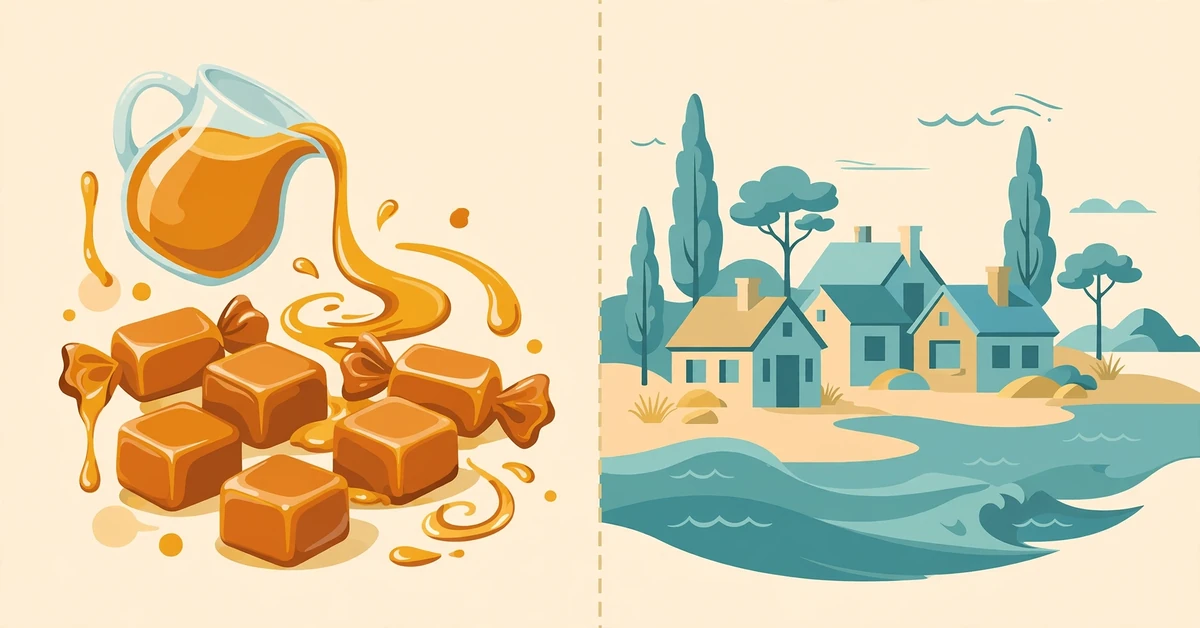
The short version is this: caramel is the sweet, golden-brown treat made from heated sugar, and Carmel is a proper noun — most famously a place name. One you can eat. The other you can visit. They are not interchangeable spellings of the same word, even though millions of people treat them that way by accident.
This confusion is one of the most common spelling traps in English. It starts with pronunciation: in much of the United States, “caramel” is said as “CAR-mel” — two syllables — which is exactly how “Carmel” the place name sounds. When the spoken forms collapse into one, the spellings start to bleed into each other, and “carmel latte” appears on menus that should have said “caramel latte.” In this guide, we will unpack every layer of the mix-up: the separate meanings, the pronunciation debate, the regional differences, and the exact spelling rules that keep you out of trouble in everyday conversation, business writing, and formal English.

Quick Answer: Carmel or Caramel?
In a hurry? Here is the one-paragraph rule. Use caramel (with three syllables in the spelling: car-a-mel) whenever you mean the food — the candy, the sauce, the flavor, or the golden-brown color. Use Carmel (capitalized, no extra “a”) only when you mean the proper noun: a place name like Carmel-by-the-Sea in California or Mount Carmel, or a person’s name. If you are talking about something sweet, it is always caramel. If you are talking about a location or a name, it is always Carmel. Nothing else on this page matters more than that single test.
What Does “Carmel” Mean?
Carmel is a proper noun, which means it always starts with a capital letter. It is never the candy, never the flavor, and never the color. It refers to specific names — of places, and sometimes of people.
Place Names: Carmel-by-the-Sea and Mount Carmel
The most famous Carmel is Carmel-by-the-Sea, a small coastal city on California’s Monterey Peninsula, known for its art galleries, fairy-tale cottages, and white-sand beach. When travel writers call it “Carmel,” that is a shortened form of the full name. A second major Carmel is Mount Carmel (Har HaCarmel), a mountain range in northern Israel that appears in the Hebrew Bible and is the namesake of the Carmelite religious order. There are also smaller towns and townships called Carmel in places like Indiana, New York, and Maine — and each one keeps the capital C and the two-syllable spelling.
A useful habit: if the word sits inside a place name, on a map, or next to words like “Mount,” “Cape,” “by-the-Sea,” or “Road,” it is Carmel. No food is involved.
Carmel as a Personal Name and Surname
Carmel is also a given name, used for both men and women, with Hebrew roots (from Karmel, often glossed as “vineyard” or “garden”). It appears as a surname too — you will find people named Carmel in the arts, academia, and public life. As with place names, it is capitalized and spelled without the middle “a.” If you meet someone named Carmel and write their name as “Caramel,” you have not been clever; you have misspelled their name.
Carmel in Culture and References
Because the name carries biblical weight, “Carmel” turns up in cultural references far beyond geography: the Carmelite religious order, Our Lady of Mount Carmel in Catholic tradition, and countless churches, schools, and cemeteries bearing the name. In literature and film, “Carmel” often functions as shorthand for understated coastal luxury — the California town’s reputation does the atmospheric work for the writer. None of these uses ever drift into the candy spelling, which is a handy signal: when you see “Carmel” in an institutional or cultural name, the two-syllable spelling is doing serious, non-edible work.
What Does “Caramel” Mean?
Caramel is a common noun — a regular word, lowercase unless it starts a sentence. It names the sweet, sticky, golden-brown substance made by heating sugar, and everything that follows from it.
The Candy and the Treat
At its simplest, caramel is cooked sugar. When sugar is heated to around 320°F (160°C), its molecules break down and recombine into hundreds of new flavor compounds — nutty, buttery, toasty — and the color shifts from white to amber to deep brown. That product is caramel: the firm, chewy square candy you unwrap from wax paper, the soft filling inside a chocolate bar, the drizzle on a sundae. A few classics make the meaning concrete: soft caramels, caramel apples (the whole autumn ritual on a stick), caramel popcorn, salted caramels, and the caramel swirl in a latte or frappuccino.
The Sauce, the Flavor, and the Color
Caramel also names the pourable sauce made by stopping the cooking process earlier and adding butter and cream — the salted caramel sauce on a dessert plate, the caramel syrup pumped into coffee. Beyond literal candy, “caramel” is a flavor label (caramel-flavored coffee creamer, caramel protein bars) and a color word: a “caramel” coat, a “caramel” interior, “caramel” highlights in hair — all pointing to that same warm, golden-brown hue. Notice the pattern: every one of these meanings traces back to the food. If it connects to sweetness, sugar, or that amber color, the spelling is caramel.
The Verb Family: Caramelize and Caramelized
Caramel gives us a whole verb family, and the spelling carries through: caramelize (to heat sugar — or onions, or meat — until it turns golden-brown), caramelized (caramelized onions on a burger, caramelized sugar on a crème brûlée), and caramelization (the chemical process itself). Dictionaries first record “caramel” in English around 1702, borrowed via French from Spanish caramelo, ultimately from late Latin calamellus (“small reed”) — a long journey from sugar cane to candy aisle. The spelling “caramelized” keeps the full “car-a-mel” root; there is no such word as “carmelized” in standard English.
Carmel vs Caramel: The Difference Side by Side
On the other hand, the two words diverge completely once you look past the sound. Here is the comparison that settles it:
| Feature | Carmel | Caramel |
|---|---|---|
| What it means | A proper noun: a place or a person’s name | A common noun: a sweet food, flavor, or golden-brown color |
| Spelling | C-a-r-m-e-l (two syllables in the spelling) | C-a-r-a-m-e-l (note the extra “a”) |
| Capitalization | Always capitalized: Carmel | Lowercase unless starting a sentence: caramel |
| Pronunciation | “KAR-mel” (two syllables, always) | “KAR-uh-mel” (three syllables) or “KAR-mel” (two syllables) — both accepted |
| Examples | Carmel-by-the-Sea, Mount Carmel, someone named Carmel | Caramel candy, caramel sauce, salted caramel, caramel color |
| Grammar role | Names one specific thing (proper noun) | Names a general category (common noun) |
| Memory trick | Think places and people | Think the extra “a” is for “appetite” — or that caramel apple needs that “a” |
| Common error | Writing someone’s name or a town as “Caramel” | Writing the candy as “carmel” because of how it is pronounced |
The golden rule still holds: food = caramel; places and names = Carmel. If you are wondering which spelling fits a sentence, run that test and you will be right almost every time.
The Pronunciation Trap: Why Everyone Gets Confused
Here is where the mischief starts. Ask a room of Americans how they say “caramel” and you will hear a split. Some say “KAR-uh-mel” (three syllables: car-a-mel), honoring the spelling and the word’s French-Spanish roots. Many others say “KAR-mel” (two syllables) — and that pronunciation is identical to “Carmel” the place name. Dictionaries, including Merriam-Webster, list both pronunciations as standard. Neither one is wrong.
Two Syllables vs Three: The Regional Split
Roughly speaking, the three-syllable “KAR-uh-mel” is more common in the Northeastern United States, Canada, and in international English, while the two-syllable “KAR-mel” dominates the Midwest and South. British English complicates it further: speakers in the UK tend toward “KARE-uh-muhl” (rhyming with “care”), keeping the middle syllable but shifting the first vowel. There is no single correct pronunciation of caramel — there are regionally correct ones. But here is the crucial point: however you say it, the spelling of the food is always c-a-r-a-m-e-l. Pronunciation is regional; spelling is fixed.
Why the Middle Syllable Disappears
Linguists have a name for what happens: vowel reduction, or syncope — the dropping of an unstressed middle vowel to say a word faster. English does it constantly. You say “choc-late” instead of “choc-o-late,” “veg-ta-ble” instead of “veg-e-ta-ble,” “in-trest-ing” instead of “in-ter-est-ing.” In “caramel,” the stress lands on the first syllable (CAR), leaving the middle “-a-” unstressed and ripe for deletion. So “car-a-mel” smooths into “car-mel” in rapid speech. This shows why the spelling error is so sticky: the ear hears “carmel,” and the hand obediently writes “carmel,” even though the dictionary spelling never changed.
Does Pronunciation Affect the Spelling Rule?
No. That is the trap. Saying “CAR-mel” for the candy is perfectly fine in conversation; writing “carmel” for the candy is always a misspelling. The reverse mistake happens too — writing “Caramel-by-the-Sea” for the California town — and it is just as wrong. Think of it like “February”: many people say “FEB-you-airy,” dropping the first “r,” but the spelling keeps it. Spoken shortcuts never rewrite the dictionary.
Usage Examples Across Contexts
In Everyday Conversation
In casual speech, you will mostly say the word aloud, so the spelling question rarely surfaces — but it does in texting and social media. A few natural sentences:
- “Grab me a caramel macchiato — extra drizzle.”
- “The caramels from that shop in the mall are dangerous.”
- “We stopped in Carmel for lunch on the drive down the coast.”
- “She wore a caramel-colored sweater that matched the season.”
In each case the rule applies silently: food or color → caramel; town → Carmel. Texting “carmel latte” to a friend is a common slip — your friend will understand you, but the spelling is still off.
In Work and Business Writing: Menus, Labels, and Marketing
This is where the mistake gets expensive. A café menu that says “carmel latte,” a product label that reads “Carmel Syrup,” or a marketing email announcing “new salted carmel truffles” tells customers — and spell-checkers — that someone was not paying attention. In food businesses especially, the correct spelling is a quality signal:
- Menu copy: “House-made caramel sauce,” “Salted caramel brownie,” “Caramelized banana bread pudding.”
- Product packaging: “Ingredients: sugar, butter, cream (for caramel flavor).”
- Hotel and travel copy: “A weekend getaway in Carmel-by-the-Sea” — and, amusingly, you might serve caramel desserts at a Carmel wedding. One letter apart, same sentence, zero overlap.
If you write menus, recipes, or product descriptions for a living, add “caramel” to your personal proofreading checklist. It is one of the most commonly misspelled food words in English.
In Formal and Academic Writing
In essays, reports, and academic prose, precision is the whole game. “Caramel” appears in chemistry and food-science writing (caramelization reactions, caramel color as a food additive), and “Carmel” appears in history, geography, and religious studies (Mount Carmel in biblical archaeology, the Carmelite order). A few correct formal examples:
- “The study measured caramelization rates at three temperatures.”
- “Caramel color (E150) is among the most widely used food colorings.”
- “Excavations on Mount Carmel have yielded artifacts dating back millennia.”
- “The conference was held in Carmel, California.”
In formal writing there is no room for the phonetic shortcut. If your draft contains “carmel” referring to anything edible, fix it before anyone else sees it.
Common Mistakes to Avoid
The same five errors show up again and again. Scan your writing for these:
1. Writing “carmel” for the candy. The classic. “Carmel apple,” “carmel popcorn,” “carmel sauce” — all wrong. The food always keeps its extra “a”: caramel.
2. Writing “caramel” for the place. “Caramel-by-the-Sea” looks plausible but is incorrect. The California town and the mountain are both Carmel.
3. Inventing “carmelized.” The verb is caramelize and the adjective is caramelized — with the full “car-a-mel” root. There is no standard English word “carmelized.”
4. Lowercasing Carmel. Because “carmel” looks like a common noun when people see it misused for candy, some writers then fail to capitalize the real proper noun: “we drove through carmel.” It should be Carmel.
5. Trusting spell-check blindly. Spell-checkers will flag “carmel” only if they recognize the context — and many won’t, because “Carmel” is a legitimate word (a name). If you type “carmel latte,” your editor may wave it through as a place name. Only your own eye catches this one.
The pattern behind all five: the words are legitimate on their own, so automated tools and hurried readers miss the swap. Manual review is the fix.
Tricky Cases and Edge Cases
Caramelization: The Process
When sugar heats and browns, the process is caramelization — always spelled with the full “caramel” root, never “carmelization.” Food scientists distinguish caramelization (sugar alone, breaking down under heat) from the Maillard reaction (sugars plus proteins, as in seared meat or toasted bread). Both create brown color and deep flavor, but only one carries the caramel name. If you write about cooking chemistry, this spelling is non-negotiable.
Caramelized vs “Carmelized”
Same rule, adjective form: caramelized onions, caramelized sugar, a caramelized crust. The incorrect “carmelized” appears on food blogs and even restaurant menus more often than you would expect — it is a misspelling every time. A quick proofread habit helps: search your document for “carmel” (no extra “a”) and check every hit that refers to food.
Brand Names and Product Names
Companies sometimes trademark playful spellings, and brand names play by their own rules — but be careful about assuming. The well-known candies are marketed as “caramels,” and most coffee chains print “caramel” on their cups. If a real brand deliberately uses an unusual spelling, match the brand exactly (as with any trademark); otherwise, default to standard caramel. When in doubt, check the company’s own website rather than a third-party reseller’s listing, where typos multiply.
“Carmel” as a Surname
“Carmel” is an established surname — athletes, authors, and academics carry it. This is worth stating plainly because the joke writes itself: a person named Carmel is not “Mr. Caramel,” and autocorrect will occasionally try to make that upgrade for you. Proper nouns deserve the dignity of correct spelling, so if you are writing about someone named Carmel, double-check that no well-meaning editor “fixed” their name into a candy.
Carmel Color vs Caramel the Food
One last nuance: caramel color (sometimes written “caramel coloring”) is a food additive made by controlled heating of carbohydrates — it gives cola its brown hue and adds color to sauces and baked goods. It shares the name and the chemistry with caramel, so it keeps the standard spelling. Don’t confuse it with the confectionery: caramel color is a coloring agent, not a candy, but the spelling is identical.
Frequently Asked Questions
Is it “carmel” or “caramel” for the candy?
It is always “caramel” for the candy. “Carmel” spelled without the middle “a” is a proper noun — a place name like Carmel-by-the-Sea or a personal name — and never refers to food. If it is sweet, sticky, or golden-brown, spell it c-a-r-a-m-e-l.
How do you pronounce “caramel”?
Both “KAR-uh-mel” (three syllables) and “KAR-mel” (two syllables) are correct in American English, and dictionaries list both. The three-syllable version is more common in the Northeast, Canada, and international English; the two-syllable version dominates the Midwest and South. British speakers often say “KARE-uh-muhl.” Whichever you say, the spelling never changes.
Is “Carmel” a real word or just a misspelling?
Carmel is a completely real word — a proper noun naming places (Carmel-by-the-Sea in California, Mount Carmel in Israel) and people. It is only a “misspelling” when someone uses it to mean the candy. The two words are not interchangeable variants; they are different words that happen to sound alike.
What is the difference between caramel and caramelized?
Caramel is the noun — the candy, sauce, flavor, or color. Caramelized is the adjective (and past-tense verb form) describing something that has undergone caramelization: caramelized onions, caramelized sugar. Both keep the full “caramel” spelling. There is no standard word “carmelized.”
Why do so many people spell caramel as “carmel”?
Because in much of American English, “caramel” is pronounced “CAR-mel” — the unstressed middle vowel drops out (a process called vowel reduction). Since that pronunciation is identical to the place name “Carmel,” people write what they hear. Spell-checkers often miss it because “Carmel” is a legitimate word. The fix is simple: food always gets the extra “a.”
Final Thoughts
Carmel or caramel is a small question with a clean answer. One is a name you capitalize — of a windswept California town, an ancient mountain, or a person. The other is a treat you unwrap, drizzle, and stir into coffee, and it keeps its extra “a” no matter how you pronounce it. The confusion is understandable: English let the middle syllable fall out of the spoken word, and the spelling paid the price in a thousand menus and text messages.
But now you have the test that never fails: if it is edible, pourable, or that warm golden-brown color, write caramel. If it is a place on a map or a name on a birth certificate, write Carmel. Keep that single distinction in your pocket, give your draft one extra scan for the stray “carmel,” and this particular spelling trap will never catch you again.
Explore more on Synonynmsof.