
Few pairs of English words cause as much hesitation as whomever or whoever. Even confident writers pause mid-sentence, staring at the screen, wondering whether that extra “m” belongs there or not. The two words look nearly identical, sound almost the same when spoken quickly, and both refer to an unspecified person. Yet mixing them up is one of those small errors that careful readers notice — and in formal writing, it can quietly chip away at your credibility.
The good news is that the rule behind this pair is simpler than it feels. Whoever is a subject-case pronoun and whomever is an object-case pronoun — and a single five-second substitution test picks the right word almost every time. There is even a well-known trap that catches out the people who try too hard, and this guide will show you exactly how to avoid it.
In this guide, you will find a quick answer for when you are in a hurry, full explanations of each word with real-world examples, a comparison table, examples across everyday conversation, business writing, and academic work, the most common mistakes, and the tricky edge cases that trip up even grammar nerds. By the end, the choice between whomever or whoever should feel automatic.

Quick Answer: Whomever or Whoever?
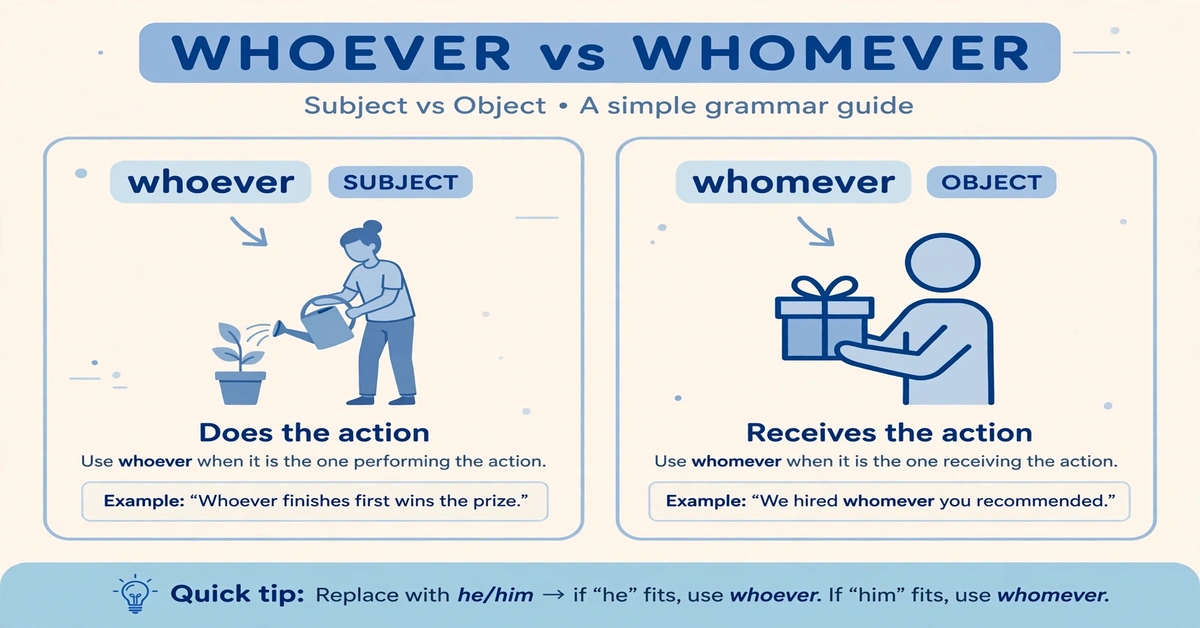
If you only have thirty seconds, here is the rule: whoever is the subject form and whomever is the object form. Swap in he or she — if it fits, use whoever. Swap in him or her — if it fits, use whomever.
- Whoever called this morning left no message. (“He called this morning” → whoever)
- Send the file to whomever you trust. (“Send it to him” → whomever)
That is genuinely most of what you need. The rest of this article explains why the test works and walks through the sneaky exceptions.
What Does “Whoever” Mean?
Whoever is an indefinite relative pronoun in the subject case. In plain language, that means it stands in for an unspecified person — any person — and it plays the role of the subject of a verb inside its own clause. It is the partner of he, she, and they: wherever those words would do the action, whoever fits too.
Think of whoever as the “doer” form. The person it refers to is performing an action, existing in a state, or otherwise driving the verb:
- Whoever finishes the report first can leave early. (Whoever performs the action of finishing.)
- Give a round of applause to whoever organized this event. (The organizer did the organizing.)
- We will promote whoever delivers the best results. (The person delivers; whoever is the subject of “delivers.”)
Notice that in every example above, the unknown person is the one doing something: finishing, organizing, wanting, delivering. That is the signature of whoever — it introduces a clause and immediately acts as that clause’s subject.
There is one important subtlety worth absorbing now, because it causes the single most common error with this pair: the decision is made inside the clause that whoever introduces, not by looking at the rest of the sentence. Consider “Give the prize to whoever arrives first.” The word “to” is a preposition, and prepositions are usually followed by object forms — so many people instinctively write “whomever” here. But the correct word is whoever, because inside the clause “whoever arrives first,” the pronoun is the subject of “arrives.” The preposition belongs to the whole clause, not to the pronoun. Keep this picture in mind; we will return to it.
What Does “Whomever” Mean?
Whomever is the object-case counterpart of whoever. It stands in for an unspecified person who is on the receiving end of an action — the object of a verb or a preposition inside its own clause. It is the partner of him, her, and them: wherever those words would fit as receivers, whomever fits too.
Think of whomever as the “receiver” form. The person it refers to is being acted upon, chosen, thanked, helped, or addressed:
- You may invite whomever you wish. (You invite him — whomever receives the inviting.)
- The committee will hire whomever the members recommend. (The members recommend her — whomever receives the recommending.)
- Choose whomever you think is most qualified for the role. (You choose him — whomever receives the choosing.)
The pattern is consistent: another person in the clause is doing something to the person described by whomever. If you can mentally replace the word with “him,” “her,” or “them” and the clause still sounds right, whomever is the grammatically correct choice.
Whomever is much less common in modern spoken English than whoever, and in casual conversation many native speakers never use it at all. In formal writing, however, it still carries weight: using it correctly signals precision and care.
The Difference Between Whoever and Whomever
Both words refer to an unspecified person, and both introduce a clause. The entire difference is grammatical case — the role the pronoun plays inside that clause. A subject performs the verb’s action; an object receives it. Whoever is the subject form (like “he”), and whomever is the object form (like “him”).
Here is a side-by-side comparison that captures everything at a glance:
| Feature | Whoever | Whomever |
|---|---|---|
| Grammatical case | Subject case (nominative) | Object case (accusative) |
| Partner pronouns | he, she, they | him, her, them |
| Role in its clause | Performs the verb’s action | Receives the action of a verb or preposition |
| Typical position | Before a verb: “whoever asks” | After a verb or preposition: “to whomever”, “whomever you choose” |
| Example | Whoever calls first wins. | Call whomever you trust. |
| Quick test | “He calls first” fits | “You trust him” fits |
If you can internalize just one row of that table, make it the “partner pronouns” row. Whoever pairs with he; whomever pairs with him. That single letter “m” is a built-in memory aid.
One more point worth stating clearly: the two words are not interchangeable. Swapping them changes the grammar of the sentence, and in formal writing the swap is noticeable.
The He/Him Test: The Only Trick You Need
The most reliable way to choose between whomever or whoever is the substitution test. It takes seconds and works in almost every sentence:
1. Find the clause that the word introduces.
2. Mentally replace the word with he (or she). Does the clause still sound grammatical? If yes, use whoever.
3. If he sounds wrong, try him (or her). If that fits, use whomever.
Let us run it through three real sentences:
Sentence 1: “Give it to (whoever / whomever) asks for it first.”
- The clause is “___ asks for it first.”
- “He asks for it first” sounds right. “Him asks for it first” does not.
- Answer: whoever. “Give it to whoever asks for it first.”
Sentence 2: “We will hire (whoever / whomever) you recommend.”
- The clause is “you recommend ___.”
- “You recommend he” is wrong. “You recommend him” is right.
- Answer: whomever. “We will hire whomever you recommend.”
Sentence 3: “We will promote (whoever / whomever) delivers the best results.”
- The clause is “___ delivers the best results.”
- “He delivers the best results” sounds right. “Him delivers the best results” does not.
- Answer: whoever. “We will promote whoever delivers the best results.”
Notice what happened in Sentence 1: the word “to” right before the blank tempted us toward whomever, because “to him” sounds natural. But the test ignores the word before the blank and looks only at the clause the pronoun belongs to. That discipline is the whole secret.
Examples of Whoever and Whomever in Different Contexts
Seeing the words in real contexts makes the rule stick far better than memorizing definitions. Here is how the pair behaves across the registers of English you actually write in.
Everyday Conversation
In casual speech, whoever does nearly all the work, and that is completely normal. Most native speakers rarely say whomever aloud, and nobody will blink if you use whoever where formal grammar would prefer whomever:
- “Whoever wants coffee, I’m making a fresh pot.” (Whoever is the subject of “wants.”)
- “Invite whoever you like to the party.” (Formally “whomever” — you invite him — but “whoever” sounds perfectly natural here.)
- “That prize should go to whoever earned it.” (“He earned it” — whoever is correct.)
The practical takeaway for conversation: default to whoever and you will sound natural. Reserve whomever for writing where formality matters.
Work and Business Writing
Professional emails and reports sit in the middle: you want to sound polished but not stiff. Here the correct choice earns quiet respect, because business readers do notice:
- “Please forward this to whoever handles client billing.” (“He handles billing” — whoever is correct, even after “to.”)
- “We should interview whomever the hiring panel shortlists.” (“The panel shortlists her” — whomever is correct.)
- “Send the draft to whomever you believe should review it.” (“You should review him” — whomever.)
A common business-writing moment: “I was wondering who to assign this to” is a sentence you might actually write in an email — and if you ever need to turn it into a clause about an unspecified person, the same test applies. Pick the pronoun by its role inside the clause, and your emails will read smoothly. For more on everyday business phrasing, see our guide to the phrase I was wondering.
Formal and Academic Writing
In academic papers, legal documents, and formal publications, whomever is expected wherever the grammar calls for it:
- “The award shall be granted to whomever the board deems most deserving.” (“The board deems him deserving.”)
- “Whoever submits the winning proposal will be credited as lead author.” (“He submits” — whoever.)
- “Whoever is elected chair will serve a two-year term.” (“He is elected” — whoever.)
In this register, both words appear regularly, so precision matters most. If your thesis or report uses whomever as a subject (“whomever arrives first”), a careful examiner will mark it.
Common Mistakes to Avoid
Mistake 1: Hypercorrection — Using “Whomever” to Sound Formal
The single most common error is not underusing whomever but overusing it. Many writers believe that “whomever” is simply the fancier, more educated version of “whoever,” so they reach for it whenever they want to sound formal. The result is sentences like:
- ❌ “Give it to whomever asks for it first.”
- ❌ “Whomever wins the raffle gets the grand prize.”
- ❌ “Contact whomever is in charge of the department.”
Every one of those is wrong. Run the he/him test: “He asks for it first,” “He wins the raffle,” “He is in charge.” All three need whoever. Using whomever where a subject is required is called hypercorrection — applying a rule beyond where it belongs — and to knowledgeable readers it has the exact opposite of the intended effect: it signals that the writer does not actually know the rule. This shows how easy it is to slip: the instinct to sound formal produces the least formal-looking error of all.
Mistake 2: Being Fooled by a Preposition Before the Clause
Prepositions are usually followed by object pronouns (“to him,” “for her”), so when a writer sees “to ___” or “for ___,” the hand reaches for whomever on autopilot. But when what follows is a whole clause, the preposition governs the clause, not the pronoun:
- ❌ “Talk to whomever knows the answer.” → ✅ “Talk to whoever knows the answer.” (“He knows the answer.”)
- ❌ “The bonus goes to whomever sells the most.” → ✅ “The bonus goes to whoever sells the most.” (“He sells the most.”)
Always isolate the clause first, then test.
Mistake 3: Judging by the Whole Sentence Instead of the Clause
Related to the last mistake: writers sometimes choose the word based on its role in the main sentence rather than its role in its own clause. “We will hire ___ you recommend” — the blank looks like the object of “hire,” so whomever feels right, and in this case it actually is right (because “you recommend him”). But compare “We will hire ___ is most qualified”: the blank again looks like the object of “hire,” yet the correct word is whoever, because inside its clause it is the subject of “is.” The whole-sentence view fails here; the inside-the-clause view never does.
Mistake 4: Avoiding “Whomever” Entirely in Formal Writing
In formal contexts, refusing to use whomever at all is also an error — just a less visible one. “You may invite whoever you like” passes unnoticed in conversation, but in a legal document or academic paper, “You may invite whomever you like” is the professional choice. Match the word to the register: casual speech can relax; formal writing should not.
Tricky Cases and Edge Cases
The Whole-Clause Rule
The master principle, worth stating as a standalone rule: the case of whoever/whomever is decided entirely by its role inside the clause it introduces. Nothing outside that clause — not a preposition, not the main verb, not the sentence’s subject — changes the answer.
- “Give the trophy to whoever scored the most points.” (Preposition “to” outside; subject “whoever” inside.)
- “Whomever you nominate will be interviewed.” (Whole clause “whomever you nominate” is the sentence’s subject; inside it, “whomever” is the object of “nominate.”)
Test yourself on that second sentence: the clause sits in the subject position of the main sentence, which tempts writers toward whoever. But isolate the clause — “you nominate ___” — and “you nominate him” settles it: whomever.
Prepositions Stuck Directly Before the Clause
This is the hypercorrection hotspot, so it deserves one more look with fresh examples:
- “The decision rests with whoever chairs the meeting.” (“He chairs” — whoever, despite “with.”)
- “Tickets are available to whoever arrives early.” (“He arrives” — whoever, despite “to.”)
- “Speak to whomever the receptionist directs you to.” (“The receptionist directs you to him” — whomever.)
The preposition test never applies to a pronoun that has its own verb. If the word is followed by its own verb (“asks,” “chairs,” “arrives”), it is almost certainly a subject — use whoever.
“Who(m)ever” in Questions
Questions add a twist because the word order shifts, but the test still works — just rearrange the clause mentally:
- “Can whoever took my charger please return it?” (Rearrange: “He took my charger” — whoever.)
- “To whomever should I address this letter?” (“I should address it to him” — whomever.)
- “Whoever wants to volunteer, raise your hand.” (“He wants” — whoever.)
The Formal Decline of “Whomever”
In contemporary spoken English, whomever is steadily fading — many native speakers never use it, even in writing. Grammar authorities still prescribe it in formal writing, and using it correctly remains the professional standard there.
What does this mean for you? In formal documents, use whomever where the grammar demands it. In emails, blog posts, and conversation, whoever is widely accepted everywhere — the only true mistake is using whomever as a subject.
A Quick Self-Test
Try these before peeking at the answers:
1. “Congratulations to (whoever / whomever) finished first.”
2. “We will support (whoever / whomever) the team elects.”
3. “(Whoever / Whomever) you choose will represent us.”
Answers: 1. whoever (“he finished first”). 2. whomever (“the team elects him”). 3. whomever (“you choose him” — the whole clause is the subject of “will represent,” but inside the clause the pronoun is the object). If you got all three, you have mastered the rule.
Frequently Asked Questions
Is it ever correct to use “whomever” at the start of a sentence?
Yes. “Whomever you elect will serve a four-year term” is correct: the clause “whomever you elect” is the subject of the sentence, but inside the clause, “whomever” is the object of “elect” (“you elect him”). Judge by the inside of the clause, not by the word’s position in the sentence.
What is the easiest trick to remember the difference?
Use the he/him test. Replace the word with “he” — if the clause still sounds right, write “whoever.” If “he” sounds wrong, try “him” — if that fits, write “whomever.” A bonus memory aid: “whomever” and “him” both contain the letter “m,” while “whoever” and “he” do not. On the other hand, if the test still feels shaky, just default to “whoever” in casual writing — it is acceptable nearly everywhere except as an obvious object in formal prose.
Is “Give it to whomever asks for it” correct?
No — this is the classic hypercorrection. The correct sentence is “Give it to whoever asks for it.” The preposition “to” seems to demand an object, but what follows is an entire clause, and inside that clause the pronoun is the subject of “asks” (“he asks”). The preposition governs the clause as a whole, not the pronoun.
Can I just use “whoever” all the time?
In conversation and informal writing, yes — most native speakers do exactly that, and no one will object. In formal writing, though, “whomever” is still expected where the grammar calls for an object. Using “whoever” everywhere is a small, forgivable lapse; using “whomever” as a subject is the mistake that gets noticed.
Why is “whomever” disappearing from English?
“Whomever” is declining for the same reason “whom” is: English is gradually losing its case distinctions for these pronouns, and the object forms sound stiff to modern ears. It survives mainly in formal and legal writing, where precision is valued. Knowing it correctly still marks you as a careful writer, even if the word itself is on a slow fade.
Conclusion
The choice between whomever or whoever comes down to one question: is the unknown person doing the action or receiving it? If they are the doer — the subject of the clause’s verb — write whoever. If they are the receiver — the object of a verb or preposition inside the clause — write whomever. The he/him test makes this mechanical: “he” points to whoever, “him” points to whomever. And the golden rule that protects you from every trap in this guide is to judge the pronoun only by its job inside its own clause, ignoring everything else in the sentence.
If you take one habit away from this article, make it this: pause for three seconds before writing either word, isolate the clause, and run the test. That tiny pause will save you from hypercorrection — the urge to write “whomever” just to sound formal — which is the most common way this pair goes wrong.
Explore more on Synonynmsof.