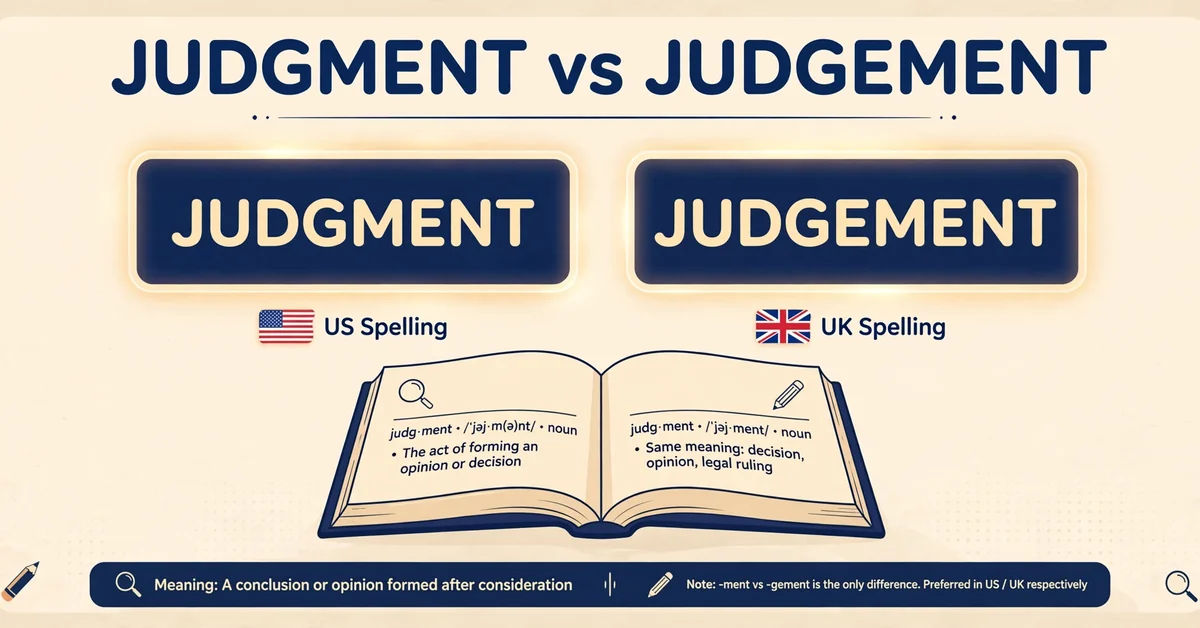

Few spelling questions spark as much quiet debate as judgment or judgement. Is one of them wrong? Does the extra “e” change the meaning? The short answer is that both spellings are correct, and both mean exactly the same thing. The longer answer — which one you should use and when — depends on where you live, what you are writing, and sometimes even which room of the courthouse you are in.
The confusion is understandable. English is full of word pairs that look like rivals but are really just regional twins, and this one sits at the very top of the list. Students lose marks over it, professionals second-guess themselves in important emails, and spell-checkers seem to change their minds depending on the day. But once you understand the simple rule behind the two spellings, you will never hesitate over it again.
In this guide, we will unpack the meaning of judgment and judgement, explain why both forms exist, show you exactly which to use in American and British English, walk through real examples from everyday life, work, and academic writing, and flag the tricky edge cases that even experienced writers get wrong. By the end, you will know the answer with complete confidence — and, on the other hand, you will understand why someone else’s “wrong” spelling might be perfectly right.
What Does “Judgment” Mean?
Judgment (without the middle “e”) is a noun with three closely related meanings. The most everyday sense is an opinion or evaluation you form about someone or something: “In my judgment, this is the best route.” It also means the act of forming that opinion — the mental process itself: “She showed poor judgment in hiring him.” And it refers to your ability to make good decisions in general, the quality we call sound thinking: “He has excellent judgment under pressure.”
The second major meaning is legal: a judgment is a formal decision or ruling handed down by a court or judge. When a judge settles a case, the resulting order is called a judgment — as in “The court issued a judgment in favor of the plaintiff.” This legal sense is one of the reasons this spelling is so deeply established: centuries of American court documents have used “judgment” without the “e,” and that tradition carried the spelling into everyday use.
In American English, “judgment” is the only standard spelling, accepted in every context from casual text messages to Supreme Court opinions. If you write for an American audience — or simply follow American spelling conventions — “judgment” is always the right choice, no exceptions. American dictionaries list “judgement” as a rare variant, but style guides, schools, and publishers across the United States treat the shorter spelling as the correct one.
What Does “Judgement” Mean?
Judgement (with the middle “e”) means precisely the same thing as “judgment.” It carries the identical three senses: an opinion or decision (“against my better judgement”), the capacity for sound thinking (“good judgement”), and, less commonly, a formal verdict. There is no difference in meaning whatsoever — the two words are true spelling variants of a single noun, not separate words with separate definitions.
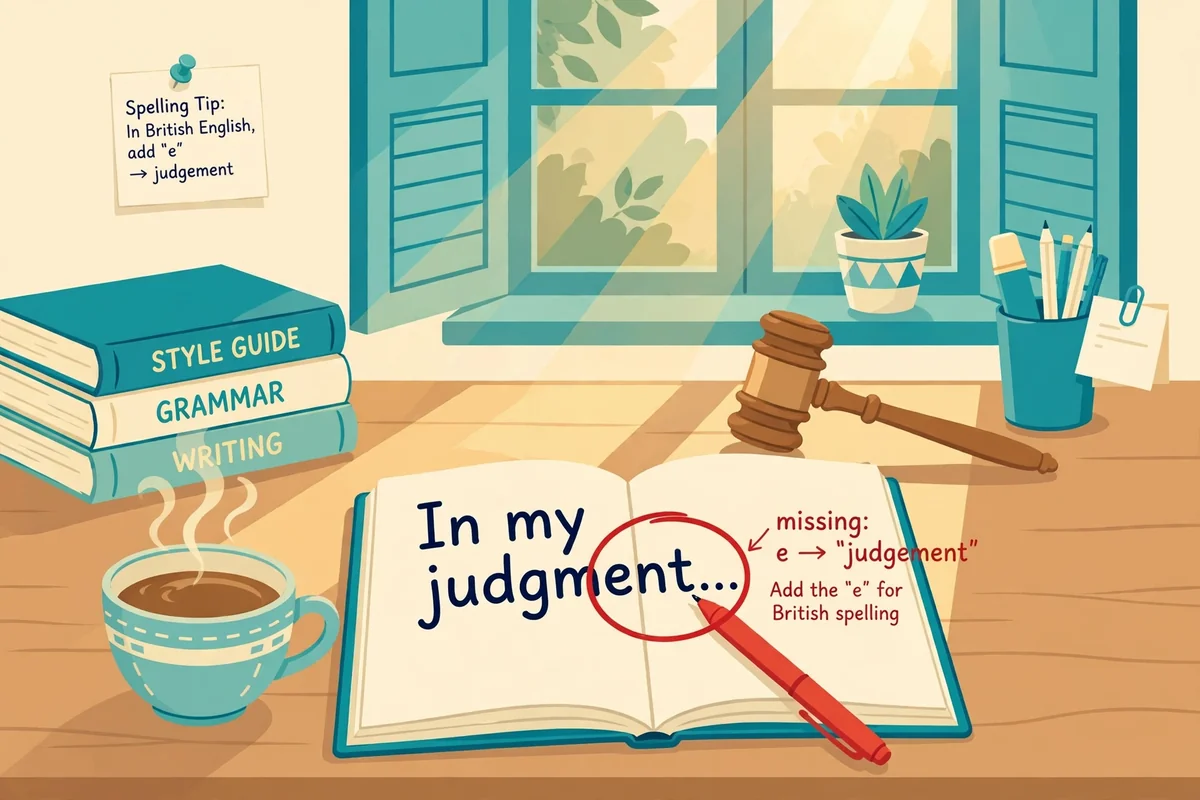
This spelling is the standard in British English for everyday use. A newspaper in London, a novel published in Edinburgh, or an essay submitted to a university in Manchester will almost always write “judgement” when talking about opinions and decision-making. For British readers, the extra “e” looks natural and correct, while “judgment” looks distinctly American.
The retained “e” follows a common British spelling habit: keeping the silent “e” of the verb judge when the suffix -ment is added. British English tends to preserve the base word’s spelling in derivatives, which is why it also prefers spellings like “acknowledgement” and “abridgement” over their American counterparts “acknowledgment” and “abridgment.” In this sense, “judgement” is not an oddity — it is part of a whole family of British spellings built on the same principle.
Why Are There Two Spellings? The Difference Explained
The difference between judgment and judgement is purely a matter of regional spelling convention, not meaning. American English drops the silent “e” from “judge” before adding “-ment”; British English keeps it. That is the entire story at the level of rules — but the history behind it is worth knowing, because it explains why the two forms feel so entrenched.
The American push to simplify
In the early 1800s, the American lexicographer Noah Webster set out to give the young United States its own spelling standards, deliberately distinct from British ones. Webster’s dictionaries promoted simplified forms across hundreds of words — “color” instead of “colour,” “center” instead of “centre,” “traveling” instead of “travelling” — and “judgment” instead of “judgement” was part of that same reform movement. The logic was phonetic and practical: the “e” in “judgement” is silent, so why keep it? Webster’s case for the shorter form was not just nationalism; it was also about regularity. English already drops the silent “e” before vowel suffixes in words like “judging” and “judged,” so “judgment” simply extended an existing pattern. The reformers argued that keeping a letter nobody pronounces was a needless complication for learners, and American schools, newspapers, and courts adopted the shorter form. Over two centuries it became universal across the United States.
The British habit of keeping the “e”
British spelling reform never took hold in the same way. Britain’s dictionaries and publishers largely kept the traditional forms, and the silent-e-retaining pattern stayed standard for the non-legal senses of the word. This is the same instinct that gives British English “acknowledgement,” “abridgement,” and “envelopment” — all words where the base verb’s final “e” survives before “-ment.” The British tradition values continuity with the root word (“judge” → “judgement”) over phonetic economy.
The modern picture
Today, usage data shows a clean geographic split with one famous exception. In the United States, “judgment” dominates completely — the variant with the “e” is so rare that most Americans consider it a typo. In Britain, “judgement” is the standard for general writing, but legal writing switches to “judgment” — British courts, law reports, and legal style guides use the American-looking spelling for formal verdicts. This means a British lawyer might write “judgement” in a letter to a client about a business decision and “judgment” in the same week when referring to a court order. Understanding this split is the key to using both spellings correctly.
Judgment vs Judgement: Side-by-Side Comparison
| Feature | Judgment | Judgement |
|---|---|---|
| Spelling | No middle “e” | Middle “e” retained |
| Meaning | Opinion, decision, legal verdict | Identical: opinion, decision, verdict |
| Standard in American English | Yes — the only correct form | No — considered a misspelling |
| Standard in British English (general use) | Accepted variant, less common | Yes — the preferred form |
| British legal writing | Yes — the required form | No — not used for court verdicts |
| Pronunciation | Identical | Identical |
| Adjective form | Judgmental | Judgemental (both accepted in the UK) |
Usage Examples Across Contexts
Seeing the two spellings in real sentences makes the rule concrete. Below, examples follow American and British conventions side by side so you can match your writing to your audience.
Everyday Conversation
In casual speech and informal writing, pick the spelling your audience expects and stay consistent:
- American: “That was a poor judgment call, honestly.”
- British: “That was a poor judgement call, honestly.”
- American: “In my judgment, the blue one looks better.”
- British: “In my judgement, the blue one looks better.”
- American: “Don’t let one mistake cloud your judgment of him.”
- British: “Don’t let one mistake cloud your judgement of him.”
- American: “Against my better judgment, I agreed to help.”
- British: “Against my better judgement, I agreed to help.”
- American: “Her judgment of people is rarely wrong.”
- British: “Her judgement of people is rarely wrong.”
Notice that the famous phrase “against my better judgment/judgement” — meaning you did something despite knowing it was unwise — follows the same regional rule as everything else. There is no special idiom spelling.
Work and Business
Professional writing is where consistency matters most, because mixed spellings look careless to clients and managers:
- American: “The board’s judgment was to delay the launch until spring.”
- British: “The board’s judgement was to delay the launch until spring.”
- American: “We trust her judgment on all hiring decisions.”
- British: “We trust her judgement on all hiring decisions.”
- American: “Using personal email for client data showed terrible judgment.”
- British: “Using personal email for client data showed terrible judgement.”
- American: “The audit questioned the judgment behind those expense claims.”
- British: “The audit questioned the judgement behind those expense claims.”
- American: “Let’s reserve judgment until we see the full report.”
- British: “Let’s reserve judgement until we see the full report.”
If your company uses a house style guide, follow it — and if you have time before submitting an important document, it is worth checking which convention your guide prescribes, because getting this detail right signals professionalism to careful readers.
Formal and Academic Writing
Academic and formal writing follows the same regional conventions, with the added pressure of graders and editors who notice spelling:
- American: “The study evaluates moral judgment in adolescents.”
- British: “The study evaluates moral judgement in adolescents.”
- American: “Critics praised the novelist’s judgment of character.”
- British: “Critics praised the novelist’s judgement of character.”
- American: “A judgment was entered against the defendant in March.”
- British (legal): “A judgment was entered against the defendant in March.”
- American: “The paper distinguishes legal judgment from moral judgment.”
- British: “The paper distinguishes legal judgment from moral judgement.”
That last British example shows the split in action within a single sentence: the courtroom verdict loses the “e” while the philosophical sense keeps it.
That last pair is the crucial exception: in a British law essay or court filing, “judgment” — without the “e” — is correct even though every other sentence in the paper uses British spelling. We explore this further in the edge cases below.
Common Mistakes to Avoid
- Mixing both spellings in one document. This is the single most common error. Writers start with “judgement,” their spell-checker underlines it, they accept the correction halfway through, and the final text contains both. Pick one spelling per document and stick with it — consistency matters more than which variant you choose.
- Assuming one spelling is simply wrong. Neither “judgment” nor “judgement” is a misspelling in absolute terms. Telling a British colleague their “judgement” is wrong — or an American colleague their “judgment” is wrong — is itself an error. The correct question is never “which is right?” but “which is right for this audience?”
- Using “judgement” in American legal writing. In the US, “judgment” is the only acceptable spelling everywhere, including court filings. The British legal exception does not apply across the Atlantic, and “judgement” in an American brief would be flagged as an error.
- Using “judgement” for British court verdicts. This is the mirror-image mistake. A British writer who uses “judgement” throughout a legal memo about a court ruling has it backwards: Oxford style and British legal convention require “judgment” for the verdict itself. General opinions get the “e”; court orders lose it.
- Letting your spell-checker decide for you. Spell-checkers follow the dictionary region set on your device, not your actual audience. An American spell-checker will “correct” a British writer’s “judgement” and vice versa. Check your language setting, and override the tool when it disagrees with your intended convention.
- Treating the noun and verb as interchangeable in spelling logic. The verb is always “judge” and its forms (“judging,” “judged”) never vary by region — only the noun has two spellings. Writers sometimes overthink this and produce odd forms like “judgementing,” which does not exist in any dialect.
- Misspelling the related adjective. The adjective is judgmental in American English (“a judgmental comment”). In British English, both judgemental and judgmental appear, with “judgemental” more common. Writing “judgemental” for an American audience is a mistake; writing “judgmental” for a British one is acceptable but less typical.
Tricky Cases and Edge Cases
Legal writing conventions in the US and UK
The legal exception is the trickiest part of this topic, so it deserves a clear summary. In the United States, “judgment” is used for everything — court verdicts, opinions, and general decision-making alike. In Britain, the rule splits: “judgment” (no “e”) for formal legal decisions — court judgments, judgments of the High Court, default judgments — and “judgement” (with “e”) for everything else, including opinions about legal strategy. Australian and Canadian English generally follow the British pattern, though Canadian legal writing, influenced by proximity to the US, leans toward “judgment” more broadly. When in doubt in a legal context anywhere in the English-speaking world, “judgment” is the safer choice.
“Judgmental” vs “judgemental”
The adjective built from this noun follows its own regional pattern. American English uses only judgmental — “judgemental” is not standard there. British English accepts both, though judgemental is the more common form in UK publications, matching the retained “e” of “judgement.” Note the subtle spelling trap: both adjectives are spelled with one “e” after the “g” in the middle (“judgemental”), never “judgemental” with a doubled pattern — the suffix is “-mental,” and the only question is whether the “e” of “judge” survives before it.
What the dictionaries say
The major dictionaries agree on the facts while differing in presentation. Merriam-Webster (American) lists “judgment” as the main entry and marks “judgement” as a less common variant. Oxford (British) does the reverse for general use, listing “judgement” first — while noting that “judgment” is the standard spelling in legal contexts. This pattern shows how the two traditions each treat the other’s preferred form: legitimate, but marked for a different region or register. Neither dictionary calls either spelling wrong.
Style-guide preferences
If you write under a specific style guide, it has already made this decision for you. The Chicago Manual of Style and AP Stylebook (American) prescribe “judgment” in all cases. Oxford style (British) prescribes “judgement” for general use but “judgment” in legal contexts — the origin of the UK legal exception. The Economist style guide and most British newspapers follow the same split. Australian government style, based on the Macquarie Dictionary, uses “judgment” as the preferred spelling in all contexts, which surprises many writers who assume Australia always follows Britain. The practical lesson: when a publication or institution sets a rule, follow it exactly rather than reasoning from geography.
Quoting and editing other people’s text
When you quote someone, keep their original spelling — do not “correct” a British author’s “judgement” to “judgment” in a quotation, or vice versa. Changing quoted spelling misrepresents the source. The same courtesy applies when editing: if you are proofreading a document written in British English, do not Americanize its “judgement” spellings unless you have been asked to convert the entire text to American English. Spelling conversion is an all-or-nothing job; converting only the words you happen to notice creates exactly the mixed-spelling mess described above.
Frequently Asked Questions
Is “judgement” with an “e” a misspelling?
No. “Judgement” is the standard British English spelling of the word, used in the UK, and in much of the Commonwealth, for opinions, decisions, and the capacity for sound thinking. It is only “wrong” if you are writing in American English, where “judgment” is the sole correct form. Context and audience decide — the spelling itself is never inherently incorrect.
Which is correct: “judgment” or “judgement”?
Both are correct. Use “judgment” (no “e”) if you write in American English or in any legal context, including British legal writing. Use “judgement” (with “e”) if you write in British English for general, non-legal purposes. Whichever you choose, use it consistently throughout the document.
Why does British English use “judgment” in legal contexts?
British legal tradition adopted the shorter spelling for formal court decisions centuries ago, and modern authorities — including Oxford style and the UK courts themselves — have kept it. The convention neatly separates a court’s official ruling (“judgment”) from an ordinary opinion (“judgement”). American English never made this distinction because it uses “judgment” for everything.
Is it “judgmental” or “judgemental”?
In American English, always “judgmental.” In British English, both appear, but “judgemental” is more common and matches the British noun “judgement.” Either way, the word is built as “judge” plus “mental” — the only question is whether the “e” survives. Mangled forms like “judggemental” (double “g”) are simply wrong in every dialect.
How can I remember which spelling to use?
Think of the letter “e” as standing for “England”: British English keeps the “e” in judgement, while American English drops it. Then remember the one exception: even in Britain, a judge’s official ruling is a “judgment” — the courtroom loses the “e.” If you write for an international audience with no clear regional home, default to “judgment,” the more universally accepted form.
Conclusion
The judgment or judgement question has a reassuringly simple answer: both spellings are correct, they mean the same thing, and the choice comes down to geography with one famous exception. American English uses “judgment” everywhere; British English uses “judgement” for opinions and decisions but switches to “judgment” for formal legal verdicts. Learn that pattern, apply it consistently, and the confusion disappears.
More broadly, this word pair is a useful reminder that English spelling is shaped by history, not pure logic — and that “different” does not mean “wrong.” The next time a spell-checker flags your “judgement” or a colleague questions your “judgment,” you will know exactly why both of you are right, and exactly which one belongs in the document in front of you.