
You are typing a sentence — maybe a work email, maybe a message to a friend — and your fingers stop cold. “I laid the file on your desk.” Or is it “I layed the file on your desk”? Both look plausible on screen, and spellcheck may not even flag the wrong one in every app. A tiny spelling choice, but it carries real weight: one version makes you look careful, the other makes the reader pause.
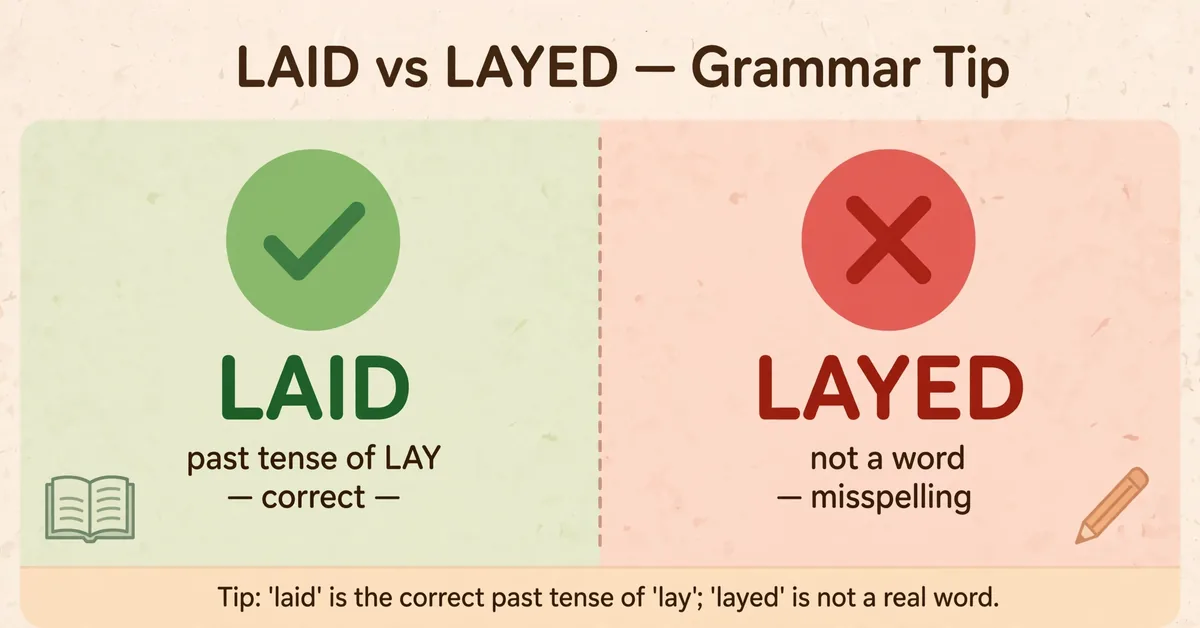
Here is the short, clear answer you can trust: laid is correct, and layed is not standard English. “Laid” is the past tense and past participle of the verb “lay,” which means to put or place something down. “Layed” is the spelling that appears when people treat “lay” like a regular verb and tack “-ed” onto it — a natural instinct, but the wrong one.
This guide walks through everything: what “laid” means and how to use it, why “layed” fails every dictionary test, a side-by-side comparison table, the deeper lay-versus-lie tangle that causes most of this confusion, real examples from conversation, business writing, and formal prose, plus the mistakes, edge cases, and memory tricks that will settle the question for good.

What Does “Laid” Mean?
“Laid” is the past tense and past participle of the verb lay. At its core, “lay” means to put, place, or set something down — and because it is an action done to something, it is a transitive verb, which means it always takes a direct object. You do not just “lay”; you lay something somewhere.
The Past Tense of “Lay”
When you describe an action that happened in the past — placing something down at an earlier time — the verb form is “laid.” The event is finished, and “laid” marks that clearly.
- Yesterday, I laid my keys on the counter.
- She laid the baby in the crib and tiptoed out.
- The workers laid the new carpet on Monday.
- He laid his jacket across the back of the chair.
In each sentence, something is being placed somewhere, and the action happened before now. That is the past tense of “lay” doing its job.
The Past Participle of “Lay”
“Laid” also serves as the past participle, the form used with helping verbs like “have,” “has,” and “had,” and in passive constructions.
- I have laid out everything you need for the meeting.
- The committee had already laid the groundwork for the new policy.
- The bricks were laid with impressive precision.
This double duty — past tense and past participle sharing one form — is common among irregular verbs. Think of “bring/brought/brought” or “think/thought/thought.” “Lay/laid/laid” follows the same pattern, and remembering that pattern is the fastest way to kill the “layed” habit.
What Does “Layed” Mean?
Strictly speaking, “layed” means nothing in modern English. It does not appear as a standard entry in major dictionaries, it is not the accepted past tense of any verb, and using it in writing today will be read as a spelling error. If you are ever choosing between the two, “layed” is never the safe pick.
Why “Layed” Is Not a Standard Word
The mistake has a perfectly logical origin. Most English verbs form their past tense by adding “-ed”: walk becomes walked, play becomes played, want becomes wanted. A writer’s brain applies that rule to “lay” and produces “layed” — the same way small children say “runned” or “eated” before they learn the exceptions. It sounds reasonable because it follows the default pattern of the language.
But “lay” is an irregular verb, and irregular verbs do not follow the default pattern. The correct form was settled centuries ago: “laid.” Every style guide, dictionary, and grammar authority agrees. There is no difference between British and American English on this point — both use “laid,” everywhere, in every register of writing. So on the other hand, while “layed” feels like it ought to exist, no edition of the language you are writing in today recognizes it.
The Rare Historical Exception
If you dig far enough back, you can find “layed” in very old texts, from periods before English spelling was standardized. In Middle English and early modern writing, spellings drifted and writers spelled words more or less as they sounded, so forms like “layed” occasionally appear in manuscripts hundreds of years old. Some dictionaries note it as an archaic or obsolete variant.
That history is interesting, but it changes nothing about modern usage. English spelling has been standardized for centuries, and “laid” won decisively. Writing “layed” today in an email, essay, novel, or text message will be corrected by teachers, flagged by editors, and judged as an error by readers — so treat it as an error and leave it in the past where it belongs.
Layed or Laid: The Key Difference
The difference is simple once it is laid out plainly: one is a word, and the other is not. But because both sound identical when spoken, the confusion lives entirely on the page. Here is the comparison at a glance.
| Feature | Laid | Layed |
|---|---|---|
| Status in English | Correct standard spelling | Misspelling (not standard) |
| Base verb | Lay (to put or place something down) | None — not a verb form |
| Verb tense | Past tense of “lay” | Not a valid tense of anything |
| Past participle | Yes — used with have/has/had | No — no such form exists |
| Pronunciation | /leɪd/ (rhymes with “paid”) | Would sound the same, /leɪd/ |
| Example (correct) | She laid the book down. | She layed the book down. ❌ |
| Use in phrasal verbs | Laid off, laid out, laid down | Never standard |
| British vs American English | Both use “laid” | Both reject “layed” |
The takeaway is absolute: in every context — formal or casual, written or typed — laid is the only correct choice. There is no sentence, dialect, or style guide in which “layed” is the recommended spelling.
Why the Lay vs Lie Confusion Is the Root Cause
Here is where the story gets genuinely interesting. The “layed” mistake does not happen in isolation; it grows out of one of the most tangled spots in all of English grammar — the overlap between the verbs “lay” and “lie.”
“Lie” has two completely separate meanings. One means to tell an untruth; its forms are regular: lie, lied, lied. The other means to recline or rest; its forms are irregular: lie, lay, lain. And “lay” — our verb meaning to place something — is irregular too: lay, laid, laid.
The killer is this: the past tense of “lie” (to recline) is “lay” — the exact same word as the present tense of “lay” (to place). Two different verbs share one form, and from that single collision, whole armies of mistakes are born. When people sense that something irregular is happening but cannot map the forms, they reach for “layed” as a guess, the way you might reach for a wrong key when the right one is hidden.
The Full Conjugation Side by Side
| Present | Past | Past Participle | Example | |
|---|---|---|---|---|
| Lay (to place something) | lay | laid | laid | I lay the keys down; I laid them down; I have laid them down. |
| Lie (to recline) | lie | lay | lain | I lie down; I lay down yesterday; I have lain here before. |
| Lie (to fib) | lie | lied | lied | I lie; I lied; I have lied. |
The object test cuts through the fog every time. If the verb acts on something — you lay the keys, the baby, the carpet — it is “lay,” and the past is “laid.” If nobody is being placed anywhere and the subject is simply reclining, it is “lie,” and the past is “lay” (confusing, yes) or the participle “lain.” And only the fibbing verb ever takes “-ed” to become “lied.” Notice what is missing from every row: “layed” appears nowhere, because it belongs to none of these verbs.
“Laid” in Everyday Conversation
In daily life, “laid” shows up in the small physical actions we describe constantly. You laid your phone on the table, your friend laid out snacks for the game, someone laid a blanket over the couch. These are ordinary sentences, and getting them right keeps your messages and texts clean.
- “I laid my bag by the door.”
- “We laid out the board games before everyone arrived.”
- “He laid the towels on the rack.”
- “They’ve laid new tiles in the kitchen.”
Casual speech forgives a lot, but writing does not — and since texts, posts, and chats are all writing, the standard applies everywhere. A quick pause before you type “layed” is all it takes.
“Laid” in Work and Business Writing
Professional writing is where the stakes rise. A misspelled verb in a client proposal, a status update, or a job application can quietly undermine credibility, because the reader’s attention catches on the error instead of your point. “Laid” appears in business contexts more often than people realize — usually inside phrasal verbs.
- “The team laid out the project timeline in Monday’s meeting.”
- “Management laid off twelve employees last quarter.”
- “She laid the proposal on the director’s desk this morning.”
- “We have laid the foundation for a strong partnership.”
If you ever find yourself typing i was wondering whether “layed off” or “laid off” is right in a sensitive HR memo, remember that the painful topic deserves the correct spelling all the more. “Laid off” is standard; “layed off” is an error, and in a document about people’s livelihoods, precision matters.
“Laid” in Formal and Academic Writing
In essays, research papers, and formal reports, “laid” appears in both literal and figurative senses. Academic writers frequently use it for abstract foundations: laying groundwork, laying bare a motive, laying claim to an argument. These figurative uses follow the same rule.
- “The study laid bare the flaws in the original methodology.”
- “Smith (2019) laid the theoretical groundwork for later research.”
- “The report has laid out three possible courses of action.”
- “These findings laid the basis for the new policy.”
Formal writing also tests your grammar on the lay-versus-lie distinction. A thesis that says participants “layed down” during the experiment will draw a red pen; one that says they “lay down” (past of recline) or that the researcher “laid the instruments on the tray” will pass without a second glance. This shows how the same one-syllable verb can shape a reader’s entire impression of a paper.
Common Mistakes to Avoid
Even writers who know the rule slip up in specific patterns. Here are the five most common errors involving “laid” — and how to fix each one.
1. Adding “-ed” to “Lay”
The classic error. “Lay” is irregular, so the “-ed” instinct misfires.
- ❌ “He layed the blame on his assistant.”
- ✅ “He laid the blame on his assistant.”
If a verb ends in “-ay” and you are tempted to write “-ayed,” stop and check: “say” becomes “said,” “pay” becomes “paid,” and “lay” becomes “laid.” The pattern is consistent.
2. Using “Laid” as the Past Tense of “Lie” (to Recline)
Because the past of “lie” (recline) is “lay,” people sometimes complete the chain wrongly and write “laid” when someone reclined.
- ❌ “Yesterday I laid in bed until noon.”
- ✅ “Yesterday I lay in bed until noon.”
- ✅ “I have lain in bed all morning.” (past participle)
The object test saves you: nothing is being placed, so “laid” cannot apply.
3. Writing “Layed Out” and “Layed Off”
Phrasal verbs inherit the past tense of their root verb. “Lay out” becomes “laid out,” “lay off” becomes “laid off,” “lay down” becomes “laid down.” The spelling of the verb does not change just because a particle joined it.
- ❌ “They layed off half the staff.”
- ✅ “They laid off half the staff.”
4. Confusing “Lied” and “Laid”
“Lied” belongs only to fibbing. If no untruth was told, “lied” is wrong.
- ❌ “She lied the documents on the table.” (She placed them; nothing about lying.)
- ✅ “She laid the documents on the table.”
- ✅ “She lied about where she put them.” (Now an untruth is involved.)
5. Letting Spellcheck Make the Decision
Autocorrect tools sometimes accept “layed” or fail to flag it, especially in casual apps. Never treat the absence of a red underline as proof of correctness. The rule lives in your head, not in the software.
Tricky Cases and Edge Cases
Some uses of “laid” trip up even confident writers because the meaning is idiomatic or the context is unusual. Here are the ones worth knowing.
“Laid Off”
As covered above, the correct spelling is always “laid off” — the past tense of the phrasal verb “lay off,” meaning to dismiss employees, usually for reasons unrelated to their performance. Note the related noun phrase “a layoff” (one word) and the adjective “laid-off” with a hyphen: “the laid-off workers received severance.”
“Lay an Egg” and Hens That Lay
The idiom “to lay an egg” means to fail badly — a comedian lays an egg when the jokes fall flat. The past tense is “laid an egg,” never “layed an egg.” Literally, hens lay eggs: “The hen laid six eggs this week,” and “She has laid an egg every day this month.”
The “Get Laid” Idiom
“Get laid” is a crude slang idiom meaning to have sexual intercourse. It uses the past participle “laid” correctly — “he got laid” — and appears in casual speech, comedy, and pop culture. It is informal and vulgar, so it has no place in professional or academic writing, but grammatically it is built on the standard form. There is no slang variant spelled “get layed” in standard usage.
“Laid Back,” “Laid Bare,” “Laid to Rest”
Several fixed expressions use the participle “laid.” “Laid back” means relaxed; “laid bare” means exposed or revealed; “laid to rest” is a euphemism for buried. All keep the standard spelling, and all would be errors with “layed”: “laid-back attitude” ✅, “layed-back attitude” ❌.
“Layed” in Song Lyrics and Informal Writing
You may occasionally spot “layed” in song lyrics, social media captions, or self-published text. Artists sometimes use nonstandard spellings for rhythm, rhyme, or stylistic effect, and informal writers simply make the same regular-verb mistake everyone else does. Seeing it in the wild does not make it correct — song lyrics are not grammar textbooks. In your own writing, always choose “laid.”
“Lay” in Old Prayers and Proverbs
The children’s prayer “Now I lay me down to sleep” uses “lay” in an older reflexive sense that overlaps with “lie down.” Modern grammar would more often use “lie,” but the prayer preserves an archaic construction. This fossilized usage is another reason the verbs feel tangled — but it is no excuse for “layed,” which does not appear even in the prayer.
Memory Tricks: Never Write “Layed” Again
Three quick devices will lock the correct spelling in place.
The paid/said/laid trio. “Say” becomes “said,” “pay” becomes “paid,” and “lay” becomes “laid.” All three swap “-ay” for “-ai” plus “d.” If you can spell “paid,” you can spell “laid.”
The object test. Ask: is something being put down? If yes — a book, a baby, blame, a foundation — the verb is “lay” and the past is “laid.” If nothing is being placed, you are dealing with “lie,” and “layed” is off the table entirely.
The blank-sentence test. Try your sentence with a different verb: “I ___ the keys on the table.” “Placed” fits, so “laid” is right. “I ___ on the bed all afternoon.” “Reclined” fits, so you need “lay” or “lain” — never “laid,” and certainly never “layed.”
Frequently Asked Questions
Is “layed” a word?
No — not in modern standard English. “Layed” is a common misspelling of “laid.” It appears in very old texts from before spelling was standardized, but every modern dictionary and style guide treats it as an error. Always write “laid.”
What is the past tense of “lay”?
The past tense of “lay” (to put or place something down) is “laid.” The past participle is also “laid.” For example: “She laid the folder on the desk,” and “She has laid the folder on the desk.” There is no form spelled “layed.”
Why do so many people write “layed” instead of “laid”?
Because “lay” looks like a regular verb, writers instinctively add “-ed” to form the past tense — the same way “walk” becomes “walked.” But “lay” is irregular, so the rule does not apply. The confusion is worsened by the lay-versus-lie overlap, since the past tense of “lie” (to recline) is “lay,” which makes the whole verb family feel unstable.
Is it “laid off” or “layed off”?
It is “laid off.” The phrasal verb “lay off” uses the past tense of “lay,” which is “laid.” This holds for all phrasal verbs built on “lay”: “laid out,” “laid down,” “laid aside.” The spelling never becomes “layed.”
Can “laid” ever be wrong when I mean “placed”?
Almost never — if something was placed or put down in the past, “laid” is correct. The only common mix-up is using “laid” for reclining: “I laid on the couch” is wrong because no object is being placed. The correct past tense of reclining “lie” is “lay” (“I lay on the couch”), and its past participle is “lain” (“I have lain here for an hour”).
Conclusion
“Layed or laid” has exactly one right answer: laid — the past tense and past participle of “lay,” correct in every dialect and every register of modern English. “Layed” is a misspelling born from treating an irregular verb as a regular one, and the lay-versus-lie tangle only deepens the confusion. With the paid/said/laid pattern, the object test, and the comparison tables in this guide, you now have everything needed to choose correctly every time.
The next time your fingers hesitate mid-sentence, trust the rule instead of the instinct. Write “laid,” keep “layed” in the history books where it belongs, and your writing — from quick texts to formal reports — will carry the quiet confidence of someone who knows exactly what they are doing.