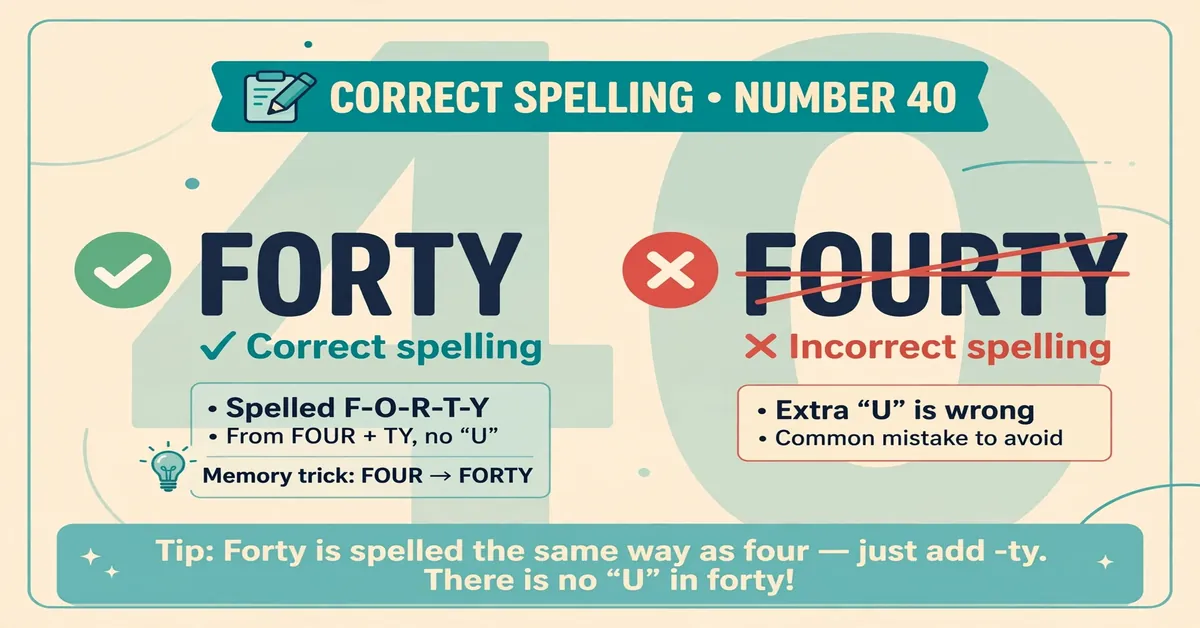

Type the number 40 in words and a small doubt creeps in. Your fingers want to write “fourty” because the number 4 is “four,” the number 14 is “fourteen,” and the fourth item is “fourth.” Every related word keeps the “u,” so dropping it feels like a mistake. Yet every spellchecker on the planet flags “fourty” with an angry red underline, and for good reason.
The correct spelling is “forty” — no “u,” no exceptions. It is the only accepted form in American, British, Canadian, and Australian English, and it has been spelled this way for centuries, appearing in the works of Shakespeare and every dictionary since. “Fourty” is not an alternative spelling, a regional variant, or an informal shortcut. It is simply a misspelling, one of the most common in the English language.
This guide settles the “forty or fourty” question once and for all. You will learn what “forty” means, why “fourty” feels so natural, the history behind the missing “u,” how to use “forty” correctly in everyday, business, and formal writing, the mistakes to avoid, and a few genuinely surprising facts about the number 40 that will make the correct spelling stick in your memory.
What Does “Forty” Mean?
“Forty” is the English word for the cardinal number 40 — the number that comes after thirty-nine and before forty-one. Like all number words, it can act as a determiner that modifies a noun (“forty guests”), a noun in its own right (“forty is an even number”), or a pronoun standing in for something counted earlier (“eighty applied, but only forty were accepted”). Its pronunciation is straightforward: /ˈfɔːrti/, rhyming with “sporty.”
Forty as the Number 40
In its most literal sense, “forty” means four tens, or 4 × 10. It is an even, composite number, and it sits at a comfortable midpoint in the tens: twenty, thirty, forty, fifty, sixty. We use it constantly without thinking — ages (“she just turned forty”), distances (“forty miles”), temperatures (“forty degrees”), prices (“forty dollars”), durations (“forty minutes”), and quantities of all kinds.
What makes “forty” unusual among the tens is its spelling. Every other multiple of ten from twenty to ninety keeps the spelling of its root digit: six becomes sixty, seven becomes seventy, eight becomes eighty (losing only a “t”), nine becomes ninety. Only “forty” drops a whole vowel from “four.” That single missing letter is the source of all the confusion, and it is worth understanding rather than just memorizing.
Forty Beyond Counting
“Forty” also lives a rich second life in idioms, culture, and history. To take “forty winks” is to take a short nap. “Life begins at forty” is the optimistic claim that middle age brings freedom and confidence. Sailors know the “roaring forties” as the stormy latitudes between 40 and 50 degrees south. In the Bible, forty appears again and again as a number of testing and transformation — forty days and forty nights of rain, forty years in the wilderness.
The number also marks cultural milestones. A fortieth birthday or wedding anniversary (the ruby anniversary) is a major celebration. In many workplaces, forty hours defines the standard full-time week. Writers have leaned on the number for centuries: Ali Baba faced forty thieves, and a “forty” of whiskey is a standard bottle size in parts of North America. Because “forty” shows up in so many fixed expressions, spelling it correctly matters beyond mere arithmetic — it appears in wedding invitations, retirement speeches, legal documents, and literature.
What Is “Fourty”?
“Fourty” is what you get when logic overrides history. It is the spelling your brain produces when it applies the perfectly reasonable rule “four + ty = fourty.” The problem is that English spelling was never fully logical, and this is one of the places where the pattern breaks. No dictionary lists “fourty” as a word, no style guide permits it, and no English-speaking country accepts it as a variant.
A Misspelling That Feels Completely Logical
The reason “fourty” feels right is pattern completion. Consider the family of “four” words: four (4), fourth (4th), fourteen (14), fourfold, fourscore. The “u” survives in every single one — until you reach forty. Your brain, which is an excellent pattern-matching machine, reasonably concludes that the “u” should survive there too.
This instinct is reinforced by the other tens. Sixty keeps the “x” of six, seventy keeps the “v” of seven, ninety keeps the “n” of nine. Only two tens alter their root at all: fifty drops the “e” from five, and eighty drops a “t” from eight. Forty is the only one that drops a vowel entirely. If English were designed by a committee, “fourty” would have won. It was not, so it did not.
Where “Fourty” Tends to Appear
Because the error is so natural, “fourty” turns up everywhere: in text messages, social media posts, student essays, emails, product listings, and occasionally even in printed materials that slipped past proofreading. Search engines receive thousands of queries for “fourty” every day, which is why this article exists — people sense something is off and want confirmation.
It is worth noting that “fourty” is not a sign of low intelligence or poor education. It is a sign of a brain applying a sensible rule to an irregular word. Native speakers make this mistake just as often as learners — teachers report seeing it in exam scripts at every level, and editors catch it in manuscripts from experienced authors. The difference between a good writer and a careless one is not never making the error — it is knowing how to catch it.
Forty vs. Fourty: Why the “U” Disappeared
The missing “u” is not a modern simplification or an American invention. It is the result of centuries of gradual sound change. The word for 40 comes from the Old English compound “feowertig,” built from “feower” (four) and the suffix “-tig” (group of ten). Over the Middle English period, pronunciation shifted, spellings multiplied, and variants like “fourti,” “forti,” and indeed “fourty” all appeared in manuscripts.
By the 1500s, the streamlined spelling “forty” had won. Even Shakespeare, writing at the turn of the 17th century, spelled it without the “u.” The change likely happened because the “u” sound weakened in the unstressed middle of the word as people said it faster — “four-ty” smoothed into “for-ty” — and spelling eventually followed speech. Meanwhile, “four,” “fourteen,” and “fourth” kept their “u” because the vowel there carries stress and remains clearly pronounced.
A Short Trip Through History
The timeline is reassuring: this is not a new rule you missed. The “u”-less spelling has been standard for roughly five hundred years, surviving every wave of spelling reform and the split between British and American English alike. When “fourty” appears in very old texts, it is a genuine historical variant from before spelling standardized — interesting to scholars, but not a license to use it in a job application today.
It also helps to know that forty is not the only number word that shed letters on its way to the present. “Five” loses its “v” sound’s partner “e” to become “fifty.” “Eight” drops a “t” to become “eighty.” “Two” becomes “twenty” and “twelve,” each mangling the root in its own way. English number words are fossils of a thousand years of speech, and fossils are rarely tidy. Once you see the whole family of irregular tens together, “forty” stops looking like a lone rule-breaker and starts looking like a member of a mischievous but lovable group.
| Feature | Forty | Fourty |
|---|---|---|
| Spelling | f-o-r-t-y | f-o-u-r-t-y |
| Correct in modern English? | Yes — the only correct form | No — always a misspelling |
| Listed in dictionaries | Yes | No |
| Accepted in British vs. American English | Identical in both | Rejected in both |
| Use in compound numbers | Forty-one, forty-two … forty-nine | Never correct |
| Spellchecker behavior | Passes without a flag | Flagged as an error |
| Historical status | Standard since the 1500s | Obsolete pre-standardization variant |
How to Use “Forty” in Real Writing
Knowing the correct spelling is step one; using it naturally across different kinds of writing is step two. The rules barely change between contexts — “forty” is “forty” everywhere — but the stakes and the surrounding conventions do.
Everyday Writing
In texts, emails, and social posts, write “forty” whenever you spell the number out: “Dinner’s at forty past seven — don’t be late” is wrong only in the number sense if you add the “u.” Real examples: “The queue had about forty people in it.” “He’s forty-two next month.” “It took forty minutes to get there.”
Casual writing is where “fourty” most often escapes, precisely because nobody proofreads a text message. A good habit is to let your phone’s autocorrect do the work — and to notice when it changes “fourty” to “forty,” because that quiet correction is a free spelling lesson. Over time, your fingers learn the shorter shape of the word, and the correct spelling starts to feel as natural as the wrong one once did.
Work and Business Writing
In professional documents, the spelling of numbers carries weight. A misspelled number on an invoice, contract, or cheque does not just look sloppy — it can raise questions about the document’s reliability. “Payment of forty thousand dollars” must never become “fourty thousand dollars.” On cheques, where amounts are written out in words as a fraud-prevention measure, “forty” written correctly is part of the document doing its job.
On the other hand, business writing also uses numerals heavily: “40 units,” “$40,000,” “40%.” Numerals eliminate the spelling question entirely, which is one reason style guides often prefer them for larger or precise figures. When words are required — legal prose, cheque amounts, formal invitations — “forty” is the only option.
Formal and Academic Writing
Style guides differ on when to spell numbers out, but none differ on how to spell “forty.” The Associated Press style generally uses numerals for numbers above nine (“40 people”), while Chicago style spells out numbers up to one hundred (“forty people”). Either way, the word itself never gains a “u.”
Academic writing adds one more convention: hyphenation. Compound numbers from twenty-one to ninety-nine take a hyphen when spelled out, so it is “forty-one,” “forty-seven,” “forty-nine” — never “forty one” and never “fourty-one.” The same hyphen appears when “forty” modifies a noun as part of a compound adjective: “a forty-year-old tradition,” “a forty-hour week.” British English adds the word “and” in larger compounds — “one hundred and forty” — while American English usually omits it: “one hundred forty.” Both are correct within their conventions; the spelling of “forty” itself never changes.
Common Mistakes to Avoid
Even writers who know the rule slip up. Here are the traps to watch for, each easy to fix once you see it.
Writing “Fourty” in Any Context
The core mistake needs no elaboration, but it deserves emphasis: there is no context — informal, technical, poetic, historical — in which “fourty” is the right choice in modern writing. Not in dialogue, not in song lyrics you transcribe, not in a hurry. If you mean the number 40, write “forty.”
Hyphenation Slip-Ups
Two related errors cluster around compound numbers. The first is omitting the hyphen: “forty two” should be “forty-two.” The second is hyphenating where no hyphen belongs: “forty people” needs none, but “a forty-person team” does. The rule of thumb is that the hyphen joins the tens and ones (“forty-two”) and joins a number phrase acting as a single adjective before a noun (“forty-minute delay”).
Forcing the Pattern of “Four”
The deeper mistake is trusting the “four” pattern instead of your memory. Writers who have just typed “fourteen” or “fourth” in the same paragraph are especially prone to typing “fourty” next, because the “u” is fresh in their fingers. If time permits, run a quick find-and-replace for “fourty” before you send anything important — it takes five seconds and catches the error your eyes skip. For a graceful way to buy yourself that moment in conversation, see if time permits used naturally in a sentence.
Tricky Cases and Edge Cases
A few corners of “forty” deserve special attention — the delightful coincidences, the neighboring misspellings, and the fixed phrases where the number has settled permanently into the language.
The Alphabetical-Order Coincidence
Here is a genuine piece of trivia: “forty” is the only number in English whose letters appear in alphabetical order — f, o, r, t, y. No other number name from zero to infinity can claim this. (Check “one,” “two,” “eight,” “sixty” — each breaks the sequence somewhere.) This shows just how quirky English number words are: the one tens-word that drops a letter from its root is also the one that accidentally alphabetizes itself.
The fact makes an excellent memory hook. If you ever hesitate over the spelling, recall that “forty” lines its letters up from A to Z — and that neat little parade has no room for a “u” cutting in line. It is a mnemonic with a built-in punchline, which is exactly the kind that sticks. Language lovers trade this fact the way sports fans trade statistics, and now you own it too.
Related Misspellings: “Ninty” and “Eigth”
“Forty” is not alone in tempting writers to regularize irregular words. Two of its neighbors suffer the same fate. “Ninety” is frequently written as “ninty,” because the root “nine” ends in a silent “e” that writers expect to keep — but the “e” vanishes, just as the “u” vanishes from “forty.” Similarly, “eighth” is often misspelled “eigth,” with the “h” migrating to the wrong side of the “t.”
Notice the pattern: each of these errors comes from applying a sensible rule (“keep the root’s spelling”) to a word that history made irregular. Learning them as a set helps — fifty, eighty, ninety, forty — the tens that remodel their roots. If you can spell all four, you have mastered the trickiest corner of English number spelling. A quick self-test helps cement them: write out “fifty,” “eighty,” “ninety,” and “forty” from memory, then check each against a dictionary. The ones you hesitate on are the ones worth drilling.
“Forty Winks” and Other Familiar Phrases
Some uses of “forty” are frozen in idioms where the number is not really about counting. “Forty winks” means a short nap, especially a daytime doze — the “forty” is whimsical, not literal. “The roaring forties” names the fierce westerly winds of the southern oceans. “Life begins at forty” reframes middle age as a beginning rather than a decline.
In these phrases, misspelling the number is doubly embarrassing, because idioms are supposed to signal fluency. “Catch fourty winks” reads as a double error: the wrong spelling of a word everyone knows from a phrase everyone knows. Fixed expressions reward memorization, so learn each phrase with its correct spelling attached. The same care applies to proper names built on the number — the “Forty-Niners” of the California gold rush, for instance, are never the “Fourty-Niners.”
Frequently Asked Questions
Is “fourty” ever correct?
No. In modern standard English, “fourty” is never correct — not in American, British, Canadian, or Australian English, not in formal or informal writing. It was a genuine spelling variant centuries ago, before English spelling standardized, but today every dictionary and style guide recognizes only “forty.”
Why is it spelled “forty” and not “fourty”?
The spelling comes from Old English “feowertig,” and over centuries of pronunciation change the “u” sound weakened and dropped out. By the 1500s, “forty” without the “u” had become the standard form — Shakespeare used it — while “four,” “fourteen,” and “fourth” kept their “u” because the vowel there is stressed and clearly pronounced.
Is there a difference between British and American spelling here?
No. Unlike pairs such as “colour/color” or “organise/organize,” the spelling of 40 is identical on both sides of the Atlantic. “Forty” is correct everywhere English is written, and “fourty” is wrong everywhere.
Should I write “forty” or “40”?
It depends on your style guide and context. The Associated Press generally uses numerals above nine (“40 guests”), while Chicago style spells out numbers up to one hundred (“forty guests”). In cheques, legal documents, and formal invitations, words are usually required. Either way, when you spell it out, it is always “forty.”
Is “forty” really the only number with its letters in alphabetical order?
Yes. F-o-r-t-y is the only number name in English whose letters run in alphabetical order. It is a widely repeated piece of word trivia, and it doubles as a handy mnemonic: the alphabetized spelling leaves no place for the “u” of “four.”
Conclusion
The “forty or fourty” question has a one-word answer: forty. The “u” belongs to “four,” “fourteen,” and “fourth,” but history dropped it from the tens word five centuries ago, and no amount of logic will bring it back. Memorize the exception, watch for it in compound numbers like “forty-two,” and give your documents a final scan for the stray “u” before they go out.
And if you take one thing away beyond the spelling, let it be the alphabet trick: f-o-r-t-y, the only number that lines its letters up in order. It is a small, satisfying fact — and the next time your fingers reach for “fourty,” it will remind you exactly where the “u” does not belong. Forty, done right, every time.