
Few grammar pairs cause as much quiet panic as “who” and “whom.” People pause mid-sentence, swap one for the other, and hope nobody notices. Even fluent, native speakers get this pair wrong regularly, and the reason is simple: the rule behind it comes from an older version of English that most of us never formally learned, yet the choice still shows up in job applications, business emails, essays, and exams.
Here is the good news: the difference between “who” and “whom” is not a matter of taste, and it is not about sounding fancy. It is a mechanical rule about what job the word is doing in a sentence. Once you see the two jobs clearly — “who” does the action, “whom” receives it — the choice stops being a coin toss. And if you ever forget, a five-second substitution trick with the words “he” and “him” will settle it every single time.
In this guide, you will learn exactly what “who” and “whom” mean, how they differ, when each one is required, and where you can safely relax. You will see examples from everyday conversation, workplace writing, and formal documents, plus the edge cases that trip up even careful writers: “whoever” versus “whomever,” questions versus relative clauses, and the question of whether “whom” is slowly disappearing from the language.
What “Who” Means: The Subject Pronoun
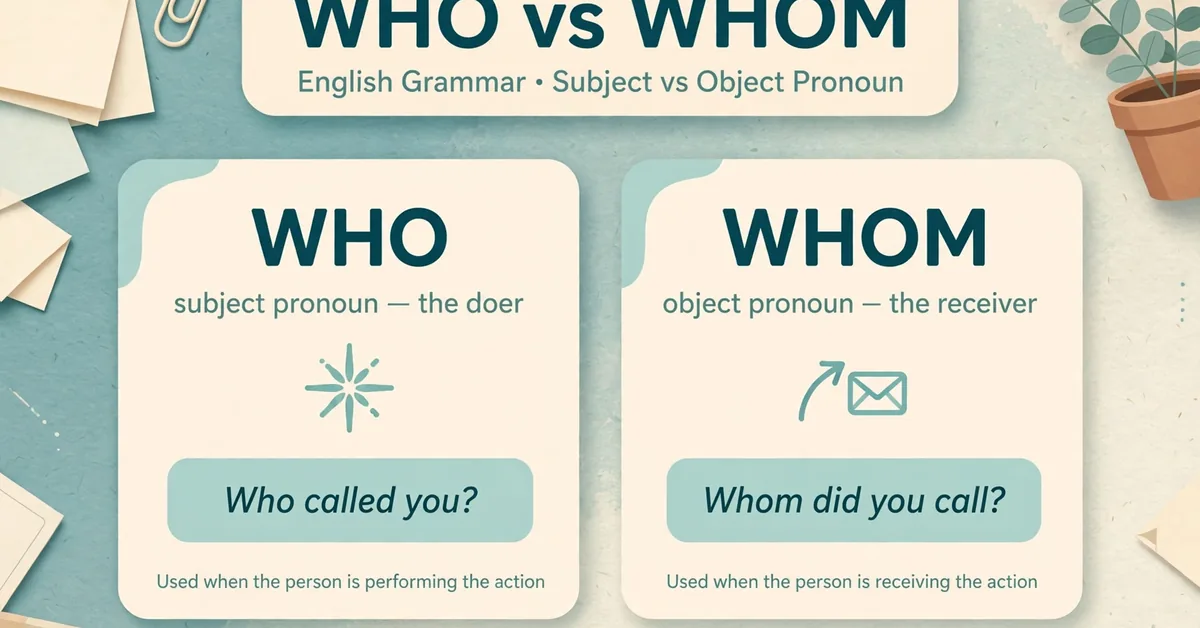
“Who” is a subject pronoun. In grammar terms, it refers to a person who performs the action of a verb or stands as the subject of a clause. Think of it as the doer — the one taking action, existing, or being described in the main part of the sentence.
Consider the question “Who called you this morning?” The unknown person is the one doing the calling, so “who” is correct. In the sentence “She is the manager who approved the budget,” the manager is the one who did the approving, so “who” fits again. You can group “who” mentally with other subject pronouns: I, he, she, we, and they. Just as you would say “He approved the budget” and never “Him approved the budget,” you say “who approved the budget.”
Who in Questions
When “who” opens a question and the unknown person is the actor, the choice is straightforward. “Who wants to lead the project?” asks for the person who will do the wanting and the leading. “Who broke the window?” asks for the person who did the breaking. “Who is coming to the dinner?” asks for the people who will do the coming. In all of these, “who” is the subject of the verb that follows it, and that is exactly where it belongs.
Who in Relative Clauses
A relative clause is a mini-sentence inside a larger one, usually introduced by who, whom, which, or that. When the pronoun is the subject inside that clause, use “who.” Take the sentence “The teacher who assigned the homework is on leave.” Inside the clause “who assigned the homework,” the teacher is the one doing the assigning — so “who” is right. Similarly, “People who arrive late will miss the opening remarks” works because the people are the ones doing the arriving. A common error is to assume that “whom” belongs here because the sentence sounds formal; it does not. Formality never changes the grammar — the pronoun’s job does.
Who After Linking Verbs
Linking verbs such as is, was, were, and seems connect a subject to a description rather than showing action. When the pronoun renames the subject, “who” is still the traditional choice in statements like “It is I who am responsible.” Here “who” refers back to “I,” the subject, so “who” stays. This construction is rare in modern speech, but you will still see it in legal documents, formal declarations, and classic literature. In casual conversation, people usually rephrase it entirely — “I’m the one responsible” — which neatly sidesteps the whole problem.
What “Whom” Means: The Object Pronoun
“Whom” is an object pronoun. It refers to a person who receives an action, is affected by a verb, or follows a preposition. If “who” is the doer, “whom” is the done-to. Mentally group it with the object pronouns: me, him, her, us, and them. Just as you say “She called him” and never “She called he,” you use “whom” where “him” would fit.
Whom as the Object of a Verb
In “Whom did you invite to the wedding?” the unknown person is the one being invited — the object of the verb “invite.” Reframe it as a statement: “You invited him,” not “You invited he.” Because “him” works, “whom” is correct. The same logic applies in “The candidate whom the panel interviewed was impressive”: inside the clause, the panel did the interviewing and the candidate received it, so “whom” belongs there.
Whom After a Preposition
This is the one place where “whom” is nearly always required in formal English: directly after a preposition such as to, for, with, by, or from. “To whom should I address the letter?” “With whom are you working on this?” “For whom is this package?” In each case, the pronoun is the object of the preposition, and “whom” is the correct form. Using “who” after a preposition — “To who should I address it?” — is the classic mistake that makes careful readers wince. If you remember nothing else, remember this: after a preposition, it is always “whom.”
Whom in Fixed Formal Phrases
Some phrases have frozen “whom” into place by tradition. The most famous is “To whom it may concern,” the classic salutation of formal letters. You will also meet “many of whom,” “some of whom,” and “all of whom” in academic and business writing: “The committee interviewed ten applicants, all of whom were qualified.” These are not stylistic flourishes — they follow the same preposition rule. “Of” is a preposition, so “whom” follows. Once you see the pattern, the frozen phrases stop looking mysterious.
The Difference Between Who and Whom
The core difference is grammatical case. “Who” marks the subject — the performer of an action or the topic being described. “Whom” marks the object — the receiver of an action or the target of a preposition. They never mean different things in the sense of different definitions; they refer to exactly the same kind of person. What changes is the role that person plays in the sentence’s machinery.
This is easier to feel than to memorize. Compare “Who wrote this report?” with “Whom did the manager praise?” In the first, the unknown person wrote something — they are the actor. In the second, the unknown person was praised by someone else — they are the receiver. English used to mark these roles on all its nouns, the way German still does today. The who/whom distinction is one of the last surviving traces of that old case system, which is why it feels fussy even though the underlying idea is simple. This shows the choice is not really about sounding formal — it is a mechanical rule about sentence structure, and that is why a simple test can solve it every time.
| Feature | Who | Whom |
|---|---|---|
| Grammatical role | Subject pronoun | Object pronoun |
| The “doer” test | The person performs the action | The person receives the action |
| Matches which personal pronoun | he, she, I, we, they | him, her, me, us, them |
| Used in questions like | “Who called?” → “He called” | “Whom did you call?” → “You called him” |
| Used in relative clauses | When the pronoun does the verb’s action | When the verb’s action lands on the pronoun |
| After a preposition | Never correct | Always correct in formal English |
| Tone | Neutral, works everywhere | Formal; often dropped in casual speech |
| Example | “The engineer who fixed it” | “The engineer whom I hired” |
Usage Examples Across Contexts
Everyday Conversation
In casual speech, “who” does almost all the work. “Who are you talking to?” “Who did you go with?” “Who should I ask?” Strictly speaking, the grammar calls for “whom” in these sentences, but no native speaker says “To whom are you talking?” at the dinner table — it would sound like a joke. This is normal and accepted. Conversation runs on speed and friendliness, and insisting on “whom” in small talk usually creates more friction than it avoids. The practical rule for everyday talk: use “who” freely and save “whom” for writing.
Work and Business Writing
Emails, reports, and client messages sit in the middle ground. Using “whom” correctly here signals attention to detail, and using it wrong signals the opposite — so this is the context where the rule pays off most. “Please send the summary to whoever needs it” is right (we will unpack “whoever” later). “Whom should I contact about the invoice?” is correct and professional. A soft opener helps too — for example, “I was wondering whom the right contact is for this invoice” keeps the question polite while the grammar stays right. In cover letters, phrases like “a position for which I am qualified” and “a manager with whom I worked” show polish without sounding stiff. One caution: if you are not sure, rephrase. “Who is the right contact for this?” beats a botched “whom” every time.
Formal and Academic Writing
In academic papers, legal documents, and published books, “whom” is still expected wherever the grammar requires it. Editors and examiners notice. “The participants, many of whom reported similar symptoms…” is standard in research writing. Test prompts often probe this directly: “To (who/whom) does the author attribute the discovery?” If you are writing a thesis, a grant proposal, or an exam essay, apply the rule fully and use the he/him test on every sentence that makes you pause.
Common Mistakes to Avoid
The single most common mistake is using “whom” in a relative clause where the pronoun is actually the subject: “Give the award to the student whom won the competition.” Inside the clause “whom won the competition,” the student did the winning, so it must be “who won the competition.” People make this error because they think “whom” sounds more educated. It does not — misplaced formality reads as the opposite of educated.
The mirror-image error is using “who” after a preposition: “With who did you travel?” or “To who should I reply?” In formal writing, this is always marked wrong. The fix is instant: preposition + whom, every time.
A third mistake involves front-loaded sentences where the pronoun looks like an object but is actually the subject of its own clause. “She interviewed several candidates who were highly recommended.” Many writers second-guess themselves and write “whom were highly recommended,” but “who” is correct because the candidates did the being-recommended (or simply because “they were recommended,” not “them were recommended”). The position of the word before or after the verb is what fools people — the rule cares about the pronoun’s own clause, not about how the whole sentence begins.
Finally, there is hypercorrection: sprinkling “whom” into places where even formal English would never put it, such as “Whom is responsible for this?” or “Whom wants coffee?” These are simply wrong in every register. If “he” fits (“He is responsible,” “He wants coffee”), then “who” is the answer.
Tricky Cases and Edge Cases
Whoever vs. Whomever
“Whoever” and “whomever” follow the same subject/object rule, but the trap is that you must test the pronoun’s own clause, not the main sentence. “Give the prize to whoever arrives first” confuses people because “to” sits right before it — but “whoever” is the subject of “arrives,” so “whoever” is correct despite the preposition. The test works beautifully here: “He arrives first,” not “Him arrives first.” Conversely, “Give the prize to whomever you choose” takes “whomever” because “you choose him,” not “you choose he.” Ignore the words around the clause; analyze what the pronoun does inside its own little verb group.
Whom in Questions vs. Relative Clauses
Questions often push the pronoun to the front, far from its verb, which makes analysis harder. “Whom will the committee appoint?” becomes clear when reordered: “The committee will appoint him.” Relative clauses hide the verb even deeper: “She is someone whom I have always admired” → “I have always admired her.” The trick for both is the same: strip the sentence down to its bare bones. Find the pronoun, find the verb it relates to, and ask whether the pronoun is doing or receiving. If you find yourself stuck, it is usually because you are analyzing the main clause instead of the one the pronoun actually lives in.
When “Whom” Is Dying Out vs. Still Required
Linguists are blunt about this: in everyday spoken English, “whom” is disappearing. Many younger speakers never use it at all, and some style guides for casual writing no longer insist on it. But “dying out” does not mean “dead.” “Whom” is still required in formal registers — academic writing, legal documents, standardized tests, and published journalism — and it survives permanently in fixed phrases like “to whom it may concern” and after prepositions in careful prose. The sensible approach is register-awareness, not a single blanket rule: speak naturally, but write correctly when the setting demands it.
The He/Him Substitution Trick
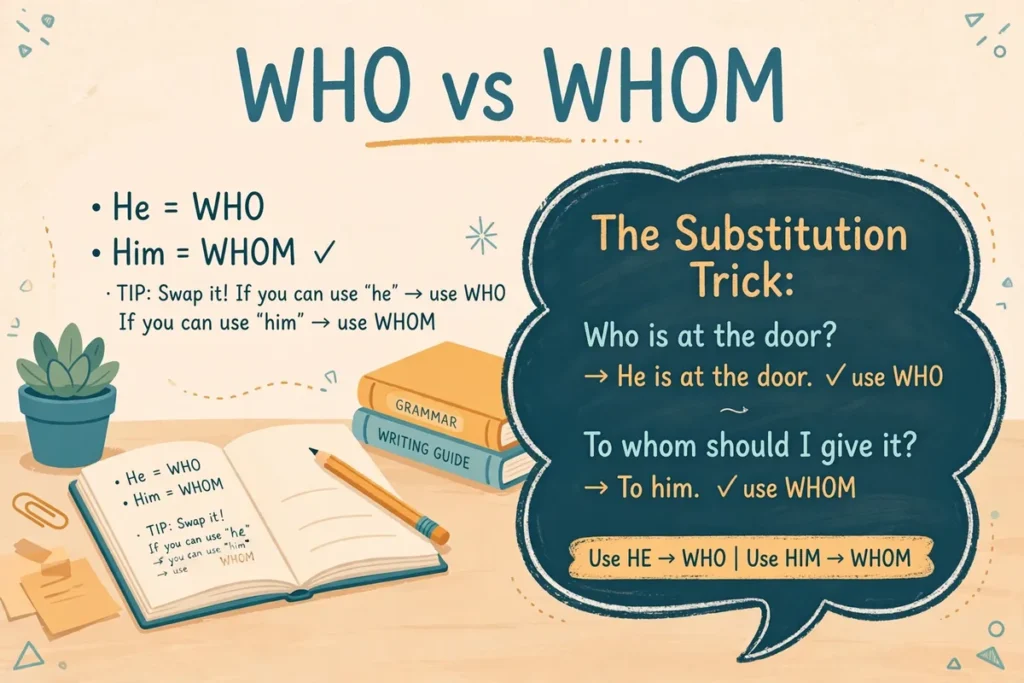
This is the one technique worth memorizing, because it turns a grammar puzzle into a two-second test. Step one: isolate the clause containing who/whom. Step two: replace the word with “he” or “him” (or she/her, they/them). Step three: pick the pronoun that sounds natural. If “he” fits, use “who.” If “him” fits, use “whom.” Test it: “The consultant (who/whom) the board hired” → “The board hired him” → whom. “The consultant (who/whom) impressed the board” → “He impressed the board” → who. It works on questions, relative clauses, and whoever/whomever alike — the trick never breaks because it is just the subject/object rule wearing a friendlier disguise.
Who vs. Whom With Phrases Like “One of the”
“She is one of the managers who approve expenses” takes “who,” and the reason hides in the full clause: “the managers who approve expenses” — the managers do the approving. But watch the plural trap: “She is the only one of the managers who approves expenses.” Now “who” refers to “one,” which is singular, so the verb takes an “s.” This is not really a who/whom issue — both sentences use “who” — but it is the relative-clause territory where these words live, and subject-verb agreement gets decided by the same clause analysis. Once you are comfortable finding the pronoun’s clause for the who/whom test, agreement questions in the same spot get easier too.
FAQs
Is it ever wrong to use “who” instead of “whom”?
In formal writing, yes. Using “who” where the grammar requires “whom” — especially after a preposition, as in “To who it may concern” — is considered an error in academic, legal, and professional contexts, and it will be marked wrong on exams. In casual conversation, however, “who” has effectively replaced “whom” for most speakers, and nobody will notice or care. The mistake is register-dependent: know your audience before you decide how strict to be.
What is the easiest way to remember the difference between who and whom?
Use the he/him test. Rewrite the clause with “he” or “him” in place of who/whom. If “he” sounds right, use “who”; if “him” sounds right, use “whom.” “Who wrote this?” becomes “He wrote this,” so “who” wins. “For whom is this?” becomes “For him,” so “whom” wins. It takes a few seconds, it works in questions and relative clauses alike, and it is far more reliable than guessing based on how formal the sentence sounds.
Should I use “whom” in everyday conversation?
Usually not. In everyday speech, “whom” can sound stiff or even affected — “Whom did you see at the party?” draws more attention to itself than the question it is asking. Most native speakers default to “who” in conversation regardless of the grammar, and that is accepted. Save “whom” for writing: emails, applications, reports, and anything formal where correctness is being judged.
Is “whom” becoming obsolete?
In casual spoken English, it is well on its way out, and some linguists expect it to vanish from speech entirely within a generation or two. But on the other hand, in formal written English it remains firmly alive: academic style guides, legal documents, standardized tests, and careful journalism all still require it where the grammar calls for it. Think of it less as a dying word and more as a formal-register word — disappearing from the dinner table, permanent in the boardroom and the examination hall.
Which is correct: “whoever” or “whomever” in “give it to whoever asks”?
“Whoever” is correct there. The rule looks only at the pronoun’s own clause: inside “whoever asks,” the pronoun is the subject of “asks” (“he asks,” not “him asks”), so it stays “whoever” even though it follows the preposition “to.” The preposition belongs to the main clause; the pronoun’s job is decided inside its own. Flip it around for “give it to whomever you prefer,” because inside that clause “you prefer him” fits — the pronoun is the object.
Conclusion
“Who” and “whom” look like a relic of fussy grammar, but underneath the old-fashioned surface is a simple, mechanical rule: “who” marks the doer, “whom” marks the receiver. Once you pair each word with its matching personal pronoun — who with he, whom with him — the choice becomes a quick test rather than a leap of faith, and it works in questions, relative clauses, and the whoever/whomever trap alike.
The final skill is knowing when to apply the rule and when to relax. Keep “whom” in your formal writing, where it still carries weight, and let “who” do the heavy lifting in conversation, where nobody misses the distinction. Grammar serves communication, not the other way around — master the mechanism, then spend it wisely.
Keep sharpening your word choices: if you ever hesitate between the two spellings, our guide to acknowledgement or acknowledgment clears it up in seconds.
Another classic mix-up worth fixing is affects or effects — our guide gives you a quick test to keep them straight in your writing.
For crisper professional writing, learn the difference between aid or aide before your next report or email.
And if you write for an international audience, our guide to aluminum or aluminium shows which spelling fits where.