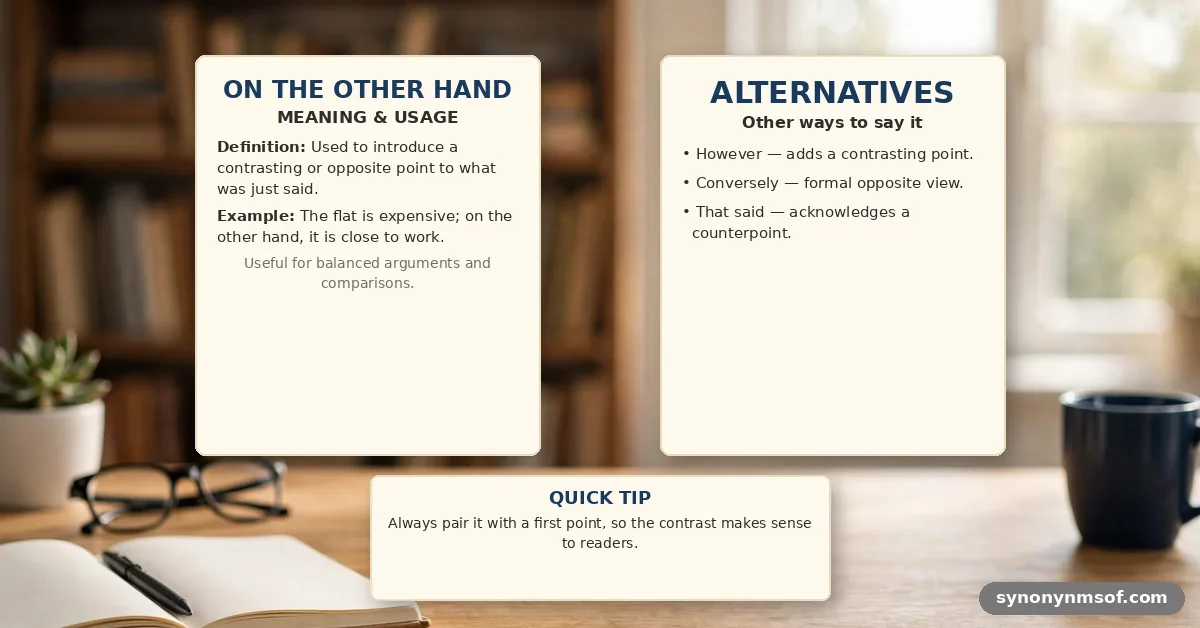

When you use the phrase on the other hand, you are signaling a shift in perspective. It functions as a bridge between two contrasting ideas, allowing you to present a balanced view of a situation.
Whether you are writing an academic essay or speaking in a casual setting, mastering this transition helps you organize your thoughts effectively. You will learn how to deploy this phrase with precision, avoid common pitfalls, and discover stylistic alternatives that keep your writing fresh and engaging.
Defining the Phrase
At its core, the phrase functions as a transitional signal. It tells the reader that a counterpoint or an alternative perspective is coming.
Think of it as a mental pivot. You establish one side of an argument, pause, and then offer a different angle.
Grammatically, this expression is a conjunctive phrase. It requires a specific setup to work correctly.
You typically introduce the first point using a lead-in such as “on the one hand.” This creates a parallel structure that guides the reader through your logic.
Without the initial “on the one hand,” the phrase can still function, but it may lose some of its rhetorical impact. It remains a powerful tool for showing complexity. Using it correctly demonstrates that you have considered multiple facets of a topic before reaching a conclusion.
The Importance of Context
Context dictates whether this phrase is the right choice for your sentence. It is best suited for formal or semi-formal writing where you need to weigh pros and cons. In very casual conversation, it can sometimes sound stiff or overly academic.
Consider the nature of your argument. If you are presenting two facts that are merely different rather than contradictory, a different transition might serve you better. You want to use this phrase when the second point genuinely challenges or complicates the first.
When to avoid it
Avoid using this transition when you are listing simple, non-conflicting items. If you are describing a shopping list, “on the other hand” would be confusing and unnecessary. Reserve it for moments where you are contrasting ideas, opinions, or data points.
Overusing it can also make your writing feel repetitive. If every paragraph or sentence relies on the same transition, your style will suffer. Mix your transitions to keep the reader engaged and the flow natural.
Examples in Practice
Seeing the phrase in action is the fastest way to understand its rhythm. It works best when the two clauses it connects are balanced in length and tone. Here is how it looks in a few common scenarios.
- Professional setting: The team wanted to launch the project early to beat the competition; on the other hand, the quality assurance department insisted on more testing.
- Academic writing: Solar power offers a clean alternative to fossil fuels; on the other hand, the initial installation costs remain prohibitive for many homeowners.
- Personal decision: I love the convenience of living in the city center; on the other hand, I miss the quiet and space of the countryside.
- Debate context: The policy will likely increase tax revenue in the short term; on the other hand, it may discourage long-term foreign investment.
Comparing Transitions
Choosing the right connector depends on the relationship between your ideas. While some people use these terms interchangeably, they often carry different nuances. You can consult a trusted dictionary to verify subtle differences in usage.
| Transition | Primary Function | Best Usage Case |
|---|---|---|
| On the other hand | Contrast/Balance | Weighing two sides of a complex issue. |
| Conversely | Direct Opposition | When the second point is the exact opposite of the first. |
| However | Refutation | When the second point negates or limits the first. |
| Nevertheless | Concession | When you admit a point but maintain your original stance. |
Common Grammatical Pitfalls
One frequent error is failing to use a semicolon or a period before the phrase. Because it is a transition, it links two independent clauses. If you write a sentence like “I like coffee, on the other hand I hate tea,” you have created a comma splice.
Always use a semicolon to join the two related thoughts. Alternatively, you can end the first sentence and start a new one, beginning with the phrase. Proper punctuation makes your writing look professional and ensures the reader understands the logical break.
Another issue is the “dangling” usage. This occurs when you start a sentence with the phrase but fail to provide a clear counterpoint.
If you say “On the other hand, the weather is nice today,” it leaves the reader wondering what the first hand was. Always ensure you have established the first perspective clearly.
Expanding Your Vocabulary
Relying solely on one phrase can make your prose feel stale. If you find yourself using this expression too often, look for synonyms that fit the tone of your work. The right choice depends on how much distance you want to put between the two ideas.
Effective alternatives
- Alternatively: Best for offering a second choice or path.
- In contrast: Ideal for highlighting stark differences between two subjects.
- By comparison: Useful when looking at data side-by-side.
- Then again: A more conversational way to introduce a second thought.
Using a thesaurus is a great way to find the perfect word for your specific context. Just be sure to check the definition of any new word you choose. Words that seem identical often have different shades of meaning in practice.
The Role of Tone and Style
Your tone plays a significant role in how your readers interpret your arguments. Using “on the other hand” suggests a calm, analytical approach. It signals that you are not rushing to judgment but are instead considering the full picture.
In creative writing, you might prefer more descriptive transitions. However, in technical or analytical writing, clarity is king. This phrase is a workhorse of professional communication because it is widely understood and rarely misinterpreted.
Always consider your audience. If you are writing for a general audience, keep your sentences simple and direct. If you are writing for experts, you can use more complex structures and longer, more nuanced sentences that incorporate these transitions comfortably.
Practical Applications in Writing
To improve your use of these transitions, try outlining your arguments before you begin writing. List your main points on one side and their counterpoints on the other. This helps you see where the transition will be most effective.
Practice reading your work aloud. If a sentence feels clunky or the transition seems forced, try rephrasing it. You might find that moving the phrase to the middle of the sentence or choosing a different connector entirely makes the flow much smoother.
Consistency is key to developing a strong writing style. As you incorporate these transitions into your daily work, they will become second nature. You will find yourself naturally balancing your arguments, which makes your writing more persuasive and authoritative.
FAQ
Is it ever correct to use “in the other hand”?
No, “in the other hand” is almost always incorrect when used as a transition. It is a literal description of holding something in your hand, not a figure of speech for contrasting ideas. Always use the preposition “on” for the idiomatic phrase.
Can I start a sentence with this phrase?
Yes, you can start a sentence with it, provided you have already established the first side of the argument in the previous sentence. It is a very common way to begin a paragraph that introduces a counter-argument.
Do I always need a comma after the phrase?
Yes, you should always place a comma after the phrase when it is used as an introductory transition. This helps the reader pause at the right moment and separates the transition from the main point of the sentence.
Is this phrase too formal for email?
It depends on the email. It is perfectly acceptable in professional correspondence where you are presenting a balanced view to a manager or client. In a quick note to a friend, it might sound a bit too stiff, and you might prefer “then again” instead.
Conclusion
Mastering the use of on the other hand is a simple yet powerful way to improve your writing. By signaling shifts in perspective, you help your reader follow your logic and appreciate the depth of your analysis. Remember that the best transitions are those that feel natural and serve the clarity of your message rather than obscuring it.
As you continue to refine your craft, pay attention to how you balance your points. Practice using a variety of connectors to see which ones best suit your voice and the specific needs of your audience.
Whether you are writing a formal report or a casual note, these small adjustments will make your communication more effective. Start experimenting with these techniques today to see how they change the way you present your ideas to the world.