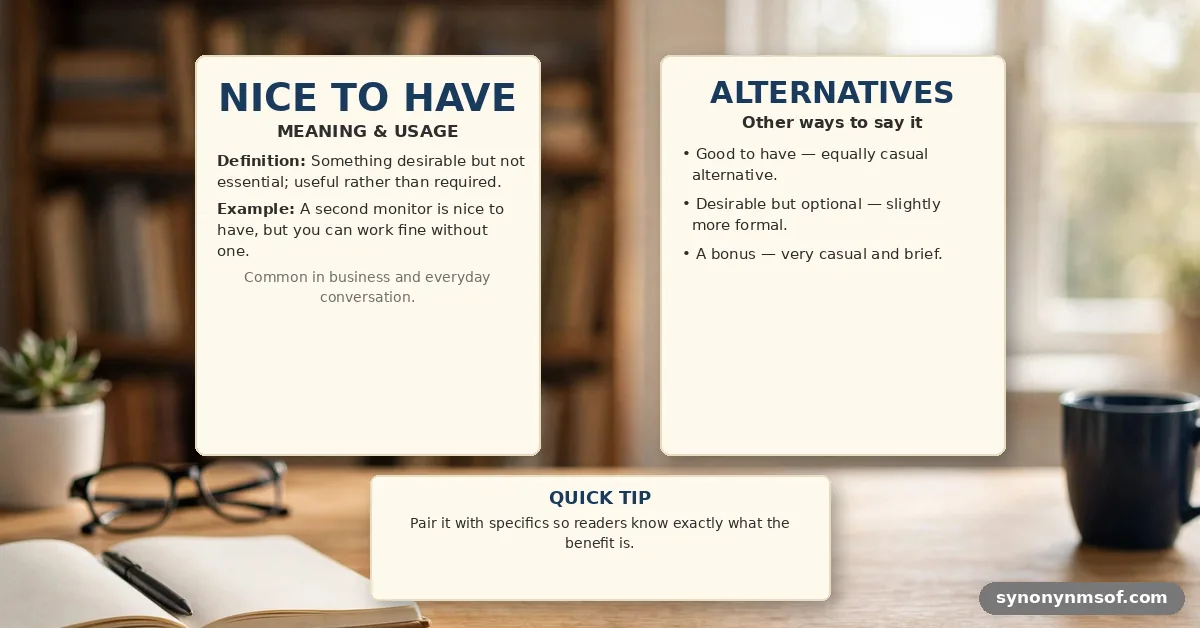

A feature, skill, or item described as a nice to have is something that adds value but isn’t strictly necessary for success. You’ll hear this term frequently in project management, hiring, and product development to distinguish between essential requirements and secondary benefits.
Understanding the distinction between what is mandatory and what is simply a bonus helps you prioritize your time and resources effectively. This article clarifies the nuance of the term so you can apply it with precision in both professional and casual contexts.
Defining the Term
At its core, the phrase refers to an attribute that is desirable but not critical to the primary objective. If you remove a nice-to-have element, the core function of the project or the viability of the hire remains intact. It is the difference between a car that drives and a car that includes a premium sound system.
The term is widely used in English to manage expectations. When a stakeholder labels a request as such, they are signaling that the item should be pursued only after all mandatory goals are met. It acts as a filter for decision-making, ensuring that limited resources aren’t squandered on non-essential tasks.
Usage in Professional Settings
In business, the distinction between requirements and preferences is vital. Project managers often use the MoSCoW method, which stands for Must have, Should have, Could have, and Won’t have. In this framework, items in the “Could have” category align directly with the definition of a nice-to-have feature.
Product Development
When building software, developers often face scope creep. They might want to add a chat function to an app, but if the core database isn’t stable, the chat is merely a luxury. By categorizing the chat as a bonus, the team keeps the development timeline focused on the essential architecture.
Hiring and Recruitment
Recruiters frequently list qualifications as either mandatory or preferred. A candidate might be required to have a degree, while experience with a specific niche software might be a nice-to-have skill. This helps applicants understand which criteria are deal-breakers and which are simply points in their favor.
Common Examples
To see how the term functions in practice, consider these common scenarios across different fields. Each example demonstrates how a secondary feature enhances a result without being the foundation of it.
- Office Perks: A high-quality coffee machine is a nice-to-have office asset, while a functional internet connection is a must-have.
- Job Requirements: Fluency in a second language is often a bonus for a domestic sales role, though not essential for closing local deals.
- Software Features: Dark mode is a popular interface preference, but the ability to save data is a core functional requirement.
- Home Buying: A walk-in closet is a desirable luxury, while a solid foundation and roof are non-negotiable structural requirements.
The Hierarchy of Needs
Distinguishing between what is essential and what is a bonus requires an understanding of your ultimate goal. If you focus too heavily on secondary items, you risk missing deadlines or overspending. The best way to evaluate these items is to measure them against the “core failure” test.
If you remove the item, does the project fail? If the answer is no, you are looking at a nice-to-have element.
If the answer is yes, that item is a hard requirement. This mental model prevents you from getting distracted by bells and whistles when the foundation is still shaking.
Comparing Requirements and Bonuses
When evaluating tasks, it helps to create a simple table to keep your priorities aligned. This prevents the common trap of treating every request as an emergency.
| Category | Essential (Must-Have) | Bonus (Nice-to-Have) |
|---|---|---|
| Software | Security encryption | Custom color themes |
| Hiring | Relevant degree | Prior volunteer work |
| Project | Budget compliance | Fancy presentation slides |
| Travel | Valid passport | First-class lounge access |
Psychological Impact
The term carries a specific psychological weight in negotiations. When you tell a client that a feature is a nice-to-have addition, you are setting a boundary. This manages their expectations so they aren’t disappointed if the item is dropped during the final phase.
Conversely, framing an item as a bonus can actually make it more attractive. When people know something is not required, they often view it as an unexpected delight. It turns a standard delivery into a high-value experience without the pressure of a contractual obligation.
Formal vs. Informal Language
While the term is common in business, you should know when to use it versus more formal alternatives. In a casual team meeting, saying “this is a nice to have” is perfectly acceptable and clear. In a formal contract or a legal document, however, you might want more precise language.
Formal Alternatives

If you need to be more professional in a document, consider using terms like “desirable,” “supplementary,” or “non-essential.” These words convey the same meaning but carry more weight in a legal or high-stakes environment. You can find more information on standard business terminology through the Merriam-Webster dictionary site.
When to Avoid the Term
Avoid using this phrase if you are trying to minimize the importance of a task that is actually critical. If you tell a boss that a mandatory security patch is just a nice-to-have item, you are misrepresenting the situation. Always ensure your labels match the actual impact of the task.
Common Pitfalls
One major mistake is letting these items become “must-haves” through procrastination. If you keep pushing a bonus item to the end of the list, you might eventually feel pressured to include it regardless of the cost. This is known as scope creep.
Another pitfall is assuming that everyone on your team defines “nice” the same way. What one stakeholder considers a minor bonus, another might consider a critical competitive advantage. Always clarify the priority of these items early in the process to avoid conflict later.
FAQ
Is it okay to use this term in a cover letter?
It is generally better to focus on your core skills rather than labeling them as bonuses. If you want to highlight a skill that isn’t required, frame it as an additional value-add rather than using the phrase nice-to-have.
How do I tell a client their request is not a priority?
Be transparent about the project scope. Explain that while their request is a nice-to-have feature, your current focus is on the essential deliverables to ensure a timely launch.
Are nice-to-have items ever bad?
They aren’t inherently bad, but they become problematic when they distract from critical work. If you find your team spending more time on bonuses than on core functions, it is time to recalibrate your focus.
Can I use this term in a formal contract?
Avoid it in legal agreements. Use specific language like “optional features” or “supplementary services” to ensure there is no ambiguity regarding what is included in the base price and what is not.
Conclusion
Distinguishing between what is essential and what is a nice to have is a fundamental skill for anyone managing projects or personal goals. By clearly categorizing your tasks, you ensure that your energy goes toward the items that truly move the needle. Remember that a bonus is meant to enhance, not replace, the core components of your work.
As you move forward, keep this distinction in mind when setting your own goals or negotiating with others. Prioritizing correctly allows you to deliver high-quality results while avoiding the trap of over-committing to non-essential features.
Whether you are building a product or managing a team, identifying these secondary items early will save you time and help you maintain a high standard of performance. Feel free to apply this framework to your next project and watch how much more efficiently you achieve your goals.