
When you send a message saying thank you for taking care of this, you are doing more than just acknowledging a completed task. You are reinforcing a professional relationship and validating the effort someone else put in to solve a problem or manage a project. Whether you are addressing a colleague, a service provider, or a project manager, choosing the right words helps cement your reputation as someone who values collaboration.
This article explores how to craft the perfect acknowledgment for various workplace scenarios. You will learn how to balance gratitude with brevity, ensuring your message remains professional while still sounding sincere. By understanding the nuances of your delivery, you can ensure that your appreciation is felt and remembered.
Understanding the Impact of Sincere Gratitude
Gratitude in a professional setting is a powerful tool for building social capital. When you express that you appreciate the support someone provided, you shift the dynamic from a purely transactional exchange to a partnership. People are far more likely to go above and beyond for someone who acknowledges their hard work.
The phrase thank you for taking care of this serves as a signal that the matter is officially closed. It provides peace of mind to the recipient, confirming that they no longer need to worry about the task. This closure is essential for maintaining momentum in fast-paced environments where projects often overlap.
Why Specificity Matters

Generic thanks often feel hollow, especially when the task was complex or time-consuming. Instead of just saying thanks, try to mention the specific aspect of the work that helped you the most. For example, noting that you appreciate the speed of their response or the thoroughness of their documentation shows that you were paying attention to their effort.
Specificity also helps the recipient understand what they did right. When you point out a specific win, they are more likely to replicate that behavior in the future. This positive reinforcement creates a feedback loop that benefits your entire team.
Choosing the Right Tone for Your Message
The tone of your message depends heavily on your existing relationship with the person. A message to a close teammate can be informal and light, while a message to a client or senior executive requires a more formal structure. You should always aim to match the intensity of the effort provided.
If someone spent their weekend resolving a critical issue, a short, casual message might feel dismissive. In these cases, it is better to be slightly more verbose to show that you recognize the sacrifice of their time. Conversely, for a quick administrative fix, a simple, punchy acknowledgment is perfectly acceptable and often preferred.
Adapting to Different Channels
Communication tools dictate the brevity and style of your gratitude. Email allows for more context and a formal sign-off, while instant messaging platforms like Slack or Microsoft Teams call for immediate, concise reactions. You can find more information on effective communication styles through the Harvard Business Review guide on professional correspondence.
Consider the following table for choosing your tone based on the platform and the recipient:
| Recipient | Best Platform | Recommended Tone |
|---|---|---|
| Direct Manager | Professional & Concise | |
| Close Colleague | Slack/Teams | Casual & Friendly |
| External Client | Formal & Polished | |
| IT/Support Staff | Ticket System | Direct & Appreciative |
When to Send Your Acknowledgment
Timing is everything when you want to show that you are truly grateful. The best time to send a message is shortly after the task is completed or the problem is resolved. Sending it immediately reinforces the positive outcome while the effort is still fresh in the recipient’s mind.
If you wait too long, the message can feel like an afterthought. Even if you are busy, a quick note takes only a few seconds to write and send. If you missed the window, it is still better to send a late message than to say nothing at all.
Handling Delays
Sometimes, we forget to send a note of thanks in the middle of a hectic work week. If you are catching up on old tasks, it is perfectly fine to send a brief follow-up. You might say, “I know this was completed a few days ago, but I wanted to make sure you knew how much I appreciate the help.”
Honesty about the delay is often appreciated. It shows that you are self-aware and that you genuinely value the contribution despite the lapse in time. Do not over-apologize, as the primary focus should remain on the gratitude, not the timing.
Variations of the Phrase
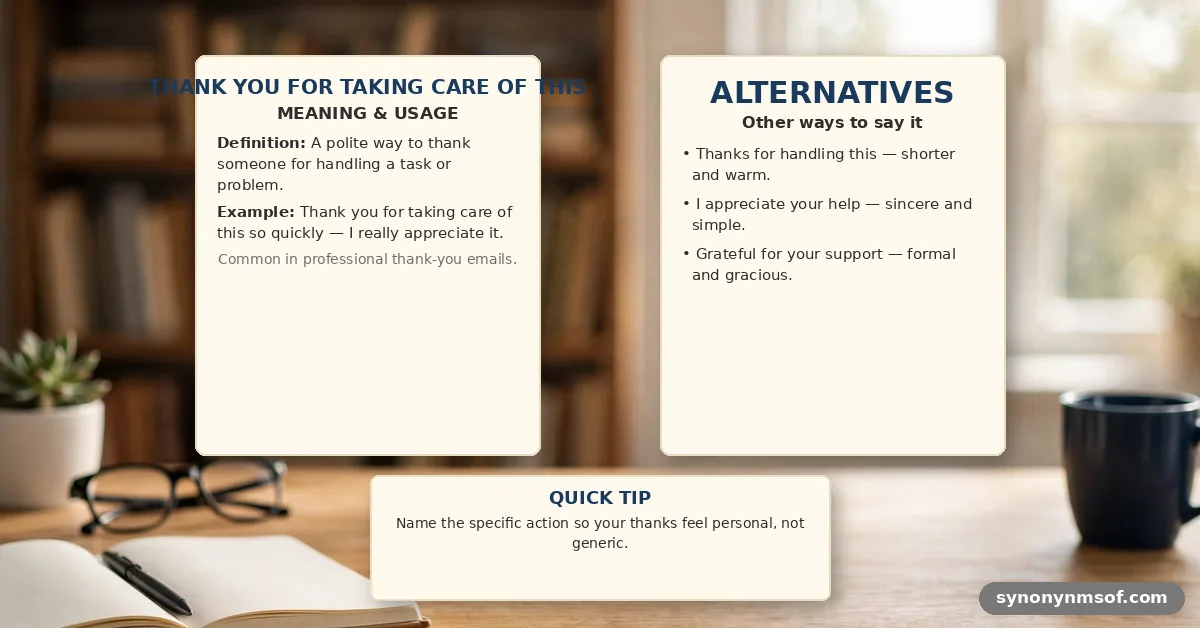
You do not always have to stick to the exact same phrasing. Depending on the context, you might want to vary your language to keep your communications feeling fresh and authentic. Here are several ways to express that you are thankful for someone’s assistance:
- I am very grateful for your support on this matter.
- Thanks for handling this so efficiently; it saved me a lot of time.
- I really appreciate you stepping in to resolve this issue.
- Thank you for your help in getting this across the finish line.
- Your assistance with this was invaluable.
Each of these options carries a slightly different emotional weight. Choose the one that feels most natural for your voice. When you use a variety of expressions, your appreciation feels more personal and less like a scripted response.
Professionalism vs. Personal Connection
Striking the right balance between being professional and showing personality is key to long-term success. You want to be viewed as a reliable colleague, but also as a human being who values others. Using language that is too stiff can create distance, while being overly familiar can sometimes be misread.
Think about the person you are messaging. Have you worked with them for years, or is this a one-time interaction?
If you have a long history, you can afford to be warmer. If this is a new contact, keep the focus on the task and the support provided.
The Role of Empathy

Empathy is the core of effective communication. When you acknowledge that someone took care of a difficult task, you are empathizing with the energy they spent on it.
This simple act of recognition builds trust. Trust is the foundation of every high-performing team.
Always consider the burden you might have placed on the other person. If the task was urgent or interrupted their workflow, acknowledge that sacrifice. A little bit of empathy goes a long way in maintaining a good working relationship over the long term.
Common Pitfalls to Avoid
One common mistake is using a thank you message as a way to slide in another request. If you say, “Thanks for fixing this, but could you also do X?” you immediately negate the sincerity of the gratitude. Keep your thank you messages focused solely on the appreciation for the completed work.
Another pitfall is being too vague. “Thanks for everything” is often too broad to be meaningful.
If you want your message to have an impact, ensure the recipient knows exactly what they are being thanked for. This clarity prevents any confusion about what task was actually resolved.
Overusing Gratitude
While expressing gratitude is generally positive, you should avoid thanking people for things that are clearly part of their job description every single time. If you thank someone for their basic daily duties, the message can lose its impact. Save your deepest expressions of gratitude for when someone goes above and beyond or handles a particularly difficult challenge.
This does not mean you should be cold. It just means you should be intentional. When you reserve your praise for significant efforts, your words carry more weight and are more appreciated by the recipient.
The Long-Term Benefits of Acknowledgment
Consistently thanking your peers and employees creates a culture of appreciation. People who feel valued are more engaged and productive.
Over time, this culture becomes a competitive advantage for your team or organization. It helps retain talent and fosters a collaborative spirit that is hard to replicate elsewhere.
Furthermore, when you are in the habit of saying thank you for taking care of this, you become known as a person who notices and values others’ work. This reputation makes people more eager to collaborate with you on future projects. You essentially create a positive feedback loop that makes your own work life easier and more enjoyable.
Building Your Personal Brand
Your communication style is a major part of your personal brand. By being someone who is consistently grateful and clear in your feedback, you establish yourself as a leader who respects their team. This is a subtle but effective way to improve your professional standing without needing to shout about your accomplishments.
People want to work with those who make them feel seen. By taking the time to send a quick note, you are investing in your own career. It is one of the easiest, yet most overlooked, ways to stand out in a crowded workplace.
FAQ
How do I thank someone for taking care of a task I forgot to do?
In this situation, you should own your mistake while expressing genuine relief and gratitude. Be direct: “I apologize that I missed this, and I am so grateful you stepped in to take care of it for me.” This shows accountability and sincerity without making the situation awkward.
Is it better to thank someone over email or in person?
If possible, a face-to-face thank you is the most powerful because it includes body language and tone. However, email or chat is perfectly fine for most business tasks. If the favor was particularly large, a quick in-person mention combined with a follow-up email is a great way to ensure the message is received and documented.
What if I don’t know the person very well?
Keep your message professional and brief. A simple, “Thank you for taking care of this; I really appreciate your help,” is sufficient. You don’t need to add personal anecdotes or excessive praise if you haven’t established that level of rapport yet.
Should I thank someone for doing their job?
Yes, but do it strategically. While you don’t need to send a thank you note for every single routine email they answer, acknowledging high-quality work or a fast turnaround time encourages that level of performance to continue. It reinforces the standards you value in your professional environment.
Final Thoughts
Mastering the art of saying thank you for taking care of this is a small adjustment that leads to significant professional dividends. By being specific, timely, and intentional with your words, you build stronger relationships and create a more positive work environment. You show that you respect the time and expertise of others, which in turn earns you their respect and support.
Next time you find yourself at the end of a project or a difficult task, take a moment to send a quick note. It doesn’t need to be long or complex to have an impact.
The simple act of acknowledging someone’s effort is often the best way to keep your team motivated and aligned. Start incorporating these habits into your daily routine and observe how your professional interactions begin to change for the better.