
When you encounter the phrase stay tuned, you are usually being asked to maintain your attention for upcoming information. It serves as a bridge between a current moment of engagement and a future reveal, signaling that more content is on the horizon. Understanding this expression helps you communicate effectively in both casual conversations and professional settings.
Whether you are managing a marketing campaign or simply wrapping up a phone call, knowing how to use this phrase correctly keeps your audience interested. By learning the nuances of its application, you can ensure your message lands with the right level of anticipation and clarity. This article explores the origins, proper grammar, and various scenarios where you might employ this common expression.
The Core Meaning and Origin

At its simplest level, the expression refers to the physical act of adjusting a radio or television receiver to a specific frequency. In the early days of broadcast media, listeners had to manually turn a dial—or tune the device—to catch a program. If a broadcast was interrupted or if a show was about to begin, the announcer would instruct the audience to keep their equipment set to that station.
Over time, the phrase evolved into a metaphorical directive. It no longer requires a physical dial or a vacuum tube receiver to function.
Instead, it acts as a social cue that promises a future development or a follow-up announcement. According to the Merriam-Webster dictionary, the term has solidified its place in the English language as a way to request patience and continued interest.
The transition from a technical instruction to a conversational staple reflects how technology shapes our vocabulary. We often use words derived from obsolete hardware long after the devices themselves disappear. By telling someone to stay tuned, you are effectively asking them to keep their metaphorical receiver pointed in your direction.
Grammar and Common Mistakes
One of the most frequent errors people make involves the spelling of the word itself. Many writers mistakenly use “stay tune” instead of the correct past participle form, “stay tuned.” Because “tuned” functions as an adjective describing the state of the listener’s attention, the ‘d’ is essential for grammatical accuracy.
Another point of confusion is the preposition that follows the phrase. Should you say “stay tuned to” or “stay tuned for”? The distinction often depends on whether you are referencing a medium or a specific piece of information.
- Use “stay tuned to” when referring to a specific channel, station, or platform (e.g., “Stay tuned to this channel for more news”).
- Use “stay tuned for” when referring to the content or the event that is coming next (e.g., “Stay tuned for the grand reveal”).
- Avoid using the phrase without a preposition if the context requires a direct object, as it can sound incomplete.
Professional Use Cases
In a business environment, the tone of your communication matters significantly. Using the phrase correctly can help maintain momentum without sounding overly informal or demanding. It is particularly effective in emails and project updates where you want to keep stakeholders engaged without providing every detail at once.
When you are working on a long-term project, you might not have all the answers immediately. Instead of ignoring a query, you can acknowledge it and provide a timeline for when the information will be ready. This manages expectations while keeping the line of communication open.
| Scenario | Recommended Phrasing | Tone |
|---|---|---|
| Project Update | “We are finalizing the budget; please stay tuned for the report.” | Professional |
| Marketing Launch | “Stay tuned for an exciting announcement arriving next week.” | Exciting |
| Customer Support | “We are investigating the issue; stay tuned for further updates.” | Reassuring |
Building Anticipation in Marketing
Marketing professionals often rely on this phrase to create a sense of mystery. By hinting at a product launch or a service upgrade, companies can build buzz before the actual event occurs. This strategy is a cornerstone of drip-feed content, where information is released in small, digestible chunks.
The best use of this tactic involves pairing the phrase with a specific call to action. Simply telling someone to wait is rarely enough to ensure they return. You need to provide a reason for them to keep checking back, such as a discount code, an exclusive preview, or a solution to a specific pain point.
If you overuse the phrase, however, you risk desensitizing your audience. If every email you send promises that something is “coming soon,” your readers will eventually stop paying attention. Use it sparingly to ensure that when you do use it, the promise of a future update carries weight.
Alternatives for Variety
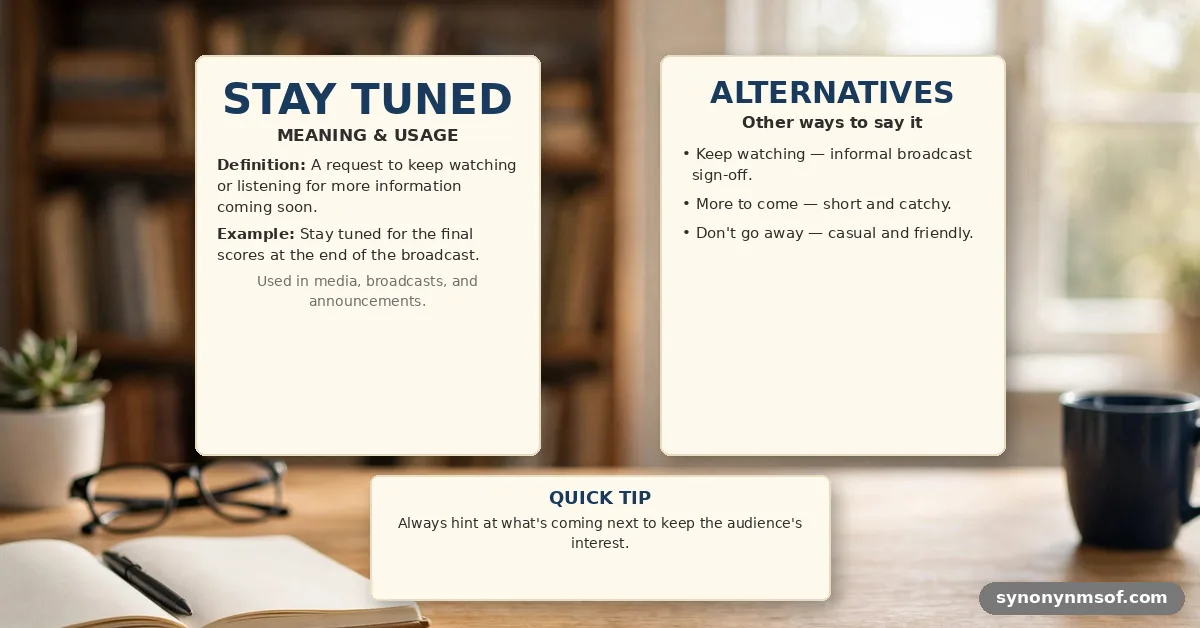
While the phrase is widely recognized, you might occasionally want to vary your vocabulary to keep your writing fresh. Depending on the context, there are several ways to express the same sentiment without repeating the exact same words. Each alternative carries a slightly different shade of meaning.
Professional Alternatives
In formal reports or executive communication, you might prefer phrases that sound more action-oriented. “We will provide further updates as they become available” is a classic, safe choice. It sounds authoritative and removes the conversational tone of the original expression.
Casual Alternatives
If you are messaging a colleague or writing a social media post, you can afford to be more relaxed. Phrases like “Keep an eye out for more” or “More to come shortly” work well. These options imply the same urgency while sounding more like natural human speech.
The Psychology of the Wait
Why do we respond so well to being told to wait? The phrase taps into the psychological principle of the “open loop.” Humans have a natural tendency to want to close loops—to finish a story, solve a puzzle, or get the final answer to a question.
When you tell an audience to stay tuned, you are intentionally leaving a loop open. This creates a state of mild cognitive tension that can only be resolved by getting the information you promised. Effectively, you are using the listener’s own brain chemistry to ensure they return to your content later.
This is why the phrase is so powerful in storytelling. If a cliffhanger is presented with the instruction to wait for the next installment, the audience is much more likely to remember the brand or the story. It turns a passive consumer into an active participant in the narrative you are building.
Common Pitfalls and How to Avoid Them
One major pitfall is failing to deliver on the promise. If you tell an audience to stay tuned for a major update and then go silent for months, you damage your credibility. The phrase is a contract; it implies that the wait will be worth the effort.
Another issue is timing. If the update is not actually coming “soon,” the phrase feels disingenuous.
Always ensure that your timeline matches the expectations you set. If the wait is going to be long, it is better to be transparent about that duration rather than relying on a vague promise of future content.
Finally, consider the medium. A phrase that works perfectly on a podcast or a live broadcast might feel out of place in a formal white paper. Match your language to the platform to ensure you are hitting the right note with your readers or listeners.
Frequently Asked Questions
Is it ever correct to say stay tune?
No, “stay tune” is grammatically incorrect. You should always use the past participle “tuned” because it functions as an adjective describing the state of your attention.
What is the most professional way to say stay tuned?
If you want to sound more formal, try saying “We will provide further updates as they become available” or “Please watch for additional information regarding this matter.”
Can I use this phrase in a formal email?
Yes, you can use it in a professional email, provided the tone is appropriate for your relationship with the recipient. It is best used when you are proactively managing expectations about a future deliverable.
What should I do if I cannot provide an update soon?
If you cannot provide an update quickly, avoid the phrase altogether. Instead, state clearly that you will reach out once you have more information, which manages expectations more effectively.
Summary of Key Concepts
Mastering the use of stay tuned allows you to bridge the gap between current interactions and future results effectively. By understanding its origins, correcting common grammatical errors, and knowing when to use professional alternatives, you can keep your audience engaged without appearing repetitive. Remember that the phrase is a promise of value; ensure that what you deliver eventually meets the anticipation you have built.
To improve your communication, start by identifying the specific scenarios where you need to manage expectations. Whether you are launching a new product or simply keeping a team informed, use the phrase to maintain interest. If you practice using it with purpose and precision, you will find that your audience is much more likely to wait for what you have to say next.