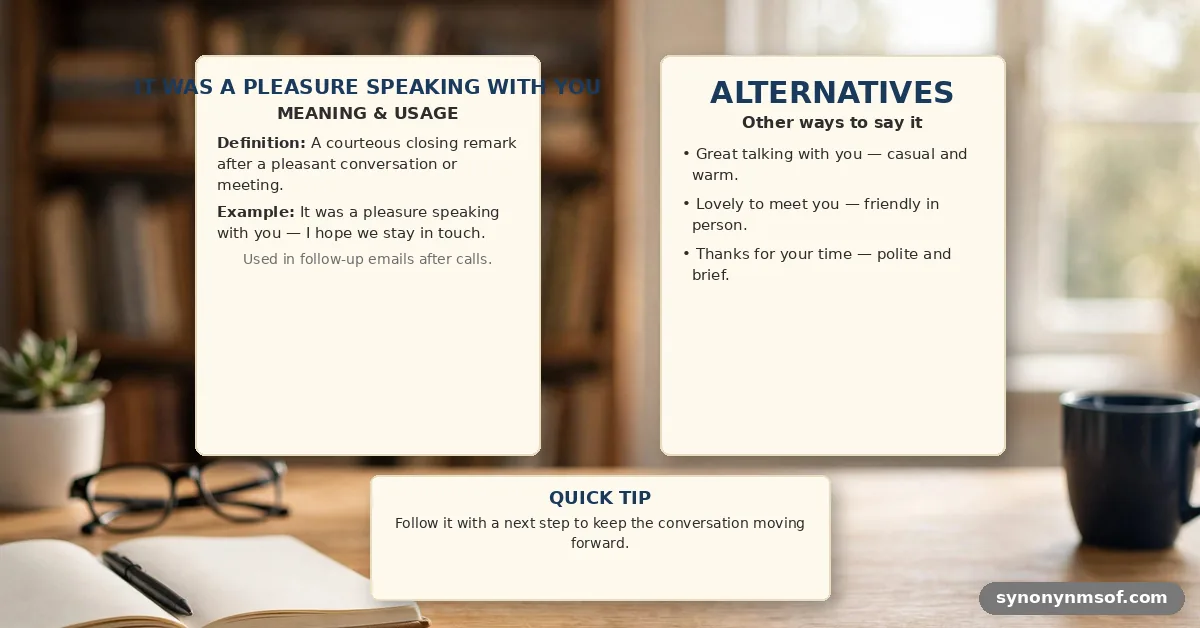

Hearing the phrase it was a pleasure speaking with you is a hallmark of a successful professional interaction. Whether you’ve just finished a high-stakes interview or a productive client meeting, this expression confirms that the connection was positive for both parties. It signals respect, gratitude, and a desire to maintain a bridge for future collaboration.
Understanding exactly when and how to deploy this sentiment allows you to solidify your reputation as a polished communicator. By mastering the nuance of this closing, you ensure that your final impression is as strong as your first.
You should use this phrase when you want to leave a lasting, positive impression after a verbal interaction. It functions as a polite bridge between the end of a conversation and the next step in a professional relationship. While it is simple, its effectiveness relies on timing and sincerity.
When you send a follow-up email or finish a call, this line confirms that you value the other person’s time and expertise. It is a standard of modern business English that helps keep professional doors open.
The Nuance of Professional Closing Statements
Choosing the right closing is an exercise in emotional intelligence. When you tell someone it was a pleasure speaking with you, you are validating their contribution to the conversation.
This validates their perspective and encourages them to view you as a thoughtful partner. You are not just ending a transaction; you are building a professional connection.
Why Sincerity Matters More Than Scripting
The most effective interactions feel natural, not rehearsed. If you use the same generic closing for every person, it risks sounding mechanical.
Instead, tailor the sentiment to the specific context of your discussion. If you discussed a complex project, acknowledge that specifically before using the standard closing.
Choosing Between Speaking With and Speaking To
In standard English, both prepositions are grammatically acceptable, but they carry slightly different connotations. Using with suggests a collaborative dialogue where both parties contributed equally.
Using to can imply a more one-sided delivery of information, such as an interview or a presentation. Choosing with often feels warmer and more inclusive in a peer-to-peer setting.
When to Use This Expression
Knowing the right moment to deploy this phrase is as important as the words themselves. It is best suited for scenarios where you have established a rapport or made a meaningful request. You want to ensure the other person feels their time was well-spent.
- After a job interview to reinforce your interest.
- Following a sales call to express appreciation for the prospect’s time.
- When concluding a networking conversation with a new contact.
- After a mentorship session where you received valuable advice.
- During a follow-up email after a brief, productive phone check-in.
Crafting the Perfect Follow-Up Email
When you follow up, the goal is to bridge the gap between the conversation you just had and the next desired outcome. The phrase should appear early in your email, serving as a gracious transition. Keep the tone professional but accessible to maintain the momentum you built earlier.
Structuring Your Message
Start by thanking them for their time. You can specify the exact topic you covered to show you were paying attention.
Then, include the core phrase to solidify the positive tone of the interaction. Finally, clearly state the next steps or your call to action.
Maintaining a Consistent Tone
Your email should mirror the tone of the actual conversation. If the meeting was formal, keep your writing crisp and direct.
If the discussion was casual and friendly, you can afford to be slightly more relaxed. Consistency is key to building trust over time.
Comparison of Closing Phrases
Not every situation calls for the same level of formality. Depending on the depth of the conversation, you may want to adjust your vocabulary to better suit the relationship. The following table provides a breakdown of common alternatives and their typical impact on the recipient.
| Closing Phrase | Best Context | Tone |
|---|---|---|
| It was a pleasure speaking with you. | Formal business meetings | Professional and polite |
| I really enjoyed our conversation. | Networking or mentorship | Warm and personal |
| Thanks for your time today. | Brief, transactional calls | Direct and efficient |
| It was great connecting with you. | Informal, peer-to-peer | Casual and friendly |
Common Pitfalls to Avoid
Even with the best intentions, it is easy to fall into traps that make your message feel generic. Overusing the phrase can dilute its impact. If you send the same exact email to five different people, you risk being perceived as lazy or insincere.
Avoiding Excessive Formality
Do not weigh down your message with overly stiff language. Using archaic or unnecessarily complex words can make you seem detached. Stick to clear, concise, and honest communication to ensure your message is received as intended.
The Danger of Being Too Vague

A generic message often fails to build a real connection. Always mention a specific detail from your talk to prove you were truly listening.
This small effort transforms a standard note into a memorable, high-impact piece of writing. For more on professional communication standards, you can review the best practices for business writing to refine your style further.
Responding to the Sentiment
When someone says it was a pleasure speaking with you, the pressure is on you to respond gracefully. You want to acknowledge the kindness without sounding like you are just reciting a script. A simple, genuine return of the sentiment is usually the most effective approach.
Keep It Simple and Direct
You do not need to overthink your reply. A brief, polite response confirms that you also found the interaction valuable.
You can say that the pleasure was all yours or that you also found the discussion very productive. This keeps the energy positive and closes the loop on the interaction.
When to Add a Call to Action
If you were the one who initiated the conversation, your response to their closing should include a clear next step. If they were the one who initiated, you can simply express your gratitude and leave the ball in their court. This shows that you respect their time and are not pressuring them for an immediate follow-up.
Cultural Considerations in Communication
Language is not static, and the way we use expressions like this can vary by region and industry. In some high-context cultures, the focus is more on building the relationship than on the specific content of the meeting. In other, more task-oriented environments, brevity is the ultimate sign of respect.
Adapting to Different Industries
In creative fields, you might find that warmer, more enthusiastic language is the norm. In finance or law, a more restrained and polished tone is often preferred. Always observe the cues from the other person to determine how much emotional weight to put into your closing.
International Professional Etiquette
When communicating across borders, keep your language simple to avoid misinterpretation. Using clear, standard English ensures that your professional intent is understood. Avoid idioms or overly complex sentence structures that might not translate well in a global business context.
FAQ
Is it better to say it was a pleasure speaking with you or it was a pleasure talking to you?
Both are grammatically correct. Speaking with generally sounds slightly more formal and collaborative. Talking to can sound more casual, though it is perfectly acceptable in most professional settings.
Should I include this phrase in every follow-up email?
No, you should use it only when it feels authentic. If you send a follow-up email daily to the same person, repeating the phrase will make it lose its sincerity. Use it for significant interactions where you truly want to highlight the value of the conversation.
How do I respond if someone sends this to me?
A simple and sincere response is best. Try saying, The pleasure was all mine, or I really enjoyed our conversation as well. This acknowledges their kindness and confirms that the interaction was mutually beneficial.
Can I use this phrase in a text message?
It is generally a bit too formal for a text message. If you are communicating via text, something like It was great chatting with you or Thanks for the call is more appropriate. Save the more formal phrasing for emails or professional letters.
Conclusion
Mastering the art of professional closing statements allows you to leave a lasting impression that extends far beyond the duration of a meeting. By using the phrase it was a pleasure speaking with you, you demonstrate that you value the time and expertise of those you engage with.
Remember that the impact of these words relies heavily on your genuine intent and the specific context of your conversation. When you combine this polite expression with a brief, personalized detail, you build trust and ensure that your professional relationships remain strong and productive.
The next time you find yourself wrapping up a meaningful discussion, take a moment to consider how your closing words reflect your character. Whether you are in a formal interview or a casual networking chat, choosing your language with care is a sign of a true professional.
Continue to refine your approach, listen to the tone of your partners, and always aim for sincerity over scripted perfection. By doing so, you will find that your professional network becomes more engaged, responsive, and supportive of your long-term goals.