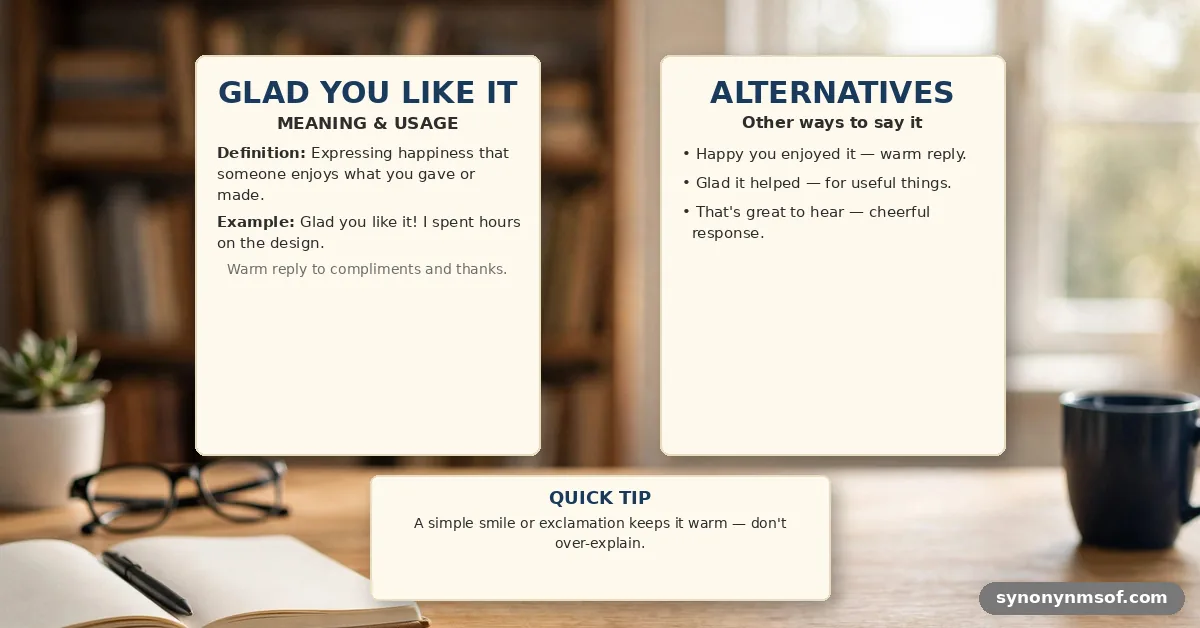

Hearing that someone enjoyed your work or a gift you provided often leads to a simple, warm response. Using the phrase “glad you like it” is a common way to acknowledge positive feedback while maintaining a friendly connection. Whether you are responding to a client who appreciates a project delivery or a friend who enjoyed a thoughtful gesture, knowing how to express your satisfaction is essential.
This article breaks down the meaning of the phrase, explores how it fits into different social and professional settings, and offers alternatives for when you need a slightly different tone. Understanding the nuances of these words will help you communicate with genuine warmth and clarity.
At its core, saying you are glad someone likes something is a statement of shared satisfaction. It signals that your goal—whether it was to please a customer or make a friend smile—has been achieved. You are confirming that the outcome aligns with the recipient’s preferences.
This phrase functions as a bridge in communication. It closes the loop on a transaction or an exchange of pleasantries by validating the other person’s positive experience. When you tell someone you are happy they enjoyed a result, you reinforce the quality of the interaction.
The emotional weight of the phrase depends heavily on the context. In a casual setting, it feels light and breezy, like a natural reaction to a compliment. In a formal environment, it serves as a polite acknowledgement of a job well done.
Choosing Between Like and Liked

One of the most common questions involves the grammatical difference between “I’m glad you like it” and “I’m glad you liked it.” The choice depends on whether the experience is currently happening or if it has already concluded. Use “like” when the recipient is actively enjoying the item or service right now.
If you are referring to a completed event, such as a dinner party or a finished project, “liked” is the appropriate choice. It frames the sentiment in the past tense, showing that you value the fact that they had a positive experience. Both versions are grammatically sound and convey the same underlying sentiment.
When to use present tense
You should reach for the present tense when the object is still in their possession or use. For example, if you gave someone a book, saying “I’m glad you like it” implies they are currently reading it or have recently started. It keeps the conversation focused on their ongoing satisfaction.
When to use past tense
The past tense is perfect for feedback on something that has already finished. If a client tells you they were pleased with a presentation you gave last week, saying “I’m glad you liked it” is the standard response. It acknowledges the specific event that occurred.
Professional Contexts and Etiquette
In a workplace, you want your responses to sound polished and appreciative. While “glad you like it” is rarely considered rude, it can sometimes feel a bit too casual for high-stakes corporate communication. You might prefer to use slightly more elevated language when speaking with senior management or external clients.
Using more formal alternatives helps maintain a professional distance while still expressing warmth. It shows that you take the feedback seriously and value the professional relationship. Always consider the power dynamic and the nature of the project before finalizing your reply.
- I am pleased to hear that the results met your expectations.
- It is wonderful to know that you are satisfied with the outcome.
- Thank you for the feedback; I am delighted you found the report helpful.
- I appreciate you sharing your positive thoughts on the project.
- We are happy that the solution aligns with your current needs.
Variations for Different Scenarios
Not every situation calls for the same level of formality. You should tailor your language based on who you are talking to and the medium you are using. A quick message on a chat platform allows for brevity, whereas an email to a long-term client requires a bit more care.
The following table provides a quick guide to help you select the right phrase for the moment. It balances the level of formality with the intensity of the sentiment.
| Phrase | Formality Level | Best Scenario |
|---|---|---|
| I’m glad you like it | Casual | Friends and close colleagues |
| I’m happy you enjoyed it | Neutral | General professional contact |
| I’m pleased to hear that | Formal | Clients or senior management |
| It’s great to hear your positive feedback | Professional | Project completion |
The Role of Tone in Communication
Your tone dictates how your message is perceived by the recipient. Even if you use the right words, the wrong tone can make you sound dismissive or overly robotic. A good rule of thumb is to match the energy of the person who gave you the feedback.
If someone sends a glowing, enthusiastic email, a short and dry response might feel cold. Match their enthusiasm with a bit more descriptive language. If they are brief and to the point, keep your response efficient to respect their time.
Common Mistakes to Avoid
Even with simple phrases, it is easy to stumble. One frequent error is sounding insincere or dismissive by being too brief. A simple “glad” might feel like you are checking a box rather than genuinely valuing their opinion.
Avoid over-explaining your work when someone gives you a compliment. If you say “I’m glad you like it, it took me forever to finish,” you shift the focus from their satisfaction to your struggle. Let the compliment stand on its own as a moment of mutual appreciation.
FAQ
Is it professional to say glad you like it?
It is generally acceptable in most office environments, especially with teammates you know well. If you are dealing with a formal client, consider using more polished alternatives like “I am pleased to hear you enjoyed the results.”
What is the best way to express urgency or excitement?
If you want to sound more enthusiastic, use words like “delighted” or “thrilled.” Saying “I am thrilled to hear that you are enjoying the new design” adds a layer of genuine excitement that feels very positive.
What is the difference between I am glad you like it and I am glad you enjoyed it?
“Liked” or “enjoyed” often implies that the experience has already taken place. “Like” implies a current, ongoing state. You can use them interchangeably, but “enjoyed” often sounds slightly more sophisticated in writing.
Can I use this phrase in a text message?
Absolutely, as text messages are typically informal. It is a perfect way to acknowledge a friend’s compliment without sounding stiff or overly formal.
Conclusion
Finding the right way to acknowledge positive feedback is a small but meaningful part of building strong relationships. Whether you choose to say you are glad you like it or opt for a more formal alternative, the goal remains the same: showing that you value the other person’s input. By paying attention to the context and the relationship you have with the recipient, you can ensure your response always hits the right note.
Remember that the best communication is clear, authentic, and attentive to the person on the other end. Keep practicing these variations to ensure your professional and personal interactions remain warm, productive, and filled with mutual appreciation.
SEO Title: Glad You Like It: Meaning, Usage, and Examples
Meta Description: Learn the meaning, usage, and professional alternatives for saying “I’m glad you like it.” Master your response to positive feedback in any scenario.
Suggested URL Slug: glad-you-like-it-meaning-usage
Primary Keyword: Glad You Like It
Secondary Keywords: happy you enjoyed it, professional, feedback, pleased, positive, appreciate