
Learning to be patient is more than just waiting for a bus or standing in a slow checkout line. It is a fundamental emotional skill that allows you to manage frustration, maintain perspective, and achieve long-term goals without burning out. When you decide to be patient, you are choosing to accept that some processes cannot be rushed, regardless of your desire for immediate results.
Understanding how to apply this trait in your daily life can transform your personal relationships and your professional productivity. This article explains the core concepts behind this virtue, how to use the terms correctly, and why it matters in a world that demands instant gratification.
Defining the Core Concept

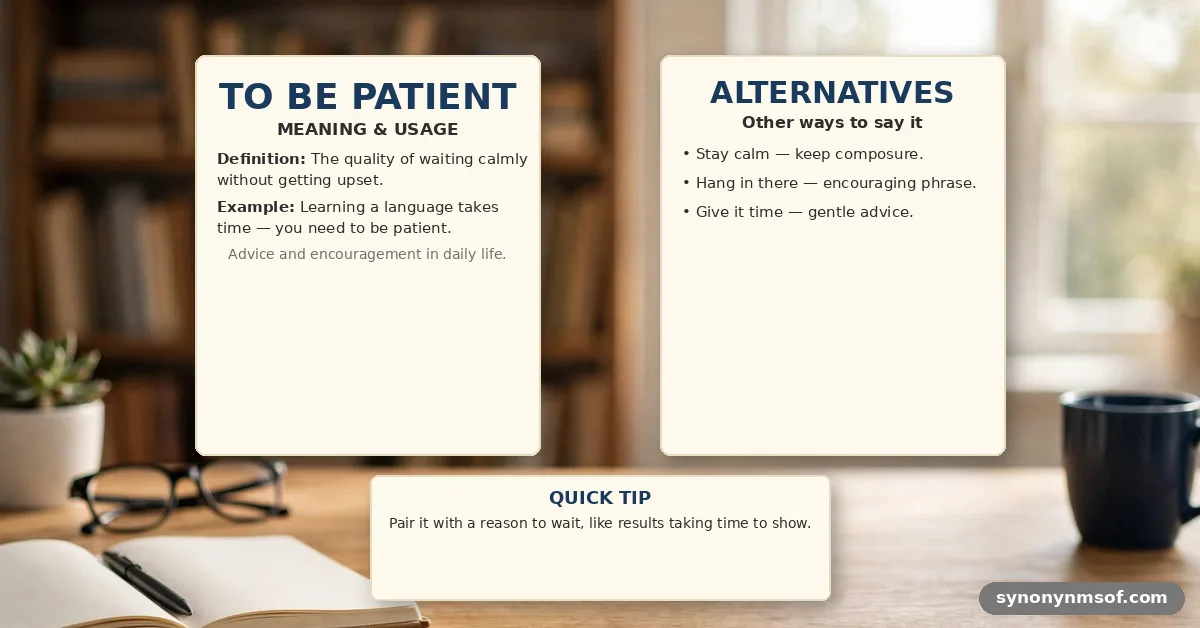
The phrase to be patient refers to the capacity to accept or tolerate delay, trouble, or suffering without getting angry or upset. It is a state of mind where you remain calm while facing circumstances that are outside of your control.
Many people confuse the noun with the adjective, but the distinction is simple. Being patient describes a person’s behavior, while patience is the quality itself.
If you are a patient someone, you possess the ability to stay composed even when things go wrong. This is not about passivity or weakness.
Instead, it is a deliberate choice to remain steady when the environment around you is chaotic. You are choosing to prioritize the outcome over the immediate emotional release of venting your frustration.
Understanding the Noun and Adjective
Distinguishing between the noun and the adjective is essential for correct usage. The word patience functions as a noun, representing the virtue or the quality of endurance. For instance, you might say, “She has the patience of a saint,” referring to her ability to deal with difficult kids without losing her cool.
Conversely, the word patient acts as an adjective describing a person or a state. You can describe a colleague as a patient listener.
Interestingly, the word also functions as a noun when referring to someone receiving medical care. A doctor treats a patient, but that same doctor must also practice patience while explaining a complex diagnosis.
The Psychology of Waiting
Why do we find it so difficult to wait? Human beings are wired for efficiency, and modern technology has conditioned us to expect instant feedback.
When we cannot immediately access information or receive a response, our brain registers a minor stressor. Choosing to be patient requires overriding this biological impulse to seek immediate closure.
Research suggests that high levels of patience are linked to better decision-making. When you slow down, you give your prefrontal cortex time to weigh the consequences of your actions.
Those who rush often make impulsive errors that require even more time to fix later. By waiting, you are actually investing in the quality of your future work.
Situations Requiring Endurance
There are specific scenarios where this virtue is tested more than others. Whether you are dealing with a technical delay or a personal conflict, identifying these triggers can help you manage your reaction.
- Professional Deadlines: Waiting for feedback on a project or approval from a client.
- Interpersonal Conflict: Allowing a friend or partner to process their emotions before responding.
- Skill Acquisition: Practicing a musical instrument or a new language for months before seeing progress.
- Commuting and Logistics: Managing your response to traffic, long queues, or public transport delays.
Comparison of Terms
Understanding how these terms function in different contexts helps you communicate more effectively. The following table highlights the differences between the noun and adjective forms in common scenarios.
| Term | Part of Speech | Meaning | Example |
|---|---|---|---|
| Patience | Noun | The capacity to endure | He showed great patience during the long meeting. |
| Patient | Adjective | Tolerant and composed | She remained patient despite the flight delay. |
| Patient | Noun | Medical recipient | The doctor consulted with the patient. |
How to Avoid Losing Your Cool
Most people lose patience when they feel they have lost control of their schedule. To combat this, focus on what you can influence rather than the external barrier itself.
If you are waiting for an email, use the time to organize your workspace or clear a smaller task. Shifting your focus from the obstacle to a secondary goal makes the waiting period feel productive.
Another strategy involves reframing the narrative. Instead of viewing a delay as a waste of your time, see it as a natural part of the process.
If you are working with kids or training a new employee, remember that growth is rarely linear. Acknowledging that the delay is necessary for the result to manifest often eases the internal pressure to rush.
Biblical Perspectives on Endurance
Many historical and philosophical texts emphasize the value of waiting. In the book of James 5:7, the text encourages readers to be like a farmer who waits for the precious fruit of the earth, being patient for it until it receives the early and latter rain. This metaphor illustrates that some results are dictated by seasons rather than effort.
The passage reminds us that just as a harvest cannot be forced before its time, human endeavors often require a period of incubation. By aligning your expectations with the reality of the process, you avoid unnecessary agitation. This perspective is a powerful tool for maintaining your mental health in high-pressure environments.
FAQ
Is it better to say I am patient or I have patience?
Both are correct but serve different grammatical roles. You use “I am patient” to describe your character or your current state of mind. You use “I have patience” to describe the attribute you possess as a noun.
How can I stay calm when things go wrong?
Focus on your breathing and acknowledge that your frustration is a reaction to the situation, not the situation itself. Taking a thirty-second break to step away from the problem can prevent you from acting impulsively.
What is the difference between waiting and being patient?
Waiting is a physical act of staying in one place or holding off on an action. Being patient is the emotional state of doing so without resentment or anger. You can wait for a bus while being impatient, which makes the experience feel much longer.
When should I stop being patient?
Patience should not be confused with tolerating poor treatment or inefficiency. If a situation is actively harmful or if you have waited past a reasonable deadline, it is appropriate to take decisive action or seek a new path.
Conclusion
Developing the ability to be patient is a lifelong practice that pays dividends in every area of your life. It is not about accepting stagnation, but about recognizing the rhythm of growth and the limitations of external circumstances. By choosing to remain composed, you protect your energy and ensure that your decisions are rooted in logic rather than momentary irritation.
Whether you are navigating a difficult project or managing the complexities of daily life, remember that the quality of your patience often determines the quality of your results. Start small by observing your reactions to minor delays today, and you will find that your capacity to handle larger challenges grows naturally over time.