
Ending an email with the phrase that you hope someone will have a great rest of your week is a common way to maintain rapport in professional settings. While it might sound slightly clunky at first glance, it serves as a polite bridge between a work-related task and the upcoming weekend.
Many people use this expression to soften the tone of their correspondence, especially when sending updates on a Wednesday or Thursday. Understanding how and when to deploy this greeting will help you appear more approachable while keeping your digital communication polished and effective.
You can use this sign-off to signal that you value the other person’s time and well-being. It is a simple gesture that acknowledges the passage of the work week without needing a deep personal connection.
Whether you are emailing a client, a colleague, or a supervisor, mastering these small social cues is essential for building a positive reputation. Let’s look at why this specific phrasing works and how you can adapt it to fit different professional scenarios.
Understanding the Meaning and Grammar

The core meaning behind the sentiment is straightforward: you are expressing a desire for the recipient to experience a positive and productive conclusion to their current work cycle. Grammatically, it is a shortened version of a more complete sentence, such as “I hope you have a great rest of your week.” Because English speakers often drop the “I hope” in casual or semi-formal emails, the phrase has become a standard idiom.
Some critics argue that the phrasing is technically awkward because it implies the week belongs solely to the sender. However, language evolves through common usage, and in a professional context, it is widely accepted as a polite, friendly closing.
No one will mistake your intent for a territorial claim over their calendar. It is simply a shorthand for wishing someone well as the weekend approaches.
Is the Phrasing Grammatically Correct?
If you are worried about the technical precision of your emails, rest assured that this expression is considered grammatically acceptable in modern business English. It functions as an imperative, much like “Have a nice day.” By dropping the subject of the sentence, you create a conversational tone that feels less rigid than a formal letter.
If you prefer a slightly more traditional structure, you can always include the subject. Writing “I hope you have a great rest of your week” removes any ambiguity regarding ownership.
Both versions are perfectly fine for internal and external communications. Choose the one that feels most natural for your specific relationship with the recipient.
When to Use This Closing
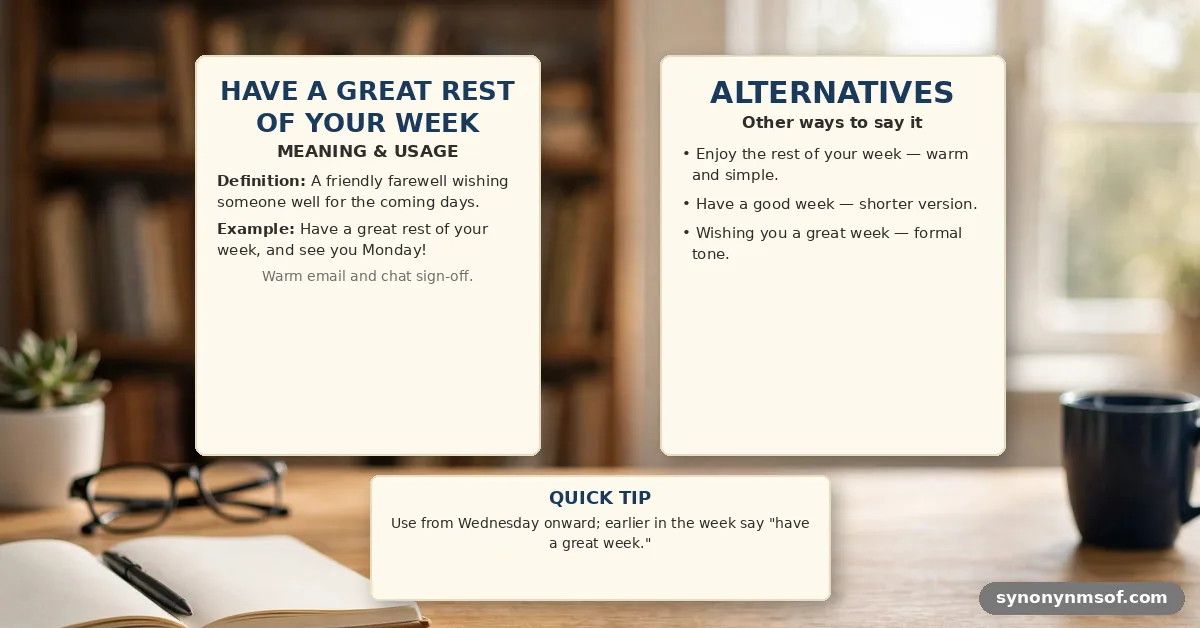
Timing is the most important factor when choosing to include this sentiment in your emails. You should generally reserve it for the middle or end of the work week, typically from Wednesday afternoon through Friday morning. Using it on a Monday morning would feel confusing, as the “rest of the week” is still five days long.
Consider the nature of your relationship with the person before hitting send. If you are communicating with a close teammate, it fits perfectly as a casual, friendly sign-off. For a formal client or a senior executive, you might choose a slightly more professional variation to ensure you maintain a respectful distance.
- Wednesday: A perfect time to use the phrase, as you are halfway through the week.
- Thursday: Highly appropriate, as it looks forward to the final push before the weekend.
- Friday: Often better to switch to “Have a great weekend” to be more specific.
- Monday/Tuesday: Avoid this phrase, as it feels premature and slightly out of place.
Professional Alternatives for Different Tones
Sometimes you need a variety of ways to close your messages to avoid sounding repetitive. Depending on the recipient, you might want to adjust your level of formality. Here are some alternatives categorized by the tone they convey.
| Tone | Alternative Phrase | Best Used For |
|---|---|---|
| Very Formal | Wishing you a productive remainder of the week. | Senior executives or new clients. |
| Professional | I hope you have a successful rest of the week. | Standard B2B communication. |
| Casual | Enjoy the rest of your week! | Close colleagues and teammates. |
| Concise | Best for the rest of your week. | Quick internal updates. |
How to Respond to the Phrase
Receiving a message that includes this sentiment doesn’t require a long-winded response. You can simply acknowledge the well-wish in your reply or ignore it if you are moving on to a different topic. If you want to be polite, a quick “Thank you, you too!” is more than sufficient.
If you are replying to a thread that is ending, you can mirror their sentiment. Responding with “Thanks, hope you have a great rest of your week as well” shows that you are attentive and appreciative of their tone. Keep it brief to respect the other person’s time.
Common Pitfalls to Avoid
One common mistake is using this phrase when the interaction is clearly ongoing. If you are in the middle of a complex negotiation, signing off with a casual pleasantry can sometimes feel like you are trying to end the conversation prematurely. Wait until the specific task or email chain is nearing its conclusion.
Another issue is overusing the phrase in every single email. If you send five emails a day to the same person, adding it to every one will make it lose its sincerity. Use it as a final sign-off for the day or the specific project update, rather than a boilerplate signature that appears in every message.
The Impact of Tone in Communication
Your choice of words reflects your professional personality. Using friendly, well-meaning phrases helps to build trust and shows that you care about more than just the bottom line. Communication is not just about exchanging data; it is about managing the human element of business.
By thoughtfully applying these small gestures, you create a more collaborative environment. People are generally more responsive to those who take the time to be courteous. A little kindness goes a long way in making your daily professional interactions more pleasant for everyone involved.
Frequently Asked Questions
Is it professional to say this in an email?
Yes, it is widely considered professional. It strikes a good balance between being friendly and maintaining a clear boundary in your work communication.
How does this differ from saying have a great weekend?
The main difference is the timeframe. “Have a great rest of your week” covers the remaining work days, whereas “Have a great weekend” is specifically about your time off.
What is the best way to express urgency politely?
If you need something quickly, it is better to state the deadline clearly rather than relying on a closing phrase. You can balance urgency with politeness by saying, “I would appreciate if you could review this by Thursday so we can meet our deadline.”
Can I use this with my boss?
It is perfectly acceptable to use with a manager, provided you have a cordial working relationship. If your workplace is extremely formal, you might prefer “I wish you a productive rest of the week.”
Final Thoughts
Choosing the right words to close your emails is a simple way to improve your professional relationships. Whether you choose to wish someone a great rest of your week or opt for a more formal alternative, the key is to remain consistent and sincere.
These small gestures help humanize digital communication, making your interactions feel less transactional and more collaborative. By paying attention to the timing and the recipient, you ensure that your message is always well-received.
As you move forward, keep experimenting with these variations to see what fits your personal style best. You will find that adding a touch of warmth to your correspondence makes your daily work life more enjoyable for you and your colleagues. Start integrating these phrases into your routine and notice the positive shift in your professional tone.
SEO Title: Have a Great Rest of Your Week: Meaning & Examples
Meta Description: Learn the professional meaning of the phrase have a great rest of your week, when to use it, and how to pick the perfect alternative for your emails.
Suggested URL Slug: have-a-great-rest-of-your-week-meaning-examples
Primary Keyword: Have a Great Rest
Primary Keyword: Have a Great Rest of Your Week
Secondary Keywords: email, professional, communication, tone, wishing, informal, friendly, casual, well, hope, best, great