
The phrase “just to clarify” seems harmless at first.
Most of us use it in emails, meetings, texts, or conversations without thinking twice. It’s one of those phrases that quietly slips into everyday communication.
But here’s the interesting part: the way you say “just to clarify” can completely change how people perceive your tone.
Sometimes it sounds helpful.
Sometimes it sounds passive-aggressive.
Sometimes it makes you seem thoughtful and detail-oriented.
And other times, it accidentally makes the other person feel corrected or challenged.
That tiny phrase carries more emotional weight than people realize.
In this guide, we’ll explore the real meaning of just to clarify, professional alternatives, examples, workplace usage, tone differences, psychological impact, common mistakes, and better ways to communicate clearly without sounding robotic or defensive.
If you’ve ever wondered:
- “Am I wording this correctly?”
- “Does this sound rude?”
- “Is there a more professional way to say this?”
You’re in the right place.
What Does “Just to Clarify” Mean?
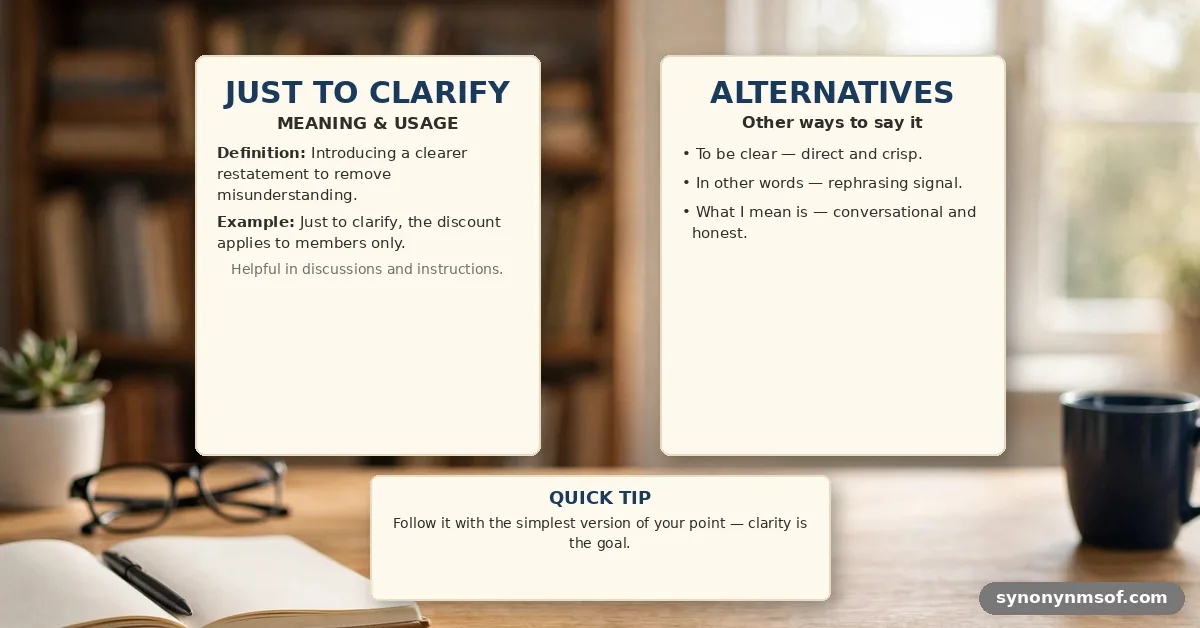
“Just to clarify” means you want to make something clearer or confirm understanding before moving forward.
You’re essentially saying:
“I want to make sure we both understand this correctly.”
People use it to:
- Avoid misunderstandings
- Confirm details
- Correct confusion politely
- Ask follow-up questions
- Restate information clearly
Simple Example
“Just to clarify, the meeting starts at 2 PM, correct?”
In this case, the speaker is simply confirming information.
See Also: Including But Not Limited To Meaning, Usage, and Better Alternatives
Why People Use “Just to Clarify”
Most communication problems don’t happen because people are malicious.
They happen because people assume.
Someone hears one thing.
Another person means something slightly different.
And suddenly a simple misunderstanding becomes frustration.
That’s why clarification phrases matter so much.
I once worked on a project where a client said they wanted “minimal edits.”
Sounds straightforward, right?
Except their version of “minimal” meant rewriting half the document.
If I had paused earlier and said:
“Just to clarify, are we talking about small revisions or structural changes?”
…I would’ve saved hours of confusion.
Clear communication prevents unnecessary stress.
Is “Just to Clarify” Polite?
Usually, yes.
But tone matters more than the phrase itself.
It Sounds Polite When:
- You genuinely want understanding
- You ask calmly
- Your wording feels collaborative
- You avoid blame
It Can Sound Rude When:
- It’s used sarcastically
- It sounds like correction
- The tone feels impatient
- You repeat it aggressively
Compare These Two Examples
Polite:
“Just to clarify, should I submit the report today or tomorrow?”
Passive-Aggressive:
“Just to clarify, like I already mentioned earlier, the deadline was Friday.”
Same phrase. Completely different emotional effect.
Quick Comparison Table: Alternatives to “Just to Clarify”
| Phrase | Tone | Best Use |
| Just to confirm | Professional | Emails, meetings |
| To make sure we’re aligned | Collaborative | Workplace discussions |
| For clarity | Formal | Reports, documentation |
| I want to make sure I understand | Friendly | Conversations |
| Let me confirm | Direct | Business communication |
| If I understand correctly | Soft and polite | Clarifying instructions |
| To avoid confusion | Neutral | Group discussions |
| Am I correct in understanding | Formal | Client communication |
Professional Alternatives to “Just to Clarify”
Using the same phrase repeatedly can make communication feel repetitive.
Here are better alternatives depending on context.
Just to Confirm
Probably the most professional replacement.
Example:
“Just to confirm, the revised proposal is due Monday.”
It sounds clean and confident.
For Clarity
More formal and polished.
Example:
“For clarity, this policy applies to all departments.”
Excellent for workplace writing.
Related Post: 37 Other Ways to Say “Good Luck” (With Meaning, Examples, and When to Use Them)
I Want to Make Sure I Understand Correctly
Warm and collaborative.
Example:
“I want to make sure I understand correctly — you’d like the homepage redesigned first?”
This reduces defensiveness because it focuses on your understanding rather than their mistake.
If I Understand Correctly
Gentle and diplomatic.
Example:
“If I understand correctly, the pricing will remain unchanged?”
Very useful in sensitive conversations.
To Avoid Confusion
Helpful in team settings.
Example:
“To avoid confusion, let’s finalize the schedule today.”
Let Me Confirm
Direct and efficient.
Example:
“Let me confirm the delivery timeline before proceeding.”
Why “Just” Changes the Tone
This is something most articles completely ignore.
The word “just” softens communication.
Without it, statements can sound abrupt.
Compare These:
“Clarify the timeline.”
Sounds commanding.
“Just to clarify the timeline…”
Sounds softer and more conversational.
That tiny word acts like social cushioning.
But overusing “just” can also weaken confidence in writing.
Especially in professional emails.
The Hidden Problem With Overusing “Just”
Many professionals unknowingly overuse softening words like:
- Just
- Actually
- Maybe
- Kind of
- Sorry
This often makes communication sound hesitant.
Example
“We just wanted to ask if maybe you could review this.”
Versus:
“Could you review this?”
The second version sounds more confident and professional.
That doesn’t mean “just” is bad. It simply needs balance.
How “Just to Clarify” Works in Emails
Email tone is tricky because people can’t hear your voice.
That means wording matters a lot.
Professional Example
“Just to clarify, are we moving forward with Option B?”
Friendlier Example
“Just wanted to clarify something quickly about tomorrow’s meeting.”
More Assertive Example
“To confirm, we agreed on a Friday delivery timeline.”
Small wording changes create very different emotional tones.
Examples of “Just to Clarify” in Real-Life Situations
In Workplace Communication
“Just to clarify, should the presentation include last quarter’s data?”
In Customer Service
“Just to clarify, you’d like a refund rather than store credit?”
In Academic Settings
“Just to clarify, is the essay due before midnight?”
In Relationships
“Just to clarify, were you upset earlier or just tired?”
In Team Meetings
“Just to clarify, who’s responsible for the final review?”
Notice how the phrase helps avoid assumptions in every situation.
When “Just to Clarify” Can Sound Passive-Aggressive
This deserves attention because many people accidentally do this.
The phrase becomes passive-aggressive when clarification is really disguised criticism.
Example
“Just to clarify, the instructions were already shared yesterday.”
This doesn’t feel like clarification.
It feels like frustration wearing a polite outfit.
People are emotionally sensitive to hidden criticism, especially in workplace communication.
That’s why intention matters.
Better Ways to Clarify Without Sounding Defensive
Instead of focusing on correction, focus on collaboration.
Less Effective
“Just to clarify, that’s not what I meant.”
Better
“I think we may be interpreting this differently.”
Less Effective
“Just to clarify, you misunderstood.”
Better
“Let me explain my thinking another way.”
These subtle shifts reduce tension dramatically.
The Psychology of Clarification
Here’s something fascinating:
People often avoid clarification because they fear looking uninformed.
But asking clarifying questions usually signals intelligence, not weakness.
Strong communicators clarify early.
Weak communicators assume.
That distinction matters in:
- Leadership
- Relationships
- Negotiations
- Client communication
- Team collaboration
Clear communication prevents emotional friction before it starts.
“Just to Clarify” in Formal Writing
In formal documents, the phrase can sound too conversational.
Instead, writers often use:
- For clarity
- Specifically
- To clarify
- Namely
- In other words
Example
“For clarity, remote employees must submit weekly reports.”
This sounds cleaner in business documentation.
Synonyms for “Just to Clarify”
Here are useful alternatives you can rotate naturally:
- Just to confirm
- For clarity
- To clarify
- To be clear
- Specifically
- In other words
- If I understand correctly
- Let me confirm
- To make sure we’re aligned
- Am I correct in understanding
Using varied language improves communication flow and readability.
How Different Personality Types Respond to Clarification
This is rarely discussed, but it’s incredibly important.
Analytical Personalities
Usually appreciate clarification because they value precision.
Emotional Personalities
May perceive repeated clarification as criticism.
Fast-Paced Communicators
Can become impatient with too many follow-up questions.
Detail-Oriented People
Often welcome clarification because it prevents mistakes.
Understanding communication style helps your wording land better.
Common Mistakes People Make
Using It Too Often
Repeating “just to clarify” in every email becomes distracting.
Sounding Accusatory
Tone can unintentionally imply blame.
Over-Explaining
Too much clarification can confuse rather than simplify.
Asking Vague Questions
“Just to clarify…” only works if the actual question is specific.
Avoiding Clarification Entirely
This is surprisingly common and creates bigger problems later.
How Leaders Use Clarification Effectively
Strong leaders ask clarifying questions constantly.
Not because they’re confused.
Because they understand the cost of assumptions.
Great managers often say things like:
- “Let me make sure I understand.”
- “Can we define success clearly?”
- “Walk me through your thinking.”
That creates alignment and reduces conflict.
Simple Tips for Better Clarification
Be Specific
Ask direct questions.
Stay Neutral
Avoid emotionally loaded wording.
Focus on Understanding
Not proving someone wrong.
Keep It Brief
Long explanations weaken clarity.
Match the Situation
Formal workplace? Use polished wording.
Friendly chat? Keep it conversational.
Final Thoughts on “Just to Clarify”
The phrase just to clarify may seem small, but it plays a powerful role in communication.
Used well, it prevents misunderstandings, builds alignment, and creates smoother conversations.
Used poorly, it can sound defensive, passive-aggressive, or unnecessarily formal.
The real secret isn’t memorizing perfect phrases.
It’s understanding the emotional impact behind the words you choose.
Whether you say:
- “Just to confirm”
- “For clarity”
- “I want to make sure I understand correctly”
…the goal stays the same:
Helping people feel understood while keeping communication clear, respectful, and human.
FAQs
What does “just to clarify” mean?
It means you want to confirm or make something clearer to avoid misunderstanding.
Is “just to clarify” rude?
No, not usually. However, tone and context can make it sound polite or passive-aggressive.
What is a professional way to say “just to clarify”?
Professional alternatives include:
- Just to confirm
- For clarity
- To confirm
- If I understand correctly
Can I use “just to clarify” in emails?
Yes. It’s commonly used in workplace emails to confirm details or avoid confusion.
Is “just to clarify” passive-aggressive?
It can be if used sarcastically or while indirectly criticizing someone.
What are synonyms for “just to clarify”?
Common alternatives include:
- To clarify
- For clarity
- Just to confirm
- Specifically
- To be clear
Why do people say “just to clarify”?
People use it to confirm understanding, avoid mistakes, or ask follow-up questions politely.
Is “just” unnecessary in professional writing?
Sometimes. Removing “just” can make writing sound more confident and direct.
How do you clarify politely?
Use collaborative wording like:
- “I want to make sure I understand.”
- “Could you clarify something for me?”
- “Just to confirm…”
What’s better than saying “just to clarify”?
That depends on tone and context. In professional settings, “just to confirm” or “for clarity” often sound stronger and cleaner.