
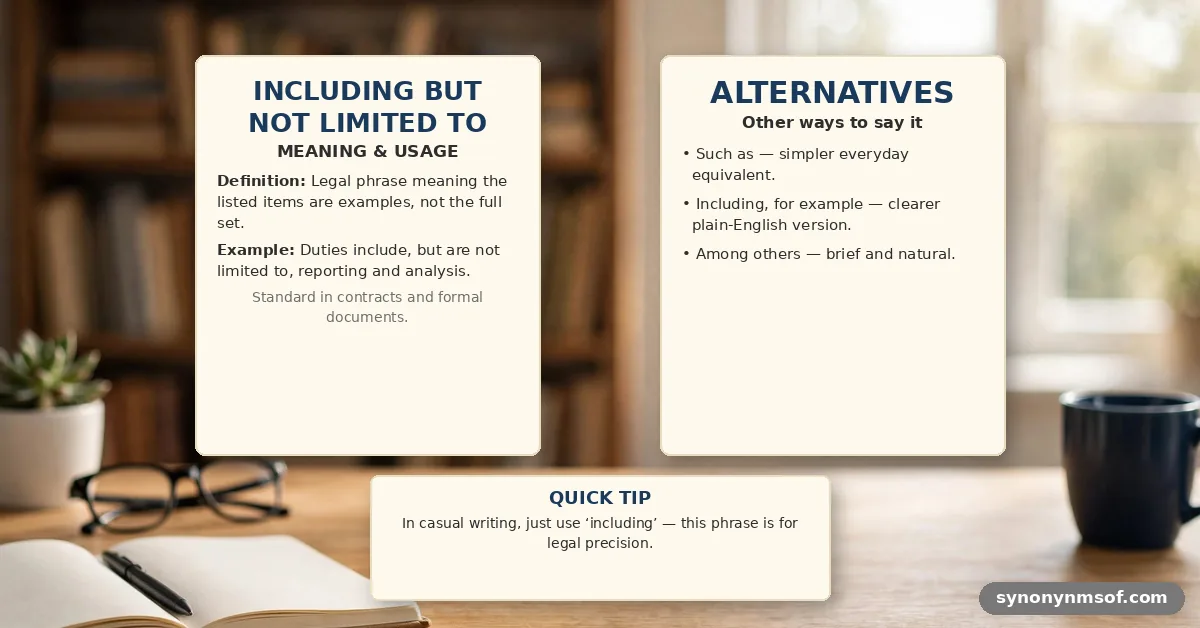

The phrase “including but not limited to” appears everywhere.
You’ll see it in contracts, workplace emails, policies, academic writing, business documents, and even casual online posts. Most people recognize it instantly, but surprisingly few actually understand why it’s used or whether it’s always necessary.
If you’ve ever paused mid-sentence wondering whether the phrase sounds too formal, repetitive, or legally intimidating, you’re not alone.
I remember writing a freelance agreement years ago and adding “including but not limited to” because it sounded professional. Later, a client asked me what it actually meant. That moment made me realize many of us use the phrase automatically without thinking about clarity.
In this guide, we’ll break down the true meaning of including but not limited to, when to use it, when to avoid it, better alternatives, grammar tips, legal importance, and real-life examples that make the phrase much easier to understand.
What Does “Including But Not Limited To” Mean?
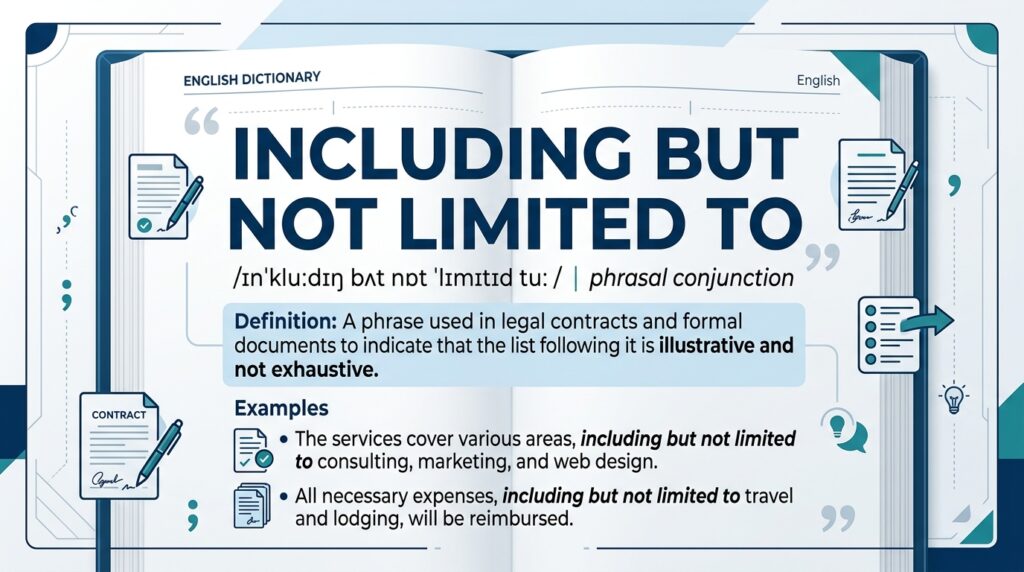
The phrase “including but not limited to” means the examples mentioned are only part of a larger list.
In simple words, it tells the reader:
“These are examples, not the complete list.”
Here’s a basic example:
The workshop covers marketing topics, including but not limited to SEO, email campaigns, and branding.
This means the workshop includes SEO, email campaigns, and branding, but there may be many additional topics too.
Without the phrase, some readers might assume the listed items are the only ones included.
Why People Use “Including But Not Limited To”
The main reason is flexibility.
Writers use the phrase to avoid creating limits unintentionally.
This is especially important in:
- Legal documents
- Contracts
- Workplace policies
- Business agreements
- Terms and conditions
- Academic or technical writing
It prevents misunderstandings later.
For example:
Employees may be assigned tasks including but not limited to reporting, scheduling, and customer communication.
This leaves room for additional responsibilities beyond the listed tasks.
Quick Comparison Table
| Phrase | Meaning | Tone | Best Use |
| Including but not limited to | Examples are not complete | Formal | Legal/business writing |
| Such as | Gives examples | Casual-neutral | Everyday writing |
| Including | Partial list | Simple | General writing |
| For example | Introduces examples | Conversational | Blogs/articles |
| Like | Informal examples | Casual | Speech and informal writing |
Is “Including But Not Limited To” Grammatically Correct?
Yes, the phrase is grammatically correct.
However, many professional editors consider it overly wordy in casual or modern writing.
That’s because the word “including” already suggests the list is incomplete in many situations.
For example:
We sell electronics including laptops, phones, and tablets.
Most readers naturally understand there may be more products.
Adding “but not limited to” can sometimes make writing sound unnecessarily heavy.
Still, in legal or contractual writing, precision matters more than simplicity.
How to Use “Including But Not Limited To” Correctly
In Sentences
The phrase usually appears before examples.
Correct Example
The package includes outdoor activities, including but not limited to hiking, kayaking, and fishing.
Incorrect Example
Including but not limited to hiking, kayaking, and fishing are part of the package.
The second version sounds awkward because the phrase disrupts sentence flow.
Common Examples in Real Life
Business Writing
Benefits include, but are not limited to, paid leave, health insurance, and remote work options.
This version is common in employee handbooks and HR documents.
Legal Contracts
Prohibited behavior includes, but is not limited to, harassment, theft, and fraud.
Lawyers use the phrase to prevent loopholes.
Academic Writing
Environmental factors including but not limited to pollution and climate change affect public health.
Workplace Emails
Please submit all required documents, including but not limited to identification records and payment receipts.
The Legal Importance of “Including But Not Limited To”
This phrase carries serious legal weight.
In contracts, wording matters enormously.
If a document says:
“The tenant is responsible for utilities including water and electricity.”
Someone could argue only water and electricity count.
But if the contract says:
“Including but not limited to water and electricity.”
It becomes much broader legally.
That tiny addition protects the writer from narrow interpretations.
This is why attorneys rely heavily on phrases like:
- Including but not limited to
- Such as
- Without limitation
- Among others
The goal is reducing ambiguity.
Why Some Writers Avoid the Phrase
Even though it’s legally useful, many modern writers dislike it because it can sound:
- Robotic
- Repetitive
- Overly formal
- Hard to read
- Intimidating
Plain language experts often recommend simplifying whenever possible.
For example:
Wordy Version
The event will feature activities including but not limited to games, music, and food stalls.
Cleaner Version
The event will feature activities such as games, music, and food stalls.
The second sentence feels more human and approachable.
Better Alternatives to “Including But Not Limited To”
Sometimes simpler phrases work better.
Here are strong alternatives depending on context.
1. Such As
Best for everyday writing.
We offer services such as graphic design and web development.
2. Including
Simple and clean.
The store sells electronics including cameras and speakers.
3. For Example
More conversational.
We teach creative skills, for example photography and editing.
4. Among Others
Professional but less bulky.
She manages several departments, among others marketing and finance.
5. Like
Informal and friendly.
I enjoy outdoor activities like hiking and camping.
Including But Not Limited To vs Such As
People often confuse these phrases.
Here’s the key difference:
| Phrase | Implies More Items Exist? | Formality |
| Including but not limited to | Strongly yes | Very formal |
| Such as | Usually yes | Moderate |
| Like | Sometimes | Casual |
“Such as” is usually enough in blogs, emails, and articles.
“Including but not limited to” works better in legal or technical writing where precision matters.
When You Should Use This Phrase
The phrase works best when:
- You need legal protection
- Precision matters
- The audience expects formal language
- You want to avoid narrow interpretation
- The list could expand later
When You Should Avoid It
Avoid it when:
- Writing casually
- Trying to sound conversational
- Creating marketing content
- Writing blog posts for readability
- Simplifying technical information
Readers today prefer clarity over complicated phrasing.
Psychological Impact of Formal Language
Interestingly, phrases like “including but not limited to” create a psychological effect too.
Formal wording often makes documents feel:
- More authoritative
- More official
- More serious
- More legally binding
That’s why contracts sound so different from normal conversation.
But there’s a downside.
Overusing formal phrases can make readers feel emotionally distant or overwhelmed.
In user-friendly writing, simplicity builds trust faster than complexity.
Real-Life Situations Where the Phrase Appears
Employment Contracts
Companies use it to keep policies flexible.
Terms and Conditions
Websites rely on it heavily for liability protection.
Insurance Policies
Insurers often use broad wording to avoid disputes.
School Policies
Educational institutions use it in disciplinary guidelines.
Freelance Agreements
Writers and designers use it to define project scope.
I personally started using simpler alternatives in client communication because people responded more positively. Legal wording has its place, but clarity usually creates stronger relationships.
Common Mistakes People Make
Using It Too Often
Repeating the phrase multiple times in one document sounds exhausting.
Using It in Casual Writing
It feels unnatural in friendly emails or social media posts.
Creating Overly Long Sentences
The phrase already adds complexity, so keep surrounding sentences short.
Forgetting Commas
Many formal versions require commas for readability.
Example:
Services include, but are not limited to, editing and proofreading.
Plain English Alternatives Lawyers Sometimes Use
Modern legal writing increasingly favors plain English.
Instead of:
Including but not limited to
Some professionals now write:
- Including
- Such as
- For example
- Including examples like
- Among others
The shift toward simpler language helps readers understand documents more easily.
Does “Including” Already Mean the List Isn’t Complete?
Technically, yes.
Many courts and grammar experts recognize that the word “including” usually introduces examples rather than a complete list.
However, legal writers often add “but not limited to” for extra protection and clarity.
It’s partly about removing doubt.
The Difference Between Formal and Human Writing
One thing I’ve noticed is that many people confuse sounding formal with sounding professional.
They’re not always the same thing.
Sometimes the clearest sentence is also the smartest one.
Compare these:
Formal
The course includes, but is not limited to, writing instruction and grammar review.
Human
The course includes writing instruction, grammar review, and more.
The second version feels warmer and easier to understand.
That matters online where attention spans are short.
Final Thoughts on Including But Not Limited To
The phrase including but not limited to exists for an important reason: flexibility.
It helps writers avoid creating accidental limits, especially in contracts, policies, and formal documents. But while it’s grammatically correct and legally valuable, it can also sound overly complicated in everyday writing.
The best choice depends on your audience.
If precision and legal protection matter, the phrase works perfectly. If readability and connection matter more, simpler alternatives like “such as” or “including” often sound better.
Good writing isn’t about sounding complicated.
It’s about making people understand you clearly.
FAQs
What does including but not limited to mean?
It means the listed examples are only part of a larger group and more items may exist.
Is including but not limited to legally binding?
Yes. The phrase is commonly used in legal writing to avoid limiting interpretation.
Is including but not limited to grammatically correct?
Yes, it is grammatically correct and widely accepted in formal writing.
Can I replace including but not limited to with including?
In many casual situations, yes. The word “including” often already implies the list is incomplete.
Why do lawyers use including but not limited to?
Lawyers use it to prevent narrow interpretations and reduce legal ambiguity.
What is a simpler alternative to including but not limited to?
Alternatives include:
- Such as
- Including
- For example
- Among others
Should I use commas with including but not limited to?
Usually yes in formal writing.
Example:
Activities include, but are not limited to, sports and music.
Is including but not limited to redundant?
Some grammar experts believe it can be redundant because “including” already suggests examples.
Can I use including but not limited to in emails?
You can, but it may sound overly formal unless the email is legal or business-related.
What’s the difference between such as and including but not limited to?
“Such as” is more conversational, while “including but not limited to” sounds formal and legally precise.