
Understanding the phrase “I will keep you posted: meaning and best uses” is essential for anyone aiming to maintain clear, professional communication in a fast-paced workplace. When you tell a colleague or client that you will keep them posted, you are making a specific commitment to provide future updates as new information becomes available.
This phrase serves as a bridge, preventing anxiety while you work behind the scenes to resolve an issue or complete a task. Mastering this expression helps you manage expectations without over-promising on immediate results.
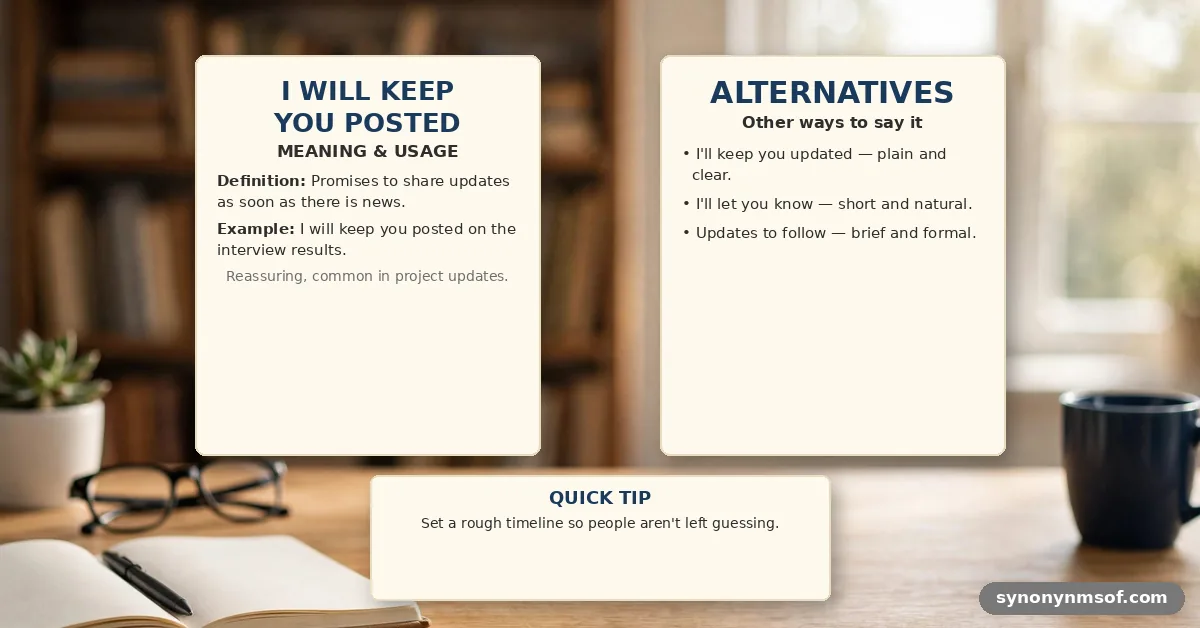
At its core, this phrase means you have acknowledged a request or a situation and intend to share relevant developments as they occur. It is not an excuse to go silent, but rather a promise of transparency. By using it correctly, you establish yourself as a reliable communicator who values the time and interest of others.
The literal meaning of “keeping someone posted” comes from the historical practice of posting notices on boards. In modern professional settings, it functions as a verbal or written contract of ongoing transparency. You are essentially saying, “I am responsible for this information flow, and I will alert you when there is something new to share.”
When you use this phrase, you aren’t just saying you will talk again; you are committing to a specific process of monitoring and reporting. It is best suited for scenarios where a resolution is pending or a project is mid-cycle. Using it when a task is already finished or when you have no intention of updating the person can lead to frustration and a lack of trust.
Professional Applications

In a business environment, the best way to utilize this phrase is to pair it with a timeline or a condition. Saying “I will keep you posted” alone is often too vague for a busy manager or a high-stakes client. Adding a detail turns it into a high-value communication tool.
Consider the difference between a vague promise and a structured one. A vague version leaves the recipient wondering when the next update will arrive. A structured version, such as “I will keep you posted by the end of the day,” gives the recipient a specific milestone to anticipate.
Best Practice Examples
- “I am waiting on the final budget approval and will keep you posted as soon as I hear back.”
- “Our team is currently troubleshooting the server error; I will keep you posted on our progress every two hours.”
- “I have received your inquiry and will keep you posted once I have consulted with the legal department.”
- “We are tracking the shipment status and will keep you posted if there are any further delays.”
The Anatomy of an Update
Effective communication relies on the quality of the information you share after the initial promise. Simply saying you will keep someone posted is only the first step. The follow-through is what determines your reputation for reliability. Precision matters in updates too — our guide to dreamt or dreamed settles a common spelling question.
When you provide an update, avoid repeating the same information twice. If there is no new information, it is often better to say, “I am still waiting on the update I promised, but I wanted to let you know I haven’t forgotten.” This shows you are still actively monitoring the situation even when there is no tangible progress to report.
Comparing Communication Styles
Different phrases carry different weights in a professional setting. Choosing the right one depends on the level of formality and the nature of the relationship you have with the recipient. For another commonly confused pair, see our guide to fliers or flyers before you finalize your message.
| Phrase | Best Used For | Tone |
|---|---|---|
| I will keep you posted | General project updates | Professional/Standard |
| I will keep you updated | Formal status reports | Formal |
| I will reach out shortly | Immediate follow-ups | Urgent |
| I’ll let you know | Casual internal chats | Informal |
Avoiding Overuse
One of the biggest mistakes professionals make is using this phrase as a way to end a conversation prematurely. If you use it too often without actually delivering updates, it becomes a signal of avoidance. People will eventually perceive it as a way to brush them off rather than a genuine promise of future contact.
If you find yourself using the phrase constantly, evaluate whether you are actually providing value in your follow-ups. If your updates are just “nothing new yet,” consider changing your strategy. Perhaps you only need to contact them when a meaningful milestone is reached, rather than promising to keep them posted on every minor detail.
The Importance of Clarity
Clarity is the antidote to communication breakdown. When you promise to keep someone posted, you must define the scope of that promise. Are you sending an email? Small details like girlie or girly can also affect how polished your writing feels.
A Slack message? A formal report?
Ambiguity creates confusion. If you don’t specify the channel of communication, the other person might be checking their email while you are sending updates via an instant messaging platform. Always clarify the “how” and the “when” to ensure your commitment is met effectively.
Cultural Context

While the phrase is widely accepted in English-speaking business environments, it is worth considering cultural nuances. In some high-context cultures, direct promises of future updates might be interpreted differently. Always assess your audience’s preferences for communication frequency.
Some clients prefer a “no news is good news” approach, while others suffer from anxiety if they don’t receive daily reports. Adapting your use of this phrase to fit the recipient’s personality is a sign of high emotional intelligence. Do not force your own communication style onto someone who clearly prefers a different rhythm.
Biblical Perspectives on Communication
Wisdom literature often highlights the value of keeping one’s word. Proverbs 10:19 suggests that in many words, sin is not absent, but he who restrains his lips is wise. This applies to how we manage our professional promises.
If you promise to keep someone informed, ensure your words are backed by action. In the book of Colossians, the writer encourages us to let our speech always be with grace, seasoned with salt, so that we may know how to answer each person. This implies that our updates should be thoughtful and appropriate for the recipient’s needs.
Managing Expectations
The ultimate goal of using this phrase is to manage expectations successfully. If you know that a project will take two weeks, saying “I will keep you posted” is not enough. You should provide an estimated date for the next update.
When you set a specific date, you give the other party permission to stop worrying about the task. They know they don’t need to ask you for an update until that date arrives. This builds massive trust over time because you are proving that you respect their mental bandwidth.
Common Pitfalls
One major pitfall is the “silent treatment” that follows the phrase. Many people use it to escape a conversation, only to disappear for days. This is the fastest way to lose credibility.
Another pitfall is providing too much information. If you promise to keep someone posted, they expect the relevant highlights, not a data dump. Keep your updates concise and focused on what actually matters to the recipient’s goals.
When to Avoid the Phrase
Sometimes, this phrase is simply inappropriate. If you are in a high-pressure situation where the other party is already frustrated, a vague promise to “keep them posted” might sound dismissive. In these cases, provide a concrete plan instead.
For example, say: “I understand the urgency of this situation. I will provide you with a status update by 4:00 PM today, regardless of whether we have a final resolution.” This is far more comforting than a generic promise of future updates.
The Psychology of Updates
People value predictability. When you promise to keep someone posted, you are offering them a sense of control over an uncertain situation. This psychological comfort is often just as valuable as the information itself.
When you fail to follow through, you strip away that sense of control. This is why consistent communication is a pillar of leadership. You are not just updating someone on a task; you are reinforcing the strength of your professional relationship through reliability.
FAQ
Is it grammatically correct to say “I’ll keep you posted”?
Yes, it is perfectly correct and widely used in both spoken and written English. It is an idiomatic expression that is accepted in almost all professional contexts.
What is a better way to say “I will keep you posted”?
If you want to sound more formal, you can use “I will keep you updated” or “I will provide progress reports as they become available.” For more casual settings, “I’ll let you know as things develop” works well.
When someone says they will keep me posted, what should I do?
You should acknowledge the statement and, if necessary, clarify the timeline. A simple “Thanks, that works for me. Looking forward to hearing from you by [Day]” is a great way to ensure you are both on the same page.
Is this phrase professional enough for high-level executives?
It is professional, but with executives, it is always better to be specific. Instead of just saying the phrase, add the frequency: “I will keep you posted with a brief email update every Friday afternoon.”
Conclusion
Mastering the phrase “I will keep you posted: meaning and best uses” requires more than just knowing the definition. It demands a commitment to transparency, a respect for timelines, and the emotional intelligence to adapt your communication to the person on the other end. Keep refining your word choices with resources like our breakdown of preventive or preventative.
When you use this phrase, you aren’t just filling silence; you are building a reputation for reliability and clear, purposeful action. By defining your updates and sticking to your promises, you transform a simple social pleasantry into a powerful tool for professional success.
Take a moment to review your recent communications. Are you using this phrase as a crutch, or are you backing it up with actual, timely information?
Start by being more specific with your follow-ups this week. You will quickly find that your colleagues and clients feel more at ease, and your own project management becomes significantly more streamlined.