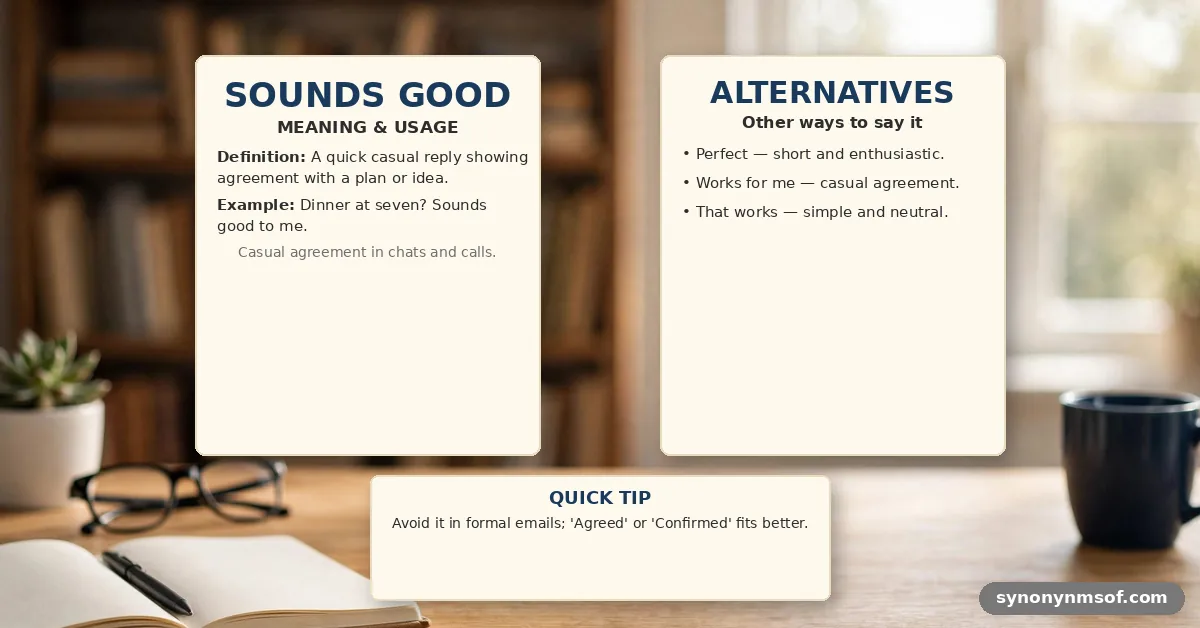

Understanding the nuances of “Sounds Good: Meaning, Replies, and Better Alternatives” is essential for anyone looking to refine their digital and verbal communication. This phrase functions as a versatile acknowledgment of a plan, a suggestion, or a piece of information, signaling both agreement and satisfaction. While it is widely accepted in casual settings, its overuse can sometimes signal a lack of engagement or professional depth.
By mastering when to use it and when to swap it for a more specific response, you can significantly improve your clarity and authority. This guide provides the tools to evaluate your current messaging habits and upgrade your conversational style across various social and professional contexts.
At its simplest level, “sounds good” is a verbal shorthand for expressing approval or consensus. It confirms that the listener has processed the information and finds it acceptable or agreeable. In most daily interactions, it serves as a low-friction way to close a loop or finalize a decision without needing a long-winded explanation.
The phrase carries a specific tone of casual efficiency. It suggests that the speaker is satisfied with the current path and does not require further changes. Because it is so brief, it is a staple in instant messaging platforms like Slack, WhatsApp, or Microsoft Teams, where speed is often valued over elaborate prose.
Despite its utility, the phrase can occasionally come across as dismissive or lazy. If a colleague presents a complex project plan and you reply only with these two words, it may imply you haven’t truly engaged with the details. Context remains the primary factor in determining whether the phrase lands as supportive or indifferent.
Immediate Replies to “Sounds Good”
When someone says “sounds good” to you, they are essentially signaling that the conversation can move forward or conclude. You don’t always need a long response, but acknowledge their confirmation to keep the momentum going. Your reply should match the level of formality established in the preceding exchange.
If you are coordinating a meeting, a simple “Great, I’ll see you then” works perfectly. If you are clarifying a task, you might opt for “Glad we’re on the same page.” Keeping your response brief shows that you respect their time and are ready to execute the discussed plan.
The following table outlines how to reply based on the situation you are facing.
| Context | Recommended Reply | Tone |
|---|---|---|
| Casual Friend | “Perfect! See you there.” | Friendly/Low-stakes |
| Professional Colleague | “Acknowledged. I’ll proceed accordingly.” | Formal/Efficient |
| Client/Customer | “I’m glad that works for you. Let me know if you need anything else.” | Service-oriented |
| Group Chat | “Awesome, thanks for the heads up!” | Collaborative/Casual |
Why “Sounds Good” Can Fall Short
The primary issue with using “sounds good” as a default response is the lack of specific feedback. If someone works hard to present a unique idea or a detailed proposal, a generic “sounds good” can feel like a brush-off. It fails to highlight what exactly you liked about the suggestion.
In high-stakes professional environments, clarity is a currency. Using vague language can lead to misunderstandings, as the other person may not know if you actually understand the nuances of the plan. They might assume you agreed to the whole thing, whereas you only agreed to a part of it.
Consider the psychological impact of your word choices on your team. A more specific affirmation acts as positive reinforcement, which builds trust and encourages better performance. If you want to be seen as a leader or a thoughtful communicator, you must move beyond filler phrases.
Professional Alternatives for Workplace Emails
In an email, the stakes for your language are higher than in a quick text message. You want to appear attentive, competent, and organized. Replacing “sounds good” with a more descriptive sentence shows that you are actively thinking about the project.
Instead of “sounds good,” try to explicitly restate the action you are taking. For example, “That plan works well for me, and I will have the report finished by Tuesday.” This leaves no room for ambiguity regarding the deadline or the task at hand.
You can also use phrases that emphasize partnership and alignment. Here are several professional alternatives you can integrate into your daily workflow:
- “That sounds like an effective approach to the problem.”
- “I agree with that timeline; let’s move forward.”
- “That works for me. I’ll get started on the first phase immediately.”
- “I appreciate the update; that plan aligns with our goals.”
- “Understood. I will implement those changes by EOD.”
Casual Alternatives for Social Settings
When you are talking to friends or family, you have more freedom to be expressive and warm. The goal in these settings is to show enthusiasm rather than just compliance. “Sounds good” can sometimes sound a bit robotic, so try using more colorful language to reflect your actual excitement.
For instance, if a friend suggests a dinner spot, “That sounds delicious, I’m in!” is far better than a flat “sounds good.” It conveys that you aren’t just agreeing to be polite; you are genuinely looking forward to the activity. Small shifts in vocabulary can make your relationships feel more vibrant.
You might also consider using short, punchy affirmations that carry more emotional weight. “Works for me,” “I’m down,” or “Let’s do it” are all excellent ways to signal agreement while sounding more human. Choose words that fit your natural personality and the specific vibe of the conversation.
The Power of Specific Affirmation
Specific feedback is a cornerstone of effective communication. When you tell someone exactly what you like about their idea, you provide them with a roadmap for future success. This is often called the “Why” behind the “Yes.”
If a coworker suggests a new software tool, don’t just say “sounds good.” Say, “That sounds like a great way to streamline our data entry process.” By naming the benefit, you prove you were listening and that you value their contribution to the team’s efficiency.
Practicing this habit will change how people perceive you in meetings. You will shift from being a passive recipient of information to an active participant. This simple change in communication style can improve your professional reputation significantly over time.
Using “Sounds Good” in Digital Chat Platforms

Slack and Microsoft Teams have changed how we communicate, making short responses the norm. In these fast-paced environments, it is easy to default to “sounds good” because you are trying to keep up with a dozen threads at once. However, even in chat, there are better ways to be brief.
Use reactions to save time while showing acknowledgement. A simple thumbs-up emoji often conveys the exact same message as “sounds good” without cluttering the chat window. This allows you to manage information flow efficiently without sacrificing the tone of your team.
When you do need to write a reply, try adding a tiny bit of context. “Sounds good, thanks for the update” is better than just the two words alone. It adds a layer of gratitude that smooths over the brevity of the message.
Avoiding the “Yes-Man” Trap
One danger of using “sounds good” too frequently is that it can make you seem like a “yes-man.” If you agree to everything without question, people might stop trusting your judgment. They may assume you are just trying to be agreeable rather than providing honest input.
If you disagree with a point, don’t use “sounds good” as a placeholder while you think. It is better to be honest early on.
You can say, “That sounds like an interesting start, but I have a few concerns about the budget.” This is much more productive than pretending to agree.
Authenticity is a key component of effective communication, as noted in the Harvard Business Review guide on giving and receiving advice. People respect those who can balance agreement with constructive skepticism. Use your words to show that you are thinking critically about the task at hand.
The Cultural Context of Agreement
Different cultures and regions view the phrase “sounds good” differently. In some high-context cultures, brevity might be seen as a lack of respect or a sign that the speaker is not taking the matter seriously. It is important to be aware of your audience’s expectations.
In more formal international business settings, you might want to avoid “sounds good” entirely in favor of more structured language. Phrases like “I confirm our agreement with the proposed terms” carry more weight and leave no room for cultural misinterpretation. Always err on the side of formality when you are unsure.
Conversely, in very casual or tight-knit groups, being overly formal can create distance. You want to blend in with the existing culture of the group. Observe how the leaders or the most respected members of your peer group communicate and mirror their level of formality.
When to Pivot to a Question
Sometimes, “sounds good” is the wrong response because you actually need more information. If you find yourself wanting to say “sounds good” but you are still confused, pivot to a clarifying question instead. This prevents you from agreeing to something you don’t fully grasp.
You could say, “That sounds like a solid plan, but could you clarify how we are handling the shipping logistics?” This shows you are engaged and proactive. It turns a simple acknowledgment into a collaborative problem-solving session.
Asking a follow-up question is the best way to ensure that both parties are aligned. It also demonstrates that you are a detail-oriented person who cares about the success of the outcome. Never sacrifice clarity for the sake of a quick, easy exit from a conversation.
Adapting Your Style Over Time
Your communication style should not be static. As you grow in your career or change social circles, the way you speak and write will naturally evolve. Take the time to audit your own messages periodically to see if you are relying too heavily on “sounds good.”
Try a week of intentional communication. Make a conscious effort to use specific alternatives every time you feel the urge to type “sounds good.” You might find that your colleagues respond more positively to your messages when you provide that extra bit of detail.
Remember that communication is a skill that requires constant practice. Just like any other professional ability, it improves with feedback and refinement. Pay attention to how others respond to your new phrasing and adjust accordingly to find what works best for your personal style.
Biblical Perspectives on Speech
The importance of careful speech is a recurring theme in ancient wisdom, reminding us that our words carry significant weight. Proverbs 15:23 suggests that a man has joy by the answer of his mouth, and a word spoken in due season, how good it is! This highlights that the timing and quality of our responses matter deeply to those around us.
Similarly, Colossians 4:6 encourages us to let our speech always be with grace, seasoned with salt, that we may know how we ought to answer every man. This implies that we should be thoughtful about the “flavor” and tone of our words. Whether we are agreeing to a plan or giving feedback, our words should reflect a genuine spirit of grace and clarity.
Thinking about the impact of our words—even simple phrases like “sounds good”—is a way to practice better stewardship of our interactions. By choosing our responses intentionally, we honor the people we speak to and ensure our communication remains effective and kind.
FAQ
What is a better professional alternative to “sounds good”?
In a professional setting, it is better to be specific about what you are agreeing to. Use phrases like “That plan works well for me,” “I agree with that approach,” or “I will implement those changes immediately.” This confirms your understanding and shows you are ready to take action.
Is “sounds good” considered rude in emails?
It is not necessarily rude, but it can come across as dismissive if it is the only thing you write. If you use it, always pair it with a follow-up sentence, such as “Sounds good—I’ll have the draft ready by tomorrow.” Adding context transforms it from a potentially lazy response into a professional confirmation.
What should I reply if someone says “sounds good” to me?
You don’t always need a long reply, but a simple acknowledgment helps close the loop. A quick “Great, talk soon,” or “Perfect, I’ll keep you posted on the progress,” is sufficient. It shows that you heard them and are moving forward with the plan.
How can I stop overusing “sounds good”?
The best way to break the habit is to force yourself to add one sentence of context after the phrase. If you find you cannot add a sentence, it means you aren’t really engaged, which is your cue to ask a question instead. Over time, this will train you to provide more meaningful input in every conversation.
Does “sounds good” work in group chats?
Yes, it is perfectly acceptable in group chats where speed is prioritized. However, if you are in a leadership position, try to vary your responses. Using reactions or more descriptive affirmations can help boost team morale and clarity more effectively than a generic reply.
Conclusion
Improving your communication style begins with a simple awareness of the words you use every day. While “Sounds Good: Meaning, Replies, and Better Alternatives” covers a common phrase, the broader lesson is about the value of clarity and intent. By replacing generic acknowledgments with specific, thoughtful responses, you demonstrate respect for your colleagues and friends while ensuring everyone stays on the same page.
Whether you are navigating a high-pressure email thread or finalizing plans with a close friend, choosing your words with care will always lead to more productive and meaningful interactions. Start by observing your own habits this week, and you will soon find that your ability to communicate with precision and grace becomes one of your most reliable professional assets.