
Understanding the proper use of phrases like please advise: meaning, examples, and professional alternatives is essential for maintaining clear and effective workplace communication. While this common business idiom is intended to solicit guidance or next steps, it often comes across as abrupt, dated, or overly passive to modern readers.
You need to know when this phrasing is appropriate and when a more specific call to action will yield better results from your colleagues or clients. Mastering these nuances allows you to project greater professionalism while ensuring your requests are actionable and well-received by those you work with every day.
At its core, the phrase is a formal request for information, instructions, or a status update. It functions as a polite imperative designed to prompt the recipient to share their expertise or provide a decision on a pending matter. By using it, you are effectively shifting the responsibility of the next step onto the person receiving your email or message.
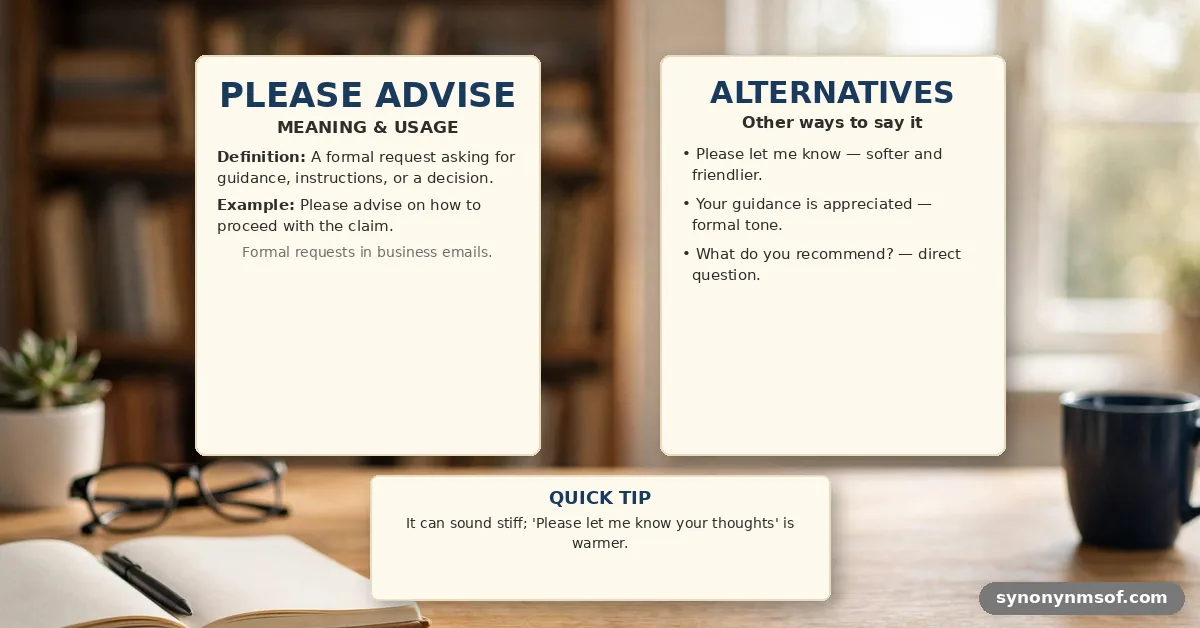
The term is technically a verb, meaning to give counsel or information. When used in a business context, it serves as a shorthand for “please provide me with the necessary details to move forward.” However, because it is so frequently overused, it can sometimes feel like a lazy way to end a message without specifying exactly what kind of input you require.
When to Use This Phrase

There are specific scenarios where using this traditional phrasing remains acceptable and even helpful. It works best when you are communicating with someone in a senior position who holds the authority to make a final decision on a project. In these cases, you are acknowledging their status by asking them to guide the direction of your work.
You might also use it when the situation is fluid and you genuinely do not know the correct path forward. If a project has hit a deadlock, asking for advice can signal that you are ready to pivot based on their assessment of the risks. It is a way to show that you are waiting for their signal before committing resources to a specific task.
Why It Often Fails
The primary issue with this phrase is its lack of specificity. When you send an email asking someone to “please advise,” you are forcing the recipient to guess what you need from them. They have to scan the entire thread to figure out which question you are actually asking, which creates unnecessary cognitive load.
It can also sound slightly cold or demanding. Because it is a short, clipped sentence, it lacks the warmth of a collaborative request.
If you use it too often, it can make you seem like you are avoiding taking ownership of your own tasks. It suggests you want someone else to do the thinking for you rather than presenting a proposed solution.
Professional Alternatives to Use
You can achieve much better results by being direct about what you need. Instead of a vague request, provide your recipient with clear options or a specific question that makes it easy for them to reply. This approach respects their time and speeds up the decision-making process.
Consider the following alternatives that convey the same intent but with more clarity:
- “Could you please let me know your thoughts on this proposal?”
- “I would appreciate your guidance on how we should handle the client’s request.”
- “Please share your feedback on the attached draft by Thursday.”
- “Which of these two options would you prefer we pursue?”
- “I am ready to proceed once I have your approval on the budget.”
Comparison of Request Phrasing
The effectiveness of your communication often depends on the specificity of your language. The following table illustrates how shifting away from the generic “please advise” can improve clarity in your daily correspondence.
| Original Phrasing | Improved Alternative | Resulting Benefit |
|---|---|---|
| Please advise on this matter. | Could you clarify the next step? | Reduces ambiguity for the reader. |
| Please advise if this is okay. | Do you approve of this timeline? | Requires a simple yes or no answer. |
| Please advise on the changes. | What are your specific edits here? | Focuses the reader on key sections. |
| Please advise at your convenience. | Could you reply by Friday at 5 PM? | Sets a clear deadline for action. |
The Grammar of the Request
A common question is whether the phrase is grammatically correct. In formal English, “advise” is a verb, while “advice” is the noun. Using “please advise” is grammatically sound, though it is often considered an elliptical construction where the object is implied rather than stated.
You should never use “please advice” as a request. That would be like saying “please information,” which makes no sense in English. Always stick to the verb form if you choose to use the phrase, or better yet, consult a trusted dictionary resource to ensure you are using the correct part of speech in your professional writing.
Setting Clear Expectations

When you ask for help, you are essentially asking the other person to invest their time in your work. If you are vague, you are wasting that investment. By defining exactly what you need, you demonstrate that you value their time and that you have done the preliminary work yourself.
Instead of just asking for advice, explain the context. Tell the recipient what you have already tried, what the potential outcomes are, and why their specific input is necessary. This shows that you are a proactive problem-solver who just needs a final push, rather than someone who is waiting for instructions.
When to Avoid the Phrase Entirely
Never use “please advise” when you are speaking to a peer or someone you work with closely. It can sound patronizing or overly bureaucratic in a casual Slack message or a quick email. In these environments, simple language is almost always more effective.
Also, avoid using it when you are in a position of authority over someone else. If you are a manager, you should provide clear instructions rather than asking for advice. If you need their input, frame it as a consultation rather than an order to provide information.
Tone and Context Matters
Your tone dictates how your request is received. If you are in a high-pressure situation, a short, clipped phrase might be interpreted as frustration. Even if you are in a hurry, taking an extra five seconds to write a complete sentence will pay off in the long run.
Consider the difference between “Please advise on the report” and “I’ve finished the draft of the report; could you take a look when you have a moment?” The latter builds a relationship, while the former simply demands a task. Always aim for a tone that invites collaboration rather than one that demands compliance.
Formatting Your Requests
If you have multiple questions, do not lump them into a single “please advise” request. Use bullet points to separate your queries. This allows the recipient to answer each point individually and ensures that nothing gets lost in the shuffle.
When you make it easy for someone to reply, they are much more likely to do so quickly. If they have to write a long paragraph to address your vague request, they might put it off until later. If they can just type a quick “Yes,” “No,” or “Option B,” you will get your answer in minutes.
Cultural Nuances in Communication
It is important to note that business norms vary by region and industry. In some international business cultures, “please advise” is a standard, polite way to initiate a request for information. It is seen as a sign of respect for the recipient’s expertise.
However, in fast-paced Western environments, it is often viewed as a holdover from older, more formal communication styles. If you are unsure of the norms, look at how your colleagues communicate with each other. If everyone else is using direct language, you should probably do the same.
Developing Your Own Style
You don’t have to be robotic in your emails to be professional. Developing a style that is both clear and personable is the hallmark of a great communicator. Use the phrase sparingly, and only when you truly feel it fits the formality of the situation.
Over time, you will find that your colleagues appreciate the clarity you bring to the table. When you stop using vague fillers, you become known as someone whose emails are always worth reading because they are helpful and concise. This builds your reputation as a reliable and thoughtful professional.
Frequently Asked Questions
Is it ever okay to use “please advise” in a formal letter?
Yes, it is perfectly acceptable in very formal, legal, or high-level business correspondence. In these contexts, the traditional, slightly detached tone is often expected and appropriate. It functions as a standard professional closing for a request.
How can I make my requests sound less demanding?
The best way to soften a request is to add context or a polite opening. Instead of starting with “Please advise,” try “I would appreciate your guidance on this” or “Could you let me know your thoughts?” These phrases frame the request as a collaborative discussion rather than a command.
What should I do if I am ignored after using this phrase?
If you don’t receive a response, the issue might be that your request was too vague for the recipient to act upon. Follow up by providing the specific details or options you need. A clear, actionable follow-up is much more effective than simply repeating your original request.
Are there any industries where this phrase is mandatory?
While not strictly mandatory, it remains common in legal, government, and some corporate finance roles. These industries often rely on standardized, formal language to ensure clarity and maintain a professional distance. If you are new to these fields, observe the correspondence of your superiors to see how they handle it.
Can I use this phrase in a text or instant message?
It is generally best to avoid this phrase in instant messaging. These platforms are designed for quick, casual, and direct communication. Using overly formal language like “please advise” can feel out of place and break the flow of a real-time conversation.
Conclusion
Improving your workplace communication starts with recognizing that your words have an impact on how others perceive your professionalism. While using phrases like please advise: meaning, examples, and professional alternatives might seem like a small detail, it is a significant part of how you build rapport and clarity with your team. By choosing more direct and specific language, you save time, reduce confusion, and show respect for your colleagues’ contributions.
Next time you sit down to write an email, try swapping out the generic filler for a clear call to action. You will likely notice that people respond faster and with more helpful information. Start making these small adjustments today to see a real difference in your professional interactions.