
Have you ever started an email with “I was referred to you by…” and wondered whether it sounded professional enough?
You’re not alone.
Whether you’re applying for a job, reaching out to a potential client, requesting a meeting, or expanding your professional network, mentioning a referral can instantly make your message feel more trustworthy. Instead of appearing as a complete stranger, you’re introducing yourself through a shared connection.
That simple phrase does more than explain how you found someone’s contact information—it creates credibility before the conversation even begins.
Still, using the exact same wording every time can feel repetitive. Fortunately, there are many natural and professional alternatives that help you sound more confident while keeping your communication fresh.
In this guide, you’ll learn exactly what “I was referred to you by” means, when to use it, why it works so well, and discover more than 35 professional alternatives with real-world examples.
Quick Answer
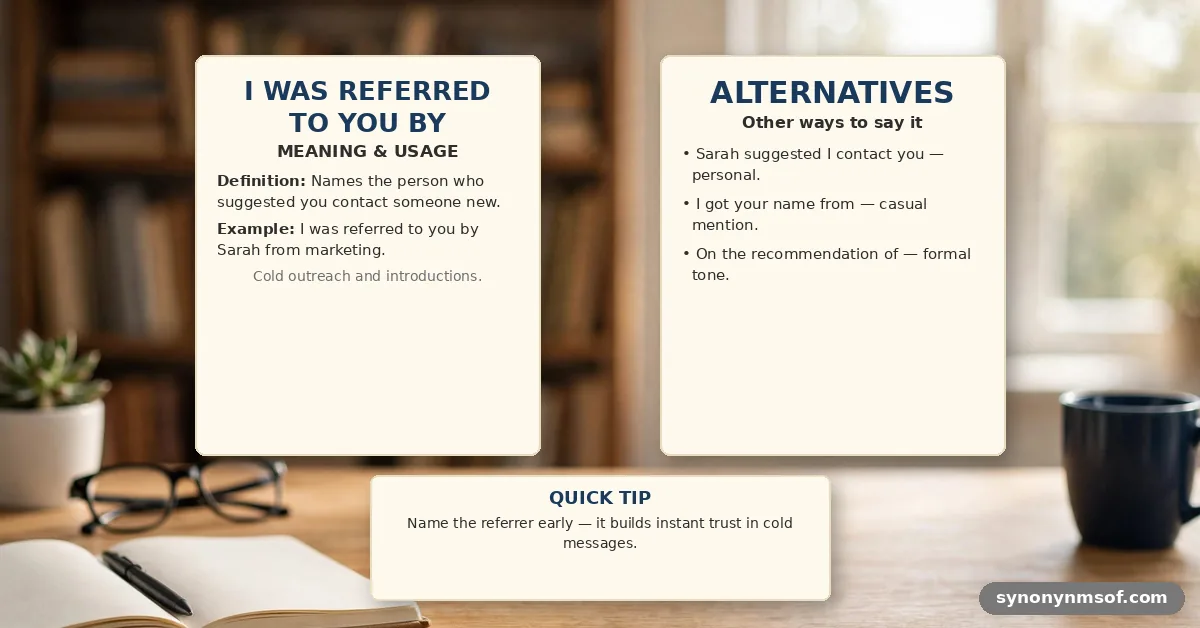
“I was referred to you by” means that another person recommended or suggested that you contact someone.
It’s commonly used in:
- Job applications
- Networking emails
- LinkedIn messages
- Business introductions
- Sales outreach
- Freelance inquiries
- Client referrals
Mentioning a referral builds trust because it shows you already share a mutual connection.
What Does “I Was Referred to You By” Mean?
The phrase simply means:
Someone recommended that I contact you.
Rather than reaching out randomly, you’re letting the recipient know that another person believed the connection would be valuable.
Usually, the referral comes from someone like:
- A colleague
- A manager
- A recruiter
- A professor
- A client
- A mutual friend
- A business partner
- A former coworker
- A mentor
For example:
“I was referred to you by Jessica Brown, who suggested I reach out regarding your open marketing position.”
This immediately provides context and makes your introduction feel much warmer than a cold email.
See Also: 28 Better Alternatives of “Thanks for the Heads Up”
Why This Phrase Is So Effective
People naturally trust recommendations.
Think about how you choose:
- Restaurants
- Doctors
- Contractors
- Software
- Books
Most people rely on recommendations before making a decision.
Professional communication works the same way.
When someone you know recommends another person, part of your trust transfers automatically.
Psychologists often refer to this as transferred credibility or borrowed trust.
Instead of asking,
“Who is this person?”
the recipient thinks,
“If someone I know recommended them, they’re probably worth talking to.”
That small shift dramatically changes how your message is received.
Is “I Was Referred to You By” Professional?
Absolutely.
In fact, it’s considered one of the most professional ways to introduce yourself when you genuinely have a mutual connection.
Hiring managers, recruiters, clients, consultants, and executives receive hundreds of unsolicited emails every week.
A referral immediately separates your message from generic outreach.
It also demonstrates honesty because you’re explaining exactly how you found the person.
When Should You Use This Phrase?
This expression works in almost every professional setting.
Some of the most common situations include:
Job Applications
Mentioning an employee referral can increase the chances that your application receives attention.
Example:
“I was referred to you by David Wilson from your engineering department.”
Networking
When building professional relationships, referrals make conversations feel more natural.
Example:
“Emily Carter suggested I reach out because of our shared interest in UX design.”
Freelancing
Freelancers often receive projects through recommendations.
Example:
“I was referred to you by Sarah Ahmed, who recently worked with your company.”
Client Introductions
Businesses frequently introduce new clients through referrals.
Example:
“Michael Thompson thought our services would be a good fit for your business.”
Sales Outreach
Warm introductions consistently outperform completely cold sales emails.
Rather than sounding promotional, your message begins with credibility.
See Also: Please Confirm Receipt of This Email: 28 Polite Alternatives
Why Referral Language Works Better Than Cold Outreach
Imagine receiving these two emails.
Example 1
Hello,
I’d like to introduce myself and discuss potential opportunities.
Professional?
Yes.
Memorable?
Not really.
Example 2
Hello Jennifer,
Michael Stevens recommended I reach out after mentioning your team’s recent expansion into digital marketing.
Notice the difference?
The second message immediately answers three questions:
- Why are you contacting me?
- How did you find me?
- Why should I pay attention?
That context makes the conversation feel far more genuine.
Benefits of Mentioning a Referral
Using referral language can help you:
- Build trust immediately
- Increase email response rates
- Create familiarity
- Reduce awkward introductions
- Improve networking success
- Strengthen professional credibility
- Make cold outreach feel warm
- Encourage meaningful conversations
Even one sentence mentioning a referral can significantly improve first impressions.
Comparison Table
| Phrase | Tone | Best Used For |
|---|---|---|
| I was referred to you by | Professional | General networking |
| [Name] suggested I reach out | Friendly | LinkedIn messages |
| [Name] recommended I contact you | Professional | Job applications |
| We have a mutual connection | Warm | Networking |
| I was introduced to you through | Formal | Business introductions |
| I received your contact information from | Professional | Client outreach |
| Your name came up in conversation | Conversational | Informal networking |
| [Name] pointed me in your direction | Friendly | Freelancing |
| I heard about you through | Casual | Professional networking |
| Following [Name]’s recommendation | Formal | Corporate emails |
Why Referrals Matter More Than Ever
Today’s professionals receive countless emails every day.
Recruiters receive hundreds of applications.
Managers receive dozens of meeting requests.
Business owners receive constant sales pitches.
The biggest challenge isn’t writing the perfect email.
It’s getting someone to open it.
A referral instantly solves part of that problem because people naturally prioritize messages connected to someone they already know.
Trust is one of the most valuable currencies in professional communication.
Referral language helps establish that trust before you’ve even introduced yourself.
35 Other Ways to Say “I Was Referred to You By” (With Examples)
Repeating the same phrase in every email or LinkedIn message can make your communication feel repetitive. The good news is that there are many professional alternatives that convey the same idea while matching different situations and tones.
Whether you’re contacting a recruiter, networking with an industry professional, or reaching out to a prospective client, the following alternatives can help you sound more natural and engaging.
1. [Name] Suggested I Reach Out
This is one of the most natural and commonly used alternatives.
Example:
“Emily Carter suggested I reach out regarding the marketing position on your team.”
Best for: Networking, LinkedIn, job applications
2. [Name] Recommended I Contact You
Slightly more formal than “suggested.”
Example:
“David Lee recommended I contact you to learn more about your consulting services.”
Best for: Business emails
3. I Was Given Your Contact Information by [Name]
A direct and professional option.
Example:
“I was given your contact information by Sarah Wilson, who thought you could help me.”
4. We Have a Mutual Connection in [Name]
Perfect when introducing yourself through shared contacts.
Example:
“We have a mutual connection in Michael Brown, who encouraged me to get in touch.”
5. I Was Introduced to You Through [Name]
Useful if someone formally connected you.
Example:
“I was introduced to you through Jennifer Adams during last week’s conference.”
6. [Name] Thought We Should Connect
Warm and conversational.
Example:
“Daniel thought we should connect because of our shared interest in product design.”
7. I Was Encouraged to Reach Out by [Name]
Shows that someone actively supported the introduction.
Example:
“I was encouraged to reach out by Lisa Morgan after discussing your recent project.”
8. Your Name Was Recommended to Me
Professional and respectful.
Example:
“Your name was recommended to me as someone with extensive experience in HR.”
9. I Heard About You Through [Name]
Simple and friendly.
Example:
“I heard about you through Robert Evans and wanted to introduce myself.”
10. [Name] Pointed Me in Your Direction
A conversational alternative.
Example:
“Amanda pointed me in your direction when I mentioned my interest in digital marketing.”
11. I Was Connected With You Through [Name]
A polished networking phrase.
Example:
“I was connected with you through Kevin Lewis after attending the industry summit.”
12. [Name] Mentioned That I Should Contact You
Professional and approachable.
Example:
“Jessica mentioned that I should contact you regarding internship opportunities.”
13. I Came Across Your Contact Through [Name]
Great when someone shares contact details.
Example:
“I came across your contact through Alex Turner, who spoke highly of your work.”
14. [Name] Believed You Could Help Me
Friendly and sincere.
Example:
“Rachel believed you could help me better understand the certification process.”
15. I Was Directed to You by [Name]
More formal wording.
Example:
“I was directed to you by our regional manager regarding vendor partnerships.”
16. I Was Advised to Contact You
Suitable for formal business communication.
Example:
“I was advised to contact you concerning the upcoming project.”
17. Your Name Came Up During a Conversation
Natural and conversational.
Example:
“Your name came up during a conversation with Melissa, and she highly recommended speaking with you.”
18. [Name] Spoke Highly of You
Complimentary and warm.
Example:
“John spoke highly of you and suggested I introduce myself.”
19. Following [Name]’s Recommendation
Professional and polished.
Example:
“Following Michael’s recommendation, I’d like to discuss potential collaboration opportunities.”
20. I Wanted to Introduce Myself After Speaking With [Name]
Ideal for networking.
Example:
“I wanted to introduce myself after speaking with David at last week’s conference.”
21. Our Mutual Acquaintance Suggested We Connect
Excellent for LinkedIn.
Example:
“Our mutual acquaintance, Emma Wilson, suggested we connect.”
22. I Learned About Your Work Through [Name]
Focuses on admiration rather than a direct referral.
Example:
“I learned about your work through James Collins and found it incredibly inspiring.”
23. [Name] Thought You’d Be the Right Person to Speak With
Shows clear intent.
Example:
“Maria thought you’d be the right person to speak with regarding your training program.”
24. I Received Your Name From [Name]
Short and professional.
Example:
“I received your name from Daniel Roberts while researching local consultants.”
25. A Colleague Suggested I Contact You
Useful when mentioning the person’s name isn’t necessary.
Example:
“A colleague suggested I contact you about potential partnership opportunities.”
26. I Was Referred Your Way
A modern variation.
Example:
“I was referred your way after expressing interest in your leadership program.”
27. I’ve Been Told You’re the Best Person to Speak With
Friendly and respectful.
Example:
“I’ve been told you’re the best person to speak with about international recruitment.”
28. Several People Recommended That I Reach Out
Helpful when there isn’t just one referral.
Example:
“Several people recommended that I reach out to you regarding your expertise in finance.”
29. I Was Happy to Receive Your Recommendation From [Name]
Warm and appreciative.
Example:
“I was happy to receive your recommendation from Karen Brooks.”
30. Your Expertise Was Recommended to Me
Emphasizes the recipient’s reputation.
Example:
“Your expertise was recommended to me by one of your former clients.”
31. I Was Encouraged to Introduce Myself
Professional and friendly.
Example:
“I was encouraged to introduce myself after attending your recent webinar.”
32. I Understand We Share a Mutual Contact
Ideal for LinkedIn networking.
Example:
“I understand we share a mutual contact in Jennifer Thomas.”
33. I Was Hoping to Connect Based on [Name]’s Recommendation
Excellent for professional outreach.
Example:
“I was hoping to connect based on Michael Green’s recommendation.”
34. [Name] Felt We Should Connect
Modern and conversational.
Example:
“Sophia felt we should connect because of our shared experience in project management.”
35. I Came to You on the Recommendation of [Name]
A polished, formal option.
Example:
“I came to you on the recommendation of Robert Harris regarding legal consulting services.”
Quick Reference Table
| Alternative | Tone | Best For |
|---|---|---|
| Suggested I reach out | Friendly | |
| Recommended I contact you | Professional | Job applications |
| We have a mutual connection | Warm | Networking |
| Introduced through | Formal | Business introductions |
| Pointed me in your direction | Casual | Freelancing |
| Spoke highly of you | Friendly | Relationship building |
| Following your recommendation | Formal | Corporate emails |
| Your name came up | Conversational | Networking |
| Directed me to you | Professional | Business communication |
| Thought we should connect | Warm | LinkedIn messages |
Choosing the Right Alternative
Not every phrase fits every situation. The wording you choose should match your audience and the relationship you hope to build.
For Job Applications
Use phrases such as:
- [Name] recommended I contact you.
- I was referred to you by…
- Following [Name]’s recommendation…
These sound polished and professional while highlighting a trusted connection.
For LinkedIn Networking
A more conversational tone often works best. Consider using:
- We have a mutual connection in…
- [Name] suggested I reach out.
- Your name came up during a conversation.
- [Name] thought we should connect.
These introductions feel approachable without sacrificing professionalism.
For Business and Client Outreach
When contacting potential clients, partners, or vendors, choose wording that conveys credibility:
- I was introduced to you through…
- I was directed to you by…
- I received your contact information from…
- Your expertise was recommended to me.
These alternatives establish trust while maintaining a respectful, businesslike tone.
How to Use “I Was Referred to You By” in Professional Communication
Knowing the right phrase is only half the battle. The real impact comes from how you use it. A referral should provide context, not dominate the conversation.
The best introductions are short, genuine, and focused on why you’re reaching out.
A good structure looks like this:
- Greet the recipient.
- Mention the referral within the first sentence.
- Explain why you’re reaching out.
- End with a polite call to action.
This approach feels natural and respects the recipient’s time.
Professional Email Examples
Example 1: Job Application
Subject: Introduction Through Michael Johnson
Hi Ms. Carter,
I hope you’re doing well.
I was referred to you by Michael Johnson, who spoke highly of your team and suggested I reach out regarding the Marketing Coordinator position. After reviewing the role, I believe my experience in content marketing and SEO aligns well with what you’re looking for.
I’d appreciate the opportunity to discuss how I could contribute to your team.
Thank you for your time, and I look forward to hearing from you.
Best regards,
Emily Davis
Example 2: Networking Email
Hi Daniel,
I hope your week is going well.
Sarah Williams suggested I reach out after mentioning your experience in UX design. I’ve been following your work and would love to learn more about your career journey.
If you have a few minutes in the coming weeks, I’d appreciate the opportunity to connect over a virtual coffee.
Thank you for considering my request.
Best,
James Lee
Example 3: Client Introduction
Hello Mr. Thompson,
Rachel Green recommended I contact you regarding your upcoming website redesign project.
After learning more about your company, I believe our team could help improve your online presence through modern web design and SEO strategies.
I’d be happy to schedule a brief call if you’re interested.
Thank you for your time.
Kind regards,
David Brown
Example 4: Sales Outreach
Hi Jennifer,
I hope you’re having a great day.
Mark Stevens thought you might be interested in learning more about our workflow automation platform. He mentioned that your team is currently exploring ways to improve operational efficiency.
I’d love to share a few ideas that may be helpful.
Would you be available for a brief conversation next week?
Best regards,
Ryan Collins
LinkedIn Message Examples
LinkedIn messages should be shorter than emails while still providing enough context.
Example 1
Hi Emma,
We have a mutual connection in Jessica Miller, who suggested I reach out. I’ve enjoyed reading your posts on leadership and would love to connect.
Thanks!
Example 2
Hi Michael,
Your name came up during a conversation with Chris Walker, and he highly recommended connecting with you. I work in digital marketing and admire the work you’ve been doing.
Looking forward to connecting.
Example 3
Hello Sarah,
John Roberts spoke highly of your experience in project management, so I wanted to introduce myself.
I hope we can connect here on LinkedIn.
Job Application Examples
Employee referrals can significantly improve the visibility of your application. When mentioning a referral, be honest and concise.
Example
Dear Hiring Manager,
I was referred to this opportunity by Laura Mitchell, a member of your customer success team. She encouraged me to apply because of my background in client relationship management.
I’m excited about the opportunity to contribute to your organization and have attached my resume for your review.
Thank you for your consideration.
Freelance Outreach Example
Hi Alex,
Jennifer Adams recommended I get in touch after hearing about your search for a freelance copywriter.
I’ve worked with several businesses in your industry and would love to discuss how I can support your upcoming projects.
Please let me know if you’d like to schedule a quick call.
Thanks,
Sophia
Asking Someone for Permission Before Mentioning Their Name
One mistake many professionals make is mentioning someone’s name without asking first.
Although it may seem harmless, it’s always good etiquette to confirm that the person is comfortable referring you.
A simple message like this works well:
“Hi Sarah, would you mind if I mention that you suggested I contact Michael? I just wanted to make sure you’re comfortable with that.”
This small step demonstrates professionalism and respect.
Common Mistakes to Avoid
Even with a referral, your message can fall flat if it’s poorly written. Avoid these common mistakes.
1. Name-Dropping Without Permission
Only mention someone if they’ve agreed to be your reference or referral.
2. Making the Referral the Entire Message
A referral opens the door, but it shouldn’t be the whole conversation.
Instead of writing:
“John told me to contact you.”
Expand it by explaining why you’re reaching out and what you hope to accomplish.
3. Sounding Too Demanding
Avoid jumping straight into requests.
Instead of:
“Can you get me an interview?”
Try:
“I’d appreciate the opportunity to learn more about your team and discuss how my experience might be a good fit.”
4. Writing Long Introductions
Your referral should take one or two sentences—not half the email.
5. Being Too Generic
Compare these two openings.
❌ Weak
“I was referred to you.”
✅ Better
“Michael Stevens suggested I reach out after hearing about your expansion into healthcare marketing.”
Specific details make your message far more memorable.
Tips for Writing Natural Referral Messages
Professional communication doesn’t have to sound robotic.
Keep these tips in mind:
- Mention the referral early.
- Be honest about your connection.
- Keep the introduction brief.
- Explain why you’re reaching out.
- Personalize your message.
- End with a polite request.
- Thank the recipient for their time.
- Proofread before sending.
The goal is to sound like a real person—not a template.
Referral vs. Recommendation vs. Introduction
These terms are often used interchangeably, but they have slightly different meanings.
| Term | Meaning | Example |
|---|---|---|
| Referral | Someone directs you to another person. | “Sarah referred me to you.” |
| Recommendation | Someone speaks positively about your abilities or suggests you. | “David recommended you for the role.” |
| Introduction | Someone formally connects two people. | “Lisa introduced us at the conference.” |
Understanding these differences helps you choose the most accurate wording.
Best Practices for Referral-Based Communication
Successful networking is built on relationships, not transactions.
Here are a few best practices:
- Always thank the person who referred you.
- Personalize every message.
- Mention the referral naturally.
- Be clear about your purpose.
- Respect the recipient’s time.
- Follow up politely if needed.
- Focus on building long-term relationships rather than seeking immediate favors.
When used thoughtfully, referral language can open doors that cold outreach often cannot.
The Psychology Behind Referral-Based Communication
Have you ever noticed how you’re more likely to try a restaurant, hire a contractor, or buy a product when someone you trust recommends it?
The same principle applies to professional communication.
A referral doesn’t just introduce your name—it transfers a small amount of trust from the person making the recommendation to you. This concept, often called social proof, helps people feel more comfortable responding because the interaction no longer feels like a complete cold introduction.
Instead of wondering, “Who is this?”, the recipient thinks, “Someone I know believes this conversation is worth having.”
That subtle shift can make a significant difference in how your message is received.
Why Warm Introductions Outperform Cold Outreach
Cold emails and unsolicited LinkedIn messages aren’t necessarily ineffective, but they often require much more effort to build credibility.
A referral shortens that process.
Warm introductions typically result in:
- Higher email open rates
- Better response rates
- Faster replies
- Stronger first impressions
- More productive conversations
- Greater professional credibility
- Easier relationship building
While referrals don’t guarantee success, they often increase the likelihood that someone will give your message genuine consideration.
How to Mention a Referral Naturally
The best referral messages don’t feel forced. Instead of making the referral the focus of your email, use it as a natural introduction before explaining your purpose.
A simple structure works well:
- Mention the mutual connection.
- Explain why you’re reaching out.
- Provide relevant context.
- End with a polite invitation to continue the conversation.
Example
Hi Amanda,
David Wilson suggested I reach out after we discussed your work in project management. I’ve been following your recent presentations and would appreciate the opportunity to learn more about your experience.
If you have a few minutes in the coming weeks, I’d be grateful for the chance to connect.
Thank you for your time.
Notice that the referral is mentioned naturally and doesn’t overshadow the rest of the message.
When You Should Avoid Using a Referral
Although referrals are valuable, there are situations where mentioning one may not be appropriate.
Avoid using referral language when:
- The person didn’t actually recommend you.
- You haven’t asked permission to mention their name.
- The recommendation is outdated.
- The mutual contact barely knows the recipient.
- You’re exaggerating the relationship.
- You’re using the referral simply to gain an advantage without any real connection.
Authenticity always outweighs clever wording.
Do’s and Don’ts
| Do | Don’t |
|---|---|
| Mention the referral early in your message. | Hide the referral until the end. |
| Ask permission before using someone’s name. | Name-drop without their knowledge. |
| Explain why you’re reaching out. | Assume the referral alone is enough. |
| Keep your introduction brief. | Write a lengthy backstory. |
| Personalize every message. | Copy and paste the same template. |
| Be respectful and professional. | Sound demanding or entitled. |
| Thank both the referrer and the recipient. | Forget to acknowledge the referral. |
Frequently Asked Questions
1. What does “I was referred to you by” mean?
It means another person recommended or suggested that you contact someone. The phrase provides context and establishes a mutual connection.
2. Is “I was referred to you by” professional?
Yes. It’s widely accepted in professional communication, including networking, job applications, business emails, and client outreach.
3. Should I mention who referred me?
Absolutely. Mentioning the person’s name adds credibility and helps the recipient understand how you’re connected. Just make sure you’ve received permission first.
4. What are the best alternatives to “I was referred to you by”?
Some excellent alternatives include:
- [Name] suggested I reach out
- [Name] recommended I contact you
- We have a mutual connection
- I was introduced to you through [Name]
- Your name came up during a conversation
- I was directed to you by [Name]
5. Does mentioning a referral improve response rates?
In many cases, yes. Messages that include a genuine referral often feel more trustworthy than unsolicited outreach, making recipients more likely to respond.
6. Can I use this phrase in a LinkedIn message?
Definitely. Referral language works especially well on LinkedIn because it highlights shared professional connections and creates a more personal introduction.
7. Should I always ask permission before mentioning someone’s name?
Yes. Asking first is considered good professional etiquette and helps avoid putting your mutual contact in an uncomfortable position.
8. Is a referral the same as a recommendation?
Not exactly. A referral directs you to another person, while a recommendation expresses confidence in your skills or qualifications. The two often overlap but aren’t identical.
9. How long should a referral introduction be?
Keep it brief—usually one or two sentences. Mention the referral, explain your purpose, and move naturally into the rest of your message.
10. What makes a referral message feel genuine?
The most effective referral messages are:
- Honest
- Personalized
- Respectful
- Clear
- Relevant
- Focused on building a relationship rather than making immediate demands
Final Thoughts
The phrase “I was referred to you by” remains one of the most effective ways to begin professional communication. It immediately establishes context, builds credibility, and makes your outreach feel more personal than a standard cold email.
Whether you’re applying for a new job, expanding your professional network, introducing yourself to a potential client, or seeking advice from an industry expert, a thoughtful referral can help open doors that might otherwise remain closed.
At the same time, it’s important not to rely on a single expression. Rotating between professional alternatives such as “[Name] suggested I reach out,” “We have a mutual connection,” or “Your name was recommended to me” keeps your communication fresh and authentic.
Ultimately, referrals are about more than simply mentioning someone’s name. They represent trust, shared relationships, and meaningful connections. When used honestly and respectfully, they can turn a cold introduction into the beginning of a valuable professional relationship.