
Have you ever received a last-minute warning about a schedule change, a project update, or an unexpected issue and replied, “Thanks for the heads up!”? It’s one of the most common expressions in everyday English because it’s quick, friendly, and shows genuine appreciation.
Whether you’re chatting with a coworker, replying to a client, or texting a friend, this simple phrase lets someone know you appreciate being informed before something happens. It acknowledges their effort and helps build positive communication.
Although the phrase sounds casual, it plays an important role in both personal and professional conversations. Knowing when to use it—and when to choose a more formal alternative—can make your communication sound more natural, thoughtful, and polished.
In this guide, you’ll learn the meaning of “thanks for the heads up,” discover 28 professional and friendly alternatives, see practical examples, understand workplace etiquette, and find the best expression for every situation.
What Does “Thanks for the Heads Up” Mean?
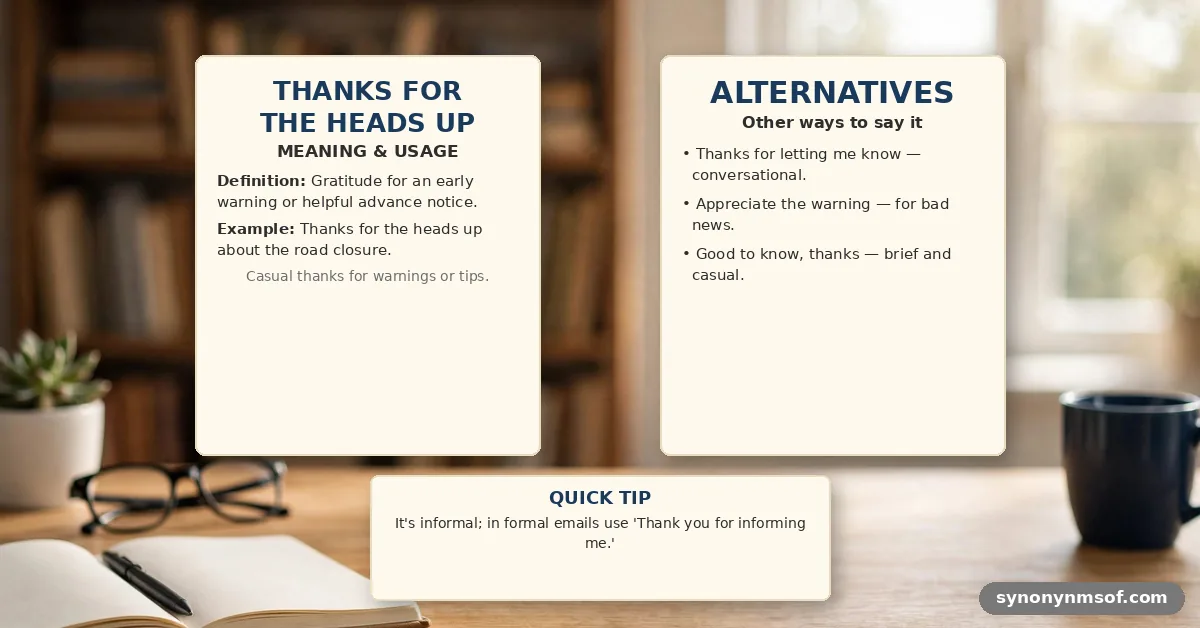
“Thanks for the heads up” simply means:
“Thank you for letting me know in advance.”
People usually say it when someone gives them useful information before an event, problem, or change occurs. It expresses gratitude for receiving an early warning or important update.
For example:
- A coworker tells you tomorrow’s meeting has been moved.
- A friend warns you about heavy traffic.
- A client lets you know a deadline has changed.
- A teammate informs you about a software issue.
In each case, responding with “Thanks for the heads up” shows that you appreciate being informed ahead of time.
See Also: Please Confirm Receipt of This Email: 28 Polite Alternatives
Is “Thanks for the Heads Up” Professional?
Yes—in most modern workplaces, it is.
Today, many companies encourage friendly, conversational communication. As a result, “Thanks for the heads up” is widely accepted in:
- Internal emails
- Team chats
- Slack or Microsoft Teams messages
- Project discussions
- Startup environments
- Friendly client relationships
However, if you’re writing to executives, government officials, legal professionals, or someone you’ve never spoken with before, a more formal alternative may be a better choice.
When Should You Use “Thanks for the Heads Up”?
This phrase works best when someone:
- Warns you about a potential issue
- Shares an important update
- Notifies you about a schedule change
- Helps you avoid a mistake
- Gives advance notice
- Keeps you informed about ongoing work
It’s especially useful because it acknowledges both the information and the person’s effort to tell you early.
Why Is This Phrase So Popular?
The phrase has remained popular because it’s:
- Short and easy to remember
- Friendly without being overly casual
- Appreciative without sounding dramatic
- Natural in both spoken and written English
- Suitable for most workplace conversations
Rather than sounding robotic, it makes communication feel more human.
28 Other Ways to Say “Thanks for the Heads Up”
Sometimes you may want a phrase that’s more formal, warmer, or better suited to a specific situation. Here are excellent alternatives you can use.
1. Thank You for Letting Me Know
Tone: Professional, polite
Example:
“Thank you for letting me know about the updated meeting schedule.”
2. I Appreciate the Advance Notice
Tone: Formal
Example:
“I appreciate the advance notice regarding tomorrow’s presentation.”
3. Thanks for the Update
Tone: Professional, neutral
Example:
“Thanks for the update on the project timeline.”
4. Good to Know
Tone: Casual
Example:
“Good to know. I’ll adjust my plans accordingly.”
5. I Appreciate the Warning
Tone: Appreciative
Example:
“I appreciate the warning about the road closure.”
6. Thanks for Keeping Me Informed
Tone: Professional
Example:
“Thanks for keeping me informed throughout the project.”
7. Thanks for Keeping Me Posted
Tone: Friendly
Example:
“Thanks for keeping me posted on the client’s feedback.”
8. I’m Glad You Told Me
Tone: Warm
Example:
“I’m glad you told me before I finalized everything.”
9. Thanks for the Advance Notice
Tone: Formal
Example:
“Thanks for the advance notice about next week’s maintenance.”
See Also: 28 Ways to Say “I Look Forward to Speaking With You”
10. I Appreciate You Telling Me
Tone: Friendly
Example:
“I appreciate you telling me before the meeting started.”
11. Thanks for the Information
Tone: Neutral
Example:
“Thanks for the information. That really helps.”
12. Thank You for Informing Me
Tone: Formal
Example:
“Thank you for informing me about the policy changes.”
13. Much Appreciated
Tone: Friendly Professional
Example:
“Much appreciated. I’ll make the necessary changes.”
14. That’s Helpful to Know
Tone: Warm
Example:
“That’s helpful to know before we move forward.”
15. Thanks for Pointing That Out
Tone: Appreciative
Example:
“Thanks for pointing that out—I almost missed it.”
16. I’m Grateful for the Notice
Tone: Formal
Example:
“I’m grateful for the notice regarding the revised deadline.”
17. Thanks for the Reminder
Tone: Friendly
Example:
“Thanks for the reminder about tomorrow’s interview.”
18. I Appreciate the Update
Tone: Professional
Example:
“I appreciate the update on the contract review.”
19. Glad You Mentioned It
Tone: Casual
Example:
“Glad you mentioned it—I was about to make the same mistake.”
20. Thanks for Bringing This to My Attention
Tone: Professional
Example:
“Thanks for bringing this to my attention so quickly.”
21. I Value the Early Notice
Tone: Formal
Example:
“I value the early notice and will plan accordingly.”
22. Thanks for Looking Out for Me
Tone: Friendly
Example:
“Thanks for looking out for me—I appreciate it.”
23. That’s Useful Information
Tone: Neutral
Example:
“That’s useful information. Thanks for sharing.”
24. I Appreciate Your Thoughtfulness
Tone: Warm
Example:
“I appreciate your thoughtfulness in letting me know ahead of time.”
25. Thanks for Giving Me a Heads-Up
Tone: Casual
Example:
“Thanks for giving me a heads-up about the schedule change.”
26. I’m Happy You Let Me Know
Tone: Warm
Example:
“I’m happy you let me know before I responded.”
27. Thanks for the Early Warning
Tone: Friendly
Example:
“Thanks for the early warning about the software outage.”
28. I Appreciate You Reaching Out
Tone: Professional
Example:
“I appreciate you reaching out with this information.”
Quick Comparison Table
| Phrase | Tone | Best Used For |
|---|---|---|
| Thanks for the heads up | Casual Professional | Team chats |
| Thank you for letting me know | Professional | Emails |
| I appreciate the advance notice | Formal | Corporate communication |
| Thanks for the update | Neutral | Projects |
| Good to know | Casual | Friends and coworkers |
| Thanks for keeping me informed | Professional | Ongoing collaboration |
| Thanks for bringing this to my attention | Formal | Workplace issues |
| Thanks for looking out for me | Friendly | Personal conversations |
| I appreciate the warning | Professional | Risk notifications |
| Thanks for the reminder | Friendly | Meetings and deadlines |
When Should You Choose an Alternative?
Although “Thanks for the heads up” is appropriate in many situations, switching to a different expression can make your communication feel more natural and tailored to the context.
For example:
- Use “Thank you for letting me know” in client emails.
- Use “I appreciate the advance notice” for formal business communication.
- Use “Thanks for the update” during project discussions.
- Use “Good to know” in casual conversations.
- Use “Thanks for bringing this to my attention” when discussing important issues or mistakes.
Rotating these expressions also helps you avoid sounding repetitive while maintaining a professional and conversational tone.
Real-Life Examples of “Thanks for the Heads Up”
One of the reasons this phrase is so popular is that it fits naturally into many different situations. Whether you’re at work, communicating with clients, or chatting with friends, it feels sincere without being overly formal.
Workplace Example
Sarah: The meeting has been moved from 2:00 PM to 1:00 PM.
You: Thanks for the heads up! I’ll update my calendar right away.
Client Communication Example
Thanks for the heads up regarding the revised timeline. We’ll adjust our schedule accordingly and ensure everything stays on track.
Team Collaboration Example
Thanks for the heads up about the server maintenance. We’ll postpone the deployment until everything is back online.
Personal Conversation Example
Thanks for the heads up about the traffic. I’ll leave a little earlier so I don’t arrive late.
School or College Example
Thanks for the heads up about tomorrow’s assignment deadline. I almost forgot!
Event Planning Example
Thanks for the heads up that the venue has changed. I’ll update everyone in the group.
Professional Email Examples
Here are a few polished examples you can adapt for different situations.
Example 1: Schedule Change
Subject: Re: Meeting Schedule
Hi Amanda,
Thanks for the heads up about tomorrow’s scheduling change.
I appreciate you letting me know early so I could rearrange my calendar. The new meeting time works perfectly for me.
Looking forward to speaking with you.
Best regards,
[Your Name]
Example 2: Project Update
Hi David,
Thank you for letting me know about the revised project deadline.
I appreciate the advance notice and will update our timeline to reflect the new schedule.
Best,
[Your Name]
Example 3: Client Communication
Hello Jennifer,
Thanks for bringing this to my attention.
I appreciate the update and will review the requested changes today. I’ll send the revised document by this afternoon.
Kind regards,
[Your Name]
Casual Workplace Chat Examples
Modern workplaces often rely on quick messaging apps like Slack, Microsoft Teams, or Google Chat. Here are a few natural responses.
- Thanks for the heads up! I’ll take care of it.
- Appreciate the update.
- Good to know. Thanks!
- Thanks for letting me know.
- Got it—thanks for the warning.
- Thanks for keeping me posted.
- I’ll keep that in mind. Thanks!
- Appreciate you telling me.
Why Appreciation Matters in Communication
Many people think “thank you” is just good manners, but it’s much more than that.
When you acknowledge someone’s effort to keep you informed, you encourage them to continue communicating openly.
Simple appreciation can:
- Build trust
- Encourage teamwork
- Strengthen relationships
- Improve workplace morale
- Increase collaboration
- Reduce misunderstandings
- Make conversations feel more positive
A two-second response like “Thanks for the heads up” can have a lasting impact on how people feel about working or communicating with you.
Emotional Intelligence Behind the Phrase
Emotionally intelligent communication isn’t about using complicated words. It’s about recognizing another person’s effort and responding thoughtfully.
When someone warns you about a problem, shares an update, or gives advance notice, they’re investing time to help you.
Saying “Thanks for the heads up” communicates:
- “I noticed your effort.”
- “I appreciate your help.”
- “Your message was valuable.”
- “Thank you for thinking of me.”
These small acknowledgments strengthen professional and personal relationships over time.
Formal vs. Casual: Which Should You Choose?
Choosing the right phrase depends on your audience.
| Situation | Recommended Phrase |
|---|---|
| Internal team chat | Thanks for the heads up |
| Client email | Thank you for letting me know |
| Executive communication | I appreciate the advance notice |
| Friends | Good to know! |
| Teacher or professor | Thank you for informing me |
| Project update | Thanks for the update |
| Risk notification | I appreciate the warning |
| Business partner | Thanks for keeping me informed |
A good rule of thumb is to match your tone to the relationship. The more formal the setting, the more polished your wording should be.
Common Mistakes to Avoid
Even simple phrases can lose their effectiveness if used incorrectly.
1. Using It in Highly Formal Situations
“Thanks for the heads up” may sound too casual in legal, government, or executive correspondence.
Instead, use:
- Thank you for informing me.
- I appreciate the advance notice.
- Thank you for bringing this to my attention.
2. Overusing the Same Phrase
Repeating the same response in every email or chat can make your communication feel repetitive.
Rotate between different alternatives to keep your writing fresh.
3. Forgetting to Express Gratitude
Simply replying with “Noted” or “Okay” may seem abrupt.
Adding a quick “Thanks” makes your response feel much warmer.
4. Sounding Passive-Aggressive
Tone matters just as much as wording.
For example:
❌ Thanks for the heads up… I guess.
Although the words are polite, the tone feels sarcastic.
Instead, write:
✅ Thanks for the heads up! I really appreciate you letting me know.
5. Choosing the Wrong Level of Formality
A phrase that’s perfect in a Slack message might not suit an email to a new client.
Always consider your audience before replying.
Why Simple Language Often Works Best
Many people believe professional writing must sound formal.
In reality, today’s workplace values communication that is:
- Clear
- Friendly
- Respectful
- Direct
- Authentic
Compare these two responses.
Overly Formal
Thank you for notifying me in advance regarding this matter.
Natural
Thanks for the heads up!
The second sounds warmer, more conversational, and easier to read.
Modern Workplace Communication Has Changed
Workplaces today are more collaborative than ever before.
Instead of sounding distant or overly formal, professionals increasingly value communication that is:
- Human
- Respectful
- Transparent
- Appreciative
- Easy to understand
That’s one reason why phrases like “Thanks for the heads up” have become so common. They help people connect while still maintaining professionalism.
Frequently Asked Questions
What does “thanks for the heads up” mean?
It means “Thank you for informing or warning me in advance.”
2. Is “thanks for the heads up” professional?
Yes. It’s appropriate in most modern workplaces, especially for internal communication and collaborative teams.
Can I use it in business emails?
Absolutely. It’s suitable for many business emails, although more formal alternatives may be better for executive or legal communication.
Is it too casual for clients?
It depends on your relationship. For long-term clients with a friendly rapport, it’s perfectly acceptable. For new or highly formal clients, choose a more polished alternative.
What’s the most professional alternative?
One of the best options is:
“Thank you for letting me know.”
It’s polite, versatile, and appropriate in nearly every professional setting.
Is “heads up” an idiom?
Yes. “Heads up” is an English idiom that means an advance warning or notice.
Can I use it in text messages?
Yes. It’s one of the most common expressions in casual texting and instant messaging.
Is it appropriate in Slack or Microsoft Teams?
Definitely. It’s widely used in workplace messaging platforms because it sounds friendly and conversational.
Should I always say “thanks” when someone gives me new information?
Whenever appropriate, yes. Expressing gratitude helps build stronger relationships and encourages open communication.
How can I avoid repeating the same phrase?
Use alternatives such as:
- Thanks for the update.
- I appreciate the advance notice.
- Thank you for letting me know.
- Thanks for keeping me informed.
- Good to know.
- I appreciate the warning.
Why is this phrase so popular?
Because it’s short, genuine, and shows appreciation without sounding overly formal. It fits naturally into both professional and everyday conversations.
Conclusion
The phrase “Thanks for the heads up” may be short, but it carries a meaningful message. It tells someone that you appreciate their effort to inform you in advance, whether they’re sharing a warning, an update, or a helpful reminder.
Its popularity comes from its balance of friendliness and professionalism. It’s warm enough for everyday conversations yet polished enough for many workplace settings. Still, knowing a variety of alternatives allows you to match your tone to different audiences and avoid sounding repetitive.
Whether you’re replying to a coworker, client, manager, friend, or family member, choosing the right expression helps your communication feel more genuine, respectful, and effective. Sometimes, the smallest phrases make the biggest difference in building trust and strengthening relationships.