
Have you ever finished writing an email and wondered how to end it politely? One of the most popular closing phrases is “I look forward to speaking with you.” You’ll often see it in interview invitations, business emails, networking messages, and meeting confirmations.
The phrase is professional, respectful, and positive. It tells the other person that you’re happy about an upcoming conversation and that you value the opportunity to talk with them.
However, because it appears in so many emails, it can sometimes feel repetitive or too formal. Using the same closing over and over may make your messages sound less personal.
The good news is that there are plenty of other ways to express the same idea. Choosing the right alternative can help your email sound warmer, more confident, or more conversational while still staying professional.
In this guide, you’ll learn the simple meaning of “I look forward to speaking with you,” when to use it, and 28 professional alternatives with tone, usage, and examples.
What Does “I Look Forward to Speaking With You” Mean?
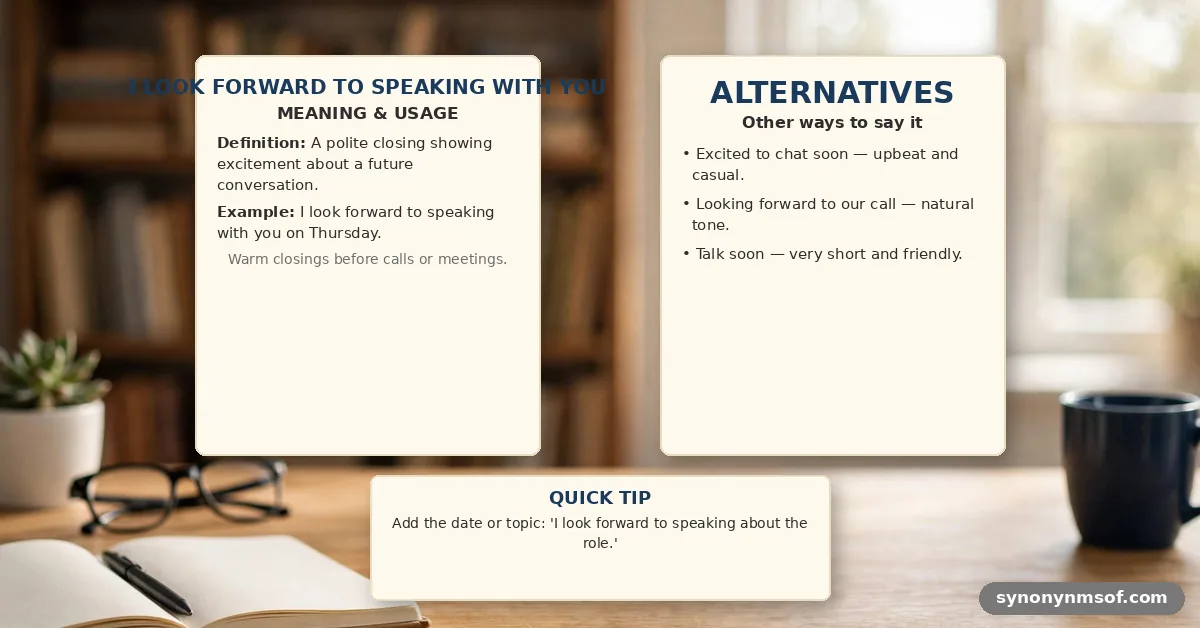
“I look forward to speaking with you” means that you are happy about an upcoming conversation. It lets the other person know that you appreciate the chance to talk and are expecting the discussion with a positive attitude.
People commonly use this phrase when ending an email because it sounds polite, respectful, and professional.
In simple words:
It means:
“I’m excited to talk with you soon.”
The phrase shows:
- Professionalism
- Respect
- Interest
- Appreciation
- Positive expectation
See Also: God Bless You: Meaning, 28 Heartfelt Alternatives, and Better Ways to Say It
Quick Comparison Table
| Phrase | Tone | Best Used For |
| I look forward to speaking with you | Professional | Interviews, business emails |
| Looking forward to our conversation | Warm | Meetings, networking |
| Excited to speak with you | Friendly | Interviews |
| Looking forward to connecting | Professional | Networking |
| Happy to speak with you soon | Warm | Clients |
| Looking forward to discussing this | Professional | Projects |
| Eager to learn more | Enthusiastic | Job interviews |
| Looking forward to hearing your thoughts | Collaborative | Team communication |
28 Other Ways to Say “I Look Forward to Speaking With You”
1. Looking Forward to Our Conversation
Tone: Professional and warm
This is one of the closest alternatives. It sounds natural and works well in almost every professional situation.
Example:
Looking forward to our conversation on Thursday.
2. Excited to Speak With You
Tone: Friendly and enthusiastic
This phrase shows genuine excitement without sounding unprofessional.
Example:
I’m excited to speak with you next week about the position.
3. Looking Forward to Connecting
Tone: Modern and professional
Perfect for networking emails, LinkedIn messages, and introductions.
Example:
Looking forward to connecting with you next Tuesday.
4. Happy to Speak With You Soon
Tone: Warm
This option feels friendly while remaining appropriate for business communication.
Example:
I’m happy to speak with you soon and answer your questions.
5. Looking Forward to Discussing This Further
Tone: Professional
Ideal when talking about projects, proposals, or business opportunities.
Example:
Looking forward to discussing this further during our meeting.
6. Eager to Learn More
Tone: Enthusiastic
This phrase is especially useful for job interviews or educational opportunities.
Example:
I’m eager to learn more about your company and the role.
7. I Appreciate the Opportunity to Connect
Tone: Respectful
Use this when you want to express gratitude while ending your email.
Example:
I appreciate the opportunity to connect and discuss the project.
8. Looking Forward to Hearing Your Thoughts
Tone: Collaborative
This alternative invites discussion and encourages feedback.
Example:
I’m looking forward to hearing your thoughts during our meeting.
9. Excited for Our Discussion
Tone: Friendly
This sounds slightly more energetic than the original phrase.
Example:
I’m excited for our discussion next week.
See Also: Please Let Me Know If You Need Anything Else: 28 Alternatives
10. I Can’t Wait to Connect
Tone: Casual
This works well in friendly professional relationships but may be too informal for highly formal business emails.
Example:
I can’t wait to connect and hear more about your ideas.
11. Looking Forward to Learning More
Tone: Curious
A great choice when you’re interested in discovering more information.
Example:
I’m looking forward to learning more about your organization.
12. It Will Be Great Speaking With You
Tone: Warm and natural
This sounds conversational while still remaining professional.
Example:
It will be great speaking with you next week.
13. I’m Looking Forward to Our Chat
Tone: Relaxed
Best for colleagues or existing business relationships.
Example:
I’m looking forward to our chat tomorrow afternoon.
14. Speak With You Soon
Tone: Neutral
A short and simple email closing that works well for everyday communication.
Example:
Thanks again for your time. Speak with you soon.
15. Looking Forward to Catching Up
Tone: Friendly and conversational
Use this phrase when speaking with someone you already know, such as a colleague, former coworker, or business contact.
Best for: Follow-up meetings, networking, and reconnecting.
Example:
Looking forward to catching up with you next week.
16. I Appreciate Your Time and Look Forward to Speaking With You
Tone: Respectful and professional
This alternative combines gratitude with anticipation, making it perfect for interview follow-ups or client emails.
Best for: Interviews, formal business emails, and client communication.
Example:
Thank you for your consideration. I appreciate your time and look forward to speaking with you on Friday.
17. I’m Excited About Our Upcoming Conversation
Tone: Positive and enthusiastic
This phrase expresses genuine interest while keeping your email professional.
Best for: Interviews, networking, and business introductions.
Example:
I’m excited about our upcoming conversation and learning more about your team.
18. Looking Forward to Exchanging Ideas
Tone: Collaborative
If your meeting involves brainstorming or sharing opinions, this is an excellent choice.
Best for: Team meetings, workshops, and project discussions.
Example:
I’m looking forward to exchanging ideas during our meeting.
19. I Welcome the Opportunity to Speak With You
Tone: Formal and respectful
This phrase sounds polished and appreciative, making it suitable for executive or corporate communication.
Best for: Formal business emails and leadership communication.
Example:
I welcome the opportunity to speak with you about the position.
20. I Look Forward to Discussing the Details
Tone: Professional
Use this when a future conversation will focus on plans, contracts, or project details.
Best for: Business proposals, client meetings, and negotiations.
Example:
I look forward to discussing the details during our meeting.
21. I’m Pleased We’ll Be Speaking Soon
Tone: Polite and formal
This alternative feels warm while maintaining a professional tone.
Best for: Client communication and formal introductions.
Example:
I’m pleased we’ll be speaking soon and appreciate your time.
22. I Hope to Speak With You Soon
Tone: Polite and optimistic
This phrase works well when the meeting or call hasn’t been confirmed yet.
Best for: Initial outreach and networking emails.
Example:
I hope to speak with you soon about this opportunity.
23. Looking Forward to Continuing Our Conversation
Tone: Warm and collaborative
Use this after you’ve already had an initial discussion and expect another one.
Best for: Follow-up meetings and ongoing projects.
Example:
I’m looking forward to continuing our conversation next week.
24. I Look Forward to Connecting With You Soon
Tone: Professional and modern
This is a popular alternative that works in almost every business setting.
Best for: Networking, interviews, and client communication.
Example:
I look forward to connecting with you soon.
25. It’ll Be a Pleasure to Speak With You
Tone: Courteous and professional
This phrase shows appreciation while sounding polished.
Best for: Formal business communication and interviews.
Example:
It’ll be a pleasure to speak with you on Tuesday.
26. I’m Looking Forward to Meeting With You
Tone: Professional
If you’ll be meeting in person or through a video call, this alternative fits perfectly.
Best for: Scheduled meetings and appointments.
Example:
I’m looking forward to meeting with you tomorrow afternoon.
27. Thank You—I Look Forward to Talking With You
Tone: Polite and appreciative
Adding a simple thank-you makes your closing feel more personal.
Best for: Interview emails, client messages, and follow-ups.
Example:
Thank you for your time. I look forward to talking with you soon.
28. I Look Forward to Our Discussion
Tone: Professional and confident
This phrase emphasizes the purpose of your upcoming conversation.
Best for: Business meetings, presentations, and interviews.
Example:
I look forward to our discussion and hearing your ideas.
Which Alternative Should You Choose?
The best alternative depends on who you’re writing to and the tone you want to create.
| Situation | Best Phrase |
| Job interview | I’m eager to learn more |
| Formal business email | I look forward to speaking with you |
| Client communication | Looking forward to discussing this further |
| Networking | Looking forward to connecting |
| Team meeting | Looking forward to hearing your thoughts |
| Existing colleague | Looking forward to our chat |
| Follow-up email | Looking forward to continuing our conversation |
| Informal workplace | Speak with you soon |
Is “I Look Forward to Speaking With You” Still Professional?
Yes. Despite being a common phrase, it remains one of the safest and most professional ways to end an email.
It communicates that you:
- Respect the other person’s time.
- Are interested in the upcoming conversation.
- Have a positive attitude.
- Value the opportunity to connect.
Because it’s clear and polite, employers, clients, and colleagues continue to use it every day.
However, if you use it in every email, your writing may begin to sound repetitive. Rotating between different alternatives can make your communication feel more natural while keeping the same professional tone.
Why People Like This Phrase
There are several reasons why this expression has remained popular for years.
It is:
- Easy to understand
- Professional without sounding cold
- Positive without being overly emotional
- Suitable for almost every industry
- Appropriate for both written and spoken communication
Most importantly, it ends an email on a friendly and optimistic note, leaving a positive final impression.
When to Use “I Look Forward to Speaking With You”
This phrase is suitable whenever you know you’ll be having a conversation with someone in the near future. It works well in both formal and semi-formal communication and helps end your message on a positive note.
Here are some of the most common situations where you can use it.
1. Job Interview Emails
One of the most common places you’ll see this phrase is in interview communication. Whether you’re confirming an interview or replying to an invitation, it shows professionalism and enthusiasm.
Example:
Thank you for inviting me to interview for the Marketing Coordinator position. I appreciate the opportunity and look forward to speaking with you on Wednesday.
2. Business Meetings
If you’ve scheduled a meeting with a client, manager, or colleague, this phrase creates a friendly and professional ending.
Example:
Thank you for arranging the meeting. I look forward to speaking with you tomorrow.
3. Client Communication
Businesses often use this phrase when discussing projects, proposals, or services with clients.
Example:
Thank you for your interest in our services. We look forward to speaking with you and answering your questions.
4. Networking Emails
When building professional relationships, a warm closing helps leave a good impression.
Example:
It was great connecting with you on LinkedIn. I look forward to speaking with you soon.
5. Follow-Up Emails
If you’ve already had one conversation and plan to continue it, this phrase is a natural choice.
Example:
Thank you for your valuable insights. I look forward to speaking with you again next week.
6. Internal Workplace Communication
The phrase also works well when communicating with coworkers or team members.
Example:
Thanks for organizing the meeting. I look forward to speaking with everyone on Monday.
When Not to Use “I Look Forward to Speaking With You”
Although this phrase is versatile, it isn’t the best choice in every situation.
Here are a few times when you should consider using a different closing.
When No Conversation Is Planned
Don’t say you look forward to speaking with someone if there isn’t actually a future conversation scheduled or expected.
Instead, you could say:
- Thank you for your time.
- I appreciate your help.
- Please let me know if you have any questions.
In Very Casual Conversations
When emailing close coworkers or friends, the phrase may sound more formal than necessary.
Instead, you might write:
- Talk soon!
- See you then!
- Catch you later.
- Looking forward to our chat.
During Difficult Conversations
If you’re discussing a complaint, conflict, or sensitive issue, a more direct closing often sounds better.
For example:
Thank you for taking the time to review this matter. I appreciate your attention and hope we can resolve it soon.
Professional Email Example
Interview Confirmation Email
Subject: Interview Confirmation
Hi Emily,
Thank you for inviting me to interview for the Customer Success Manager position.
I appreciate the opportunity to learn more about your company and the role. I’m excited to discuss how my experience and skills can contribute to your team.
I look forward to speaking with you on Tuesday at 10:00 a.m.
Thank you again for your time and consideration.
Kind regards,
James Carter
Client Follow-Up Email
Subject: Looking Forward to Our Meeting
Hello David,
Thank you for taking the time to discuss your project requirements.
I’ve reviewed the information you shared and have prepared several ideas that I believe will help achieve your goals.
I look forward to speaking with you during our meeting on Thursday and discussing the next steps.
Have a wonderful day.
Best regards,
Sophia Wilson
Networking Email
Hi Sarah,
It was a pleasure connecting with you during yesterday’s networking event.
I enjoyed learning more about your work in digital marketing, and I appreciate you taking the time to share your experiences.
I look forward to speaking with you again and continuing our conversation.
Best wishes,
Michael
Common Mistakes to Avoid
Even though this phrase is simple, people sometimes use it incorrectly. Avoid these common mistakes to make your emails sound more natural.
1. Using It Too Often
If every email ends with the exact same sentence, your writing may start to feel repetitive.
Instead, rotate between different alternatives like:
- Looking forward to connecting.
- Excited to speak with you.
- Looking forward to our discussion.
- Happy to chat soon.
Small changes can make your communication feel more personal.
2. Sounding Too Formal
Some people try to sound professional by using overly complicated language.
Less Natural:
I enthusiastically anticipate engaging in further dialogue with you.
Better:
I look forward to speaking with you.
Simple language is usually more effective.
3. Forgetting Personalization
A generic closing isn’t always memorable. Adding one sentence that relates to your conversation makes your email feel more genuine.
Generic:
I look forward to speaking with you.
Better:
I enjoyed learning about your team’s upcoming projects and look forward to speaking with you next week.
A little personalization goes a long way.
4. Using It in the Wrong Situation
Only use this phrase when a future conversation is actually expected.
If there isn’t one, choose a different closing that matches the context.
5. Being Overly Enthusiastic
Professional emails should sound positive without being exaggerated.
Too Much:
I’m beyond excited and absolutely can’t wait to speak with you!
Better:
I’m looking forward to speaking with you.
A calm, confident tone is usually the best choice.
Tips for Sounding More Natural
Want your emails to feel warmer and less like templates? Try these simple tips.
Be Specific
Instead of writing:
I look forward to speaking with you.
Write:
I look forward to speaking with you about the upcoming product launch.
Specific details make your message more meaningful.
Show Appreciation
Combining gratitude with anticipation creates a positive impression.
For example:
Thank you for your time. I look forward to speaking with you next week.
Match the Tone
Think about who you’re writing to.
- A recruiter may expect a formal tone.
- A coworker may appreciate a more relaxed style.
- A client may prefer polite and professional wording.
Choosing the right tone helps build stronger relationships.
Keep It Short
A simple closing is often the most effective.
There’s no need to overcomplicate your message. Clear, natural language almost always sounds more confident than long, formal phrases.
Frequently Asked Questions
What does “I look forward to speaking with you” mean?
It means you are happy and eager to have a future conversation with someone. The phrase expresses positive anticipation while maintaining a polite and professional tone.
Is “I look forward to speaking with you” professional?
Yes. It is one of the most professional email closing phrases you can use. It’s commonly used in business emails, interview invitations, client communication, and workplace messages.
Can I use this phrase in an interview email?
Absolutely. It’s an excellent choice for interview confirmations, thank-you emails, and follow-up messages because it shows enthusiasm and professionalism.
Example:
Thank you for the opportunity. I look forward to speaking with you on Thursday.
Is this phrase too formal?
Not necessarily. It has a professional tone but isn’t overly formal. For casual conversations, however, you may prefer alternatives like “Looking forward to our chat” or “Speak with you soon.”
What’s the difference between “I look forward to speaking with you” and “I look forward to meeting you”?
Although they’re similar, they refer to different situations.
- I look forward to speaking with you focuses on the conversation itself.
- I look forward to meeting you emphasizes meeting the person, whether in person or online.
Choose the phrase that best fits your situation.
Can I use it in a networking email?
Yes. It’s a great way to end networking emails because it sounds polite, confident, and welcoming.
Example:
Thank you for accepting my invitation. I look forward to speaking with you soon.
What are some good alternatives?
Here are a few popular options:
- Looking forward to our conversation
- Excited to speak with you
- Looking forward to connecting
- Happy to speak with you soon
- Looking forward to discussing this further
- Eager to learn more
- It’ll be a pleasure to speak with you
- Looking forward to hearing your thoughts
Each one offers a slightly different tone, so choose the one that best suits your audience.
Why does this phrase sometimes sound repetitive?
Because it’s one of the most common email closings in professional communication. If you use it in every message, your writing can start to feel repetitive.
Rotating between different alternatives helps your emails sound more natural and engaging.
Should I personalize this phrase?
Yes. Adding a small detail makes your email feel warmer and more genuine.
Instead of writing:
I look forward to speaking with you.
Try:
I look forward to speaking with you about your upcoming marketing campaign.
Personalization shows you’ve paid attention to the conversation.
Is it okay to use this phrase with clients?
Definitely. It’s widely used in client communication because it sounds respectful, positive, and professional.
Can I use it after sending my resume?
Yes. If you’ve applied for a job and expect an interview or follow-up, it’s an appropriate closing.
Example:
Thank you for reviewing my application. I look forward to speaking with you soon.
Is “Looking forward to our conversation” better?
Neither phrase is better—they simply create different impressions.
- I look forward to speaking with you sounds more formal.
- Looking forward to our conversation feels slightly warmer and more conversational.
Both are correct, so choose the one that matches your audience and the tone you want to convey.
Final Thoughts
The phrase “I look forward to speaking with you” has remained a trusted part of professional communication for good reason. It’s polite, respectful, and leaves your email on a positive note. Whether you’re writing to a recruiter, client, colleague, or business partner, it communicates that you value the upcoming conversation and appreciate the opportunity to connect.
That said, using the same phrase in every email can make your writing feel repetitive. Learning a variety of alternatives allows you to match your tone to the situation while keeping your messages fresh and natural. For example, “Looking forward to our conversation” sounds warm and conversational, while “I appreciate the opportunity to connect” adds gratitude to your closing.
The key is to choose language that feels authentic. Clear, simple wording often creates a stronger impression than overly formal or complicated expressions. A personalized closing that reflects the purpose of your conversation can also make your email more memorable and engaging.
Whether you’re preparing for a job interview, following up with a client, or reaching out to a new professional contact, the right closing helps build trust and encourages positive communication. By using these 28 alternatives to “I look forward to speaking with you,” you’ll be able to write emails that sound confident, genuine, and professional every time.