
You have probably typed the word “lieing” at least once, watched your spellchecker underline it in angry red, and wondered what you did wrong. It looks right. It follows a sensible pattern. After all, you can write “being” from “be” and “seeing” from “see,” so why should “lie” plus “ing” not give you “lieing”? The answer is that English has a specific rule for this situation, and once you learn it, the confusion disappears for good.
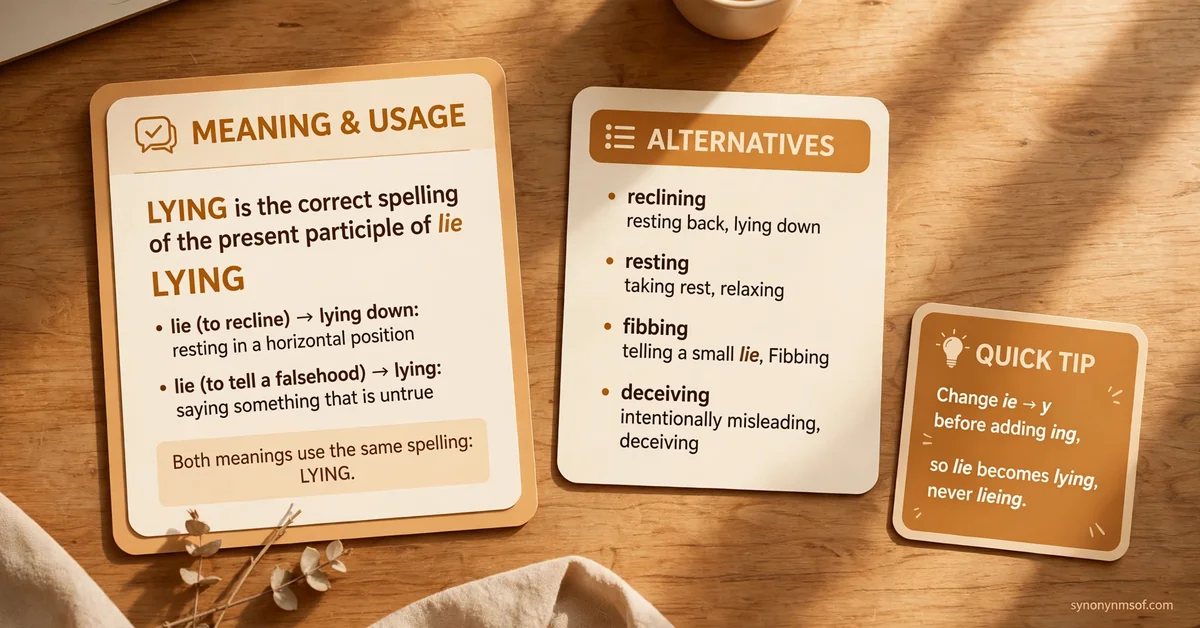
The correct spelling is “lying,” and it is the present participle of the verb “lie.” That single word carries two very different meanings. It can describe someone stretched out in a horizontal position, as in “she is lying on the sofa,” or it can describe someone telling a falsehood, as in “he is lying about his age.” In both cases, the spelling is identical, and “lieing” never enters the picture.
This guide walks you through everything you need to know about lieing or lying. You will learn both meanings of lying, why “lieing” is always a misspelling, the simple spelling rule that produces the correct form, and how to use the word with confidence in everyday writing. Plenty of example sentences, common mistakes to avoid, and answers to the most frequent questions are included along the way.

What Does “Lying” Mean?
“Lying” is the present participle of the verb “lie,” and it carries two distinct meanings that have nothing to do with each other. The first means to recline or rest in a horizontal position. The second means to say something you know is not true. Context tells you which meaning is intended, because the spelling and the grammar are the same either way.
Lying as Reclining
When “lying” describes a physical position, it means that a person, animal, or object is stretched out flat or resting horizontally on a surface. “The cat is lying in the sun” tells you the cat is stretched out comfortably, not that the cat is telling fibs. This meaning comes from the verb “lie” in the sense of rest, and its forms run lie, lying, lay, lain. That irregular pattern is worth learning: today you lie down, yesterday you lay down, and in the past you have lain down.
You will see this sense of lying everywhere in daily life. “I was lying awake half the night” describes tossing and turning in bed. “The town lies in the valley” uses the same verb for a place that sits in a low position. “Her keys were lying on the kitchen counter” describes objects at rest. Notice that none of these sentences involve a direct object receiving an action. Lying in this sense is intransitive, which means the subject is simply in a state or position, and nothing else is being acted upon.
Lying as Telling a Falsehood
The second meaning of “lying” is the one most people think of first: deliberately saying something untrue in order to deceive. “Stop lying to me” is a demand for honesty. “The witness was lying under oath” describes perjury, a serious legal offense. This meaning comes from a different verb, also spelled “lie,” but with a fully regular set of forms: lie, lying, lied, lied.
This sense of lying is about intent. A mistake is not a lie; lying requires knowing that the statement is false and saying it anyway. “He lied about his qualifications” means he knew the truth and hid it. “She is lying through her teeth” is an idiom for telling an obvious, shameless falsehood. Related words include fibbing, deceiving, and misrepresenting, though each carries its own shade of meaning. “Fibbing” usually suggests a small, harmless untruth, while “deceiving” and “misrepresenting” sound more deliberate and serious. In legal writing you will meet phrases like “giving false testimony” or “making a false statement,” which describe the same act with extra precision. The key point for this article is the spelling: whether you mean reclining or deceiving, the present participle is always spelled “lying,” never “lieing.”
Is “Lieing” Ever Correct?
No. “Lieing” is not a recognized word in English. You will not find it in any standard dictionary, and every major style guide treats it as a misspelling. If you type it into a search engine or a spellchecker, the tool will flag it and suggest “lying” instead. It has no meaning, no accepted usage, and no corner of formal or informal writing where it becomes correct.
So why does the error happen so often? Because “lieing” is a completely logical guess. Most English verbs form their present participle by adding “ing” to the base form without any other change: “walk” becomes “walking,” “talk” becomes “talking,” “be” becomes “being.” A writer who applies that same straightforward pattern to “lie” naturally produces “lieing.” The trouble is that “lie” belongs to a small family of verbs ending in “ie” that follow a different rule, and skipping that rule is what produces the misspelling.
There is one more reason for the confusion. The word “lying” is already doing double duty with two meanings, and it looks similar to “laying,” a genuinely different word. Faced with that tangle, some writers invent “lieing” as an escape hatch, a form that feels less tangled. It is an understandable impulse, but it does not work. Every context that tempts you to write “lieing” is a context where “lying” is the right choice.
The Spelling Rule: Why “Lie” Becomes “Lying”
The rule is short: when a verb ends in “ie,” change the “ie” to “y” before adding “ing.” That single step turns “lie” into “lying,” “die” into “dying,” and “tie” into “tying.” There are no exceptions hiding in the corners. Once you know the pattern, you can apply it mechanically and stop guessing.
The rule exists for a good reason. In “lie,” the letters “ie” work together to make one sound, the long “i” you hear in “sky.” If you bolted “ing” straight onto the end, you would get “lieing,” a spelling that looks like it should be pronounced “lee-ing,” with two separate vowel sounds. That would send readers in the wrong direction. Changing “ie” to “y” keeps the pronunciation clean and the spelling tidy: “lying” still sounds like “lie” plus “ing,” which is exactly what it is.
This is the same reason the rule applies to the whole family. “Die” becomes “dying,” not “dieing.” “Tie” becomes “tying,” not “tieing.” “Vie” becomes “vying.” Notice that the rule also protects meaning: “dying” is unambiguous on the page, while “dieing” would look like a machine cutting metal, a completely different activity. Learning this one rule fixes a whole cluster of common misspellings at once, which makes it one of the most useful spelling patterns in English.
Lieing vs Lying: Key Differences
Because “lieing” is not a real word, the difference between the two forms is really a difference between a mistake and the correct spelling. The table below summarizes what you need to know at a glance.
| Feature | Lieing | Lying |
|---|---|---|
| Correct spelling | No | Yes |
| Recognized by dictionaries | No | Yes |
| Meaning | None | Reclining, or telling a falsehood |
| Verb form | Not a word | Present participle of “lie” |
| Accepted in formal writing | Never | Always |
The practical takeaway is simple. Any time you reach for “lieing,” replace it with “lying.” There is no sentence, no register, and no style of writing where “lieing” is the better option. If your meaning is reclining, write “lying.” If your meaning is telling a falsehood, write “lying.” The spelling does not change, even though the meaning does.
How to Use “Lying” Correctly
Using “lying” correctly is mostly a matter of matching the word to your meaning and keeping your verb forms consistent. Start by asking yourself what you want to say. If someone is resting horizontally, you want the recline sense: “He is lying on the couch.” If someone is being dishonest, you want the falsehood sense: “He is lying to the manager.” In both cases, the spelling is “lying,” and the sentence structure is natural and direct.
Context does the heavy lifting of separating the two meanings. “She was lying on the bed” is almost certainly about rest, because beds are for resting. “She was lying about the money” is almost certainly about deception, because of the word “about.” English speakers handle this effortlessly in conversation, and readers handle it the same way in writing. You do not need to add extra words to clarify; the surrounding sentence makes the meaning clear.
Watch your tense forms, because this is where the recline sense of “lie” causes trouble. The present participle is always “lying.” The simple past is “lay,” as in “Yesterday, I lay on the couch.” The past participle is “lain,” as in “I have lain here too long.” Do not write “I was lied on the couch” or “I have lied down,” because “lied” belongs to the falsehood sense of the verb: “He lied about his age.” Keeping these forms straight is the difference between sounding natural and sounding careless.
Finally, remember that “lying” in the recline sense never takes a direct object. You cannot “lie” something down the way you can “lay” something down. “The baby is lying in the crib” is correct. “She is lying the baby in the crib” is not; that sentence wants “laying.” If there is an object being placed, you have left “lie” territory and entered “lay” territory, which is a different verb with different rules.
Example Sentences with “Lying”
Seeing the word in real sentences is the fastest way to make the correct spelling stick. The examples below are grouped by meaning so you can see how context shapes each one.
Lying in the Sense of Reclining
- The dog is lying under the table, fast asleep.
- She was lying on the beach with a book over her face.
- After the long hike, we spent an hour lying in the grass.
- The patient had been lying still for nearly twenty minutes.
- I found my brother lying across the sofa, watching cartoons.
- The letter had been lying on the doormat all morning.
- They were lying side by side, watching the clouds drift past.
- He fell asleep while lying in the hammock.
- The town lies in a valley, and the river lies beyond it.
- She lay down for a nap and was lying there when I called.
- Do not disturb him; he is lying down with a headache.
- The keys were lying exactly where she had left them.
Lying in the Sense of Telling a Falsehood
- He is lying about where he was last night.
- Stop lying and tell me what really happened.
- The witness admitted she had been lying under oath.
- They accused him of lying on his job application.
- She was lying through her teeth about the broken vase.
- If you keep lying, no one will trust you.
- He lied about his age to get the job.
- The child was lying to avoid getting in trouble.
- Investigators proved that the suspect had lied.
- She suspected he was lying when his story kept changing.
- Lying on a legal document can lead to serious penalties.
- He apologized for lying to his parents.
Common Mistakes to Avoid
The most common mistake is simply writing “lieing.” It appears in student essays, social media posts, emails, and even professional documents. Every occurrence is wrong, and every one is easy to fix with a quick mental check: change “ie” to “y,” then add “ing.” Running a spellchecker helps too, but it is better to internalize the rule so you catch the error before the software does.
The second most common mistake is confusing “lying” with “laying.” This one is understandable because the two words sound similar and both relate to horizontal positions. The rule is straightforward: if there is no object, use “lying.” “He is lying on the couch” is correct because nothing is being placed. “He is laying on the couch” is wrong. If there is an object being put down, use “laying.” “She is laying the blanket on the couch” is correct because the blanket is the object. A handy test is to ask “what?” after the verb. If you can answer, you want “laying.”
The third mistake involves the past tense. Because the past tense of “lie” (recline) is “lay,” writers sometimes pair “lying” with the wrong past forms. They write “I was lied down” when they mean “I lay down,” or they write “he lay about his age” when they mean “he lied about his age.” Remember the two families: the reclining verb runs lie, lying, lay, lain, while the falsehood verb runs lie, lying, lied, lied. Only the present and the present participle are identical.
A fourth mistake is subtler: using “lying” where a more precise word would serve better. In formal or legal writing, “lying” is fine, but “misrepresenting,” “falsifying,” or “giving false testimony” may fit the context more precisely. In descriptions of rest, “reclining” or “resting” can add variety. None of these alternatives change the spelling rule, but they show that “lying” is a starting point, not the only option.
How to Proofread for the “Lieing” Mistake
Because “lieing” looks so plausible, it slips past tired eyes. A short proofreading routine catches it every time. First, search your document for the string “ieing.” Any verb ending in “ieing” deserves a second look, because the “ie” to “y” rule applies to all of them. If you find “lieing,” “dieing,” or “tieing,” you have found three errors for the price of one search. Most word processors let you run this search in seconds, and it is worth doing before anything important goes out.
Second, read the sentences around each occurrence aloud. Hearing the word helps your ear confirm what your eyes missed. If you hear yourself say “lye-ing” with the long “i” of “lie,” the spelling “lying” matches the sound. If you find yourself stumbling over “lie-ing,” that stumble is your brain telling you the spelling is off. This read-aloud trick works for the two meanings too: “He is lying on the bed” and “He is lying to the judge” both sound natural with the same pronunciation, which confirms that one spelling serves both senses.
Third, check the tense family around the word. If the sentence is about the past, “lying” should not appear at all; you want “lay” or “lain” for reclining, or “lied” for falsehoods. Many “lieing” errors travel with tense errors, so fixing the spelling often reveals a verb-form problem worth fixing at the same time. Writers who proofread for the pair together end up with cleaner sentences overall.
Finally, keep a small personal list of your own repeat errors. If “lieing” is on yours, add “dying” and “tying” beside it as reminders of the rule, plus “laying” as a reminder of the related confusion. A five-word list taped to your monitor or pinned in your notes app does more for your spelling than any grammar guide you read once and forget. Patterns stick when you see them every day.
Frequently Asked Questions
Is “lieing” ever correct?
No, “lieing” is never correct in any context. It is a misspelling of “lying,” which is the present participle of the verb “lie.” Standard dictionaries do not list “lieing,” and spellcheckers flag it. Always write “lying,” whether you mean reclining or telling a falsehood.
Can “lying” refer to both resting and telling a falsehood?
Yes. “Lying” is the present participle of two different verbs that happen to share the spelling “lie.” One means to recline, as in “she is lying on the bed,” and the other means to tell an untruth, as in “he is lying about his age.” The surrounding context makes the intended meaning clear.
What is the past tense of “lie” when it means to recline?
The past tense is “lay,” as in “Yesterday, I lay on the couch.” The past participle is “lain,” as in “I have lain here too long.” Do not confuse these with “lied,” which is the past tense of the other “lie,” the one that means telling a falsehood: “He lied about his age.”
How do I remember the correct spelling of “lying”?
Remember the rule for verbs ending in “ie”: change the “ie” to “y” before adding “ing.” The same pattern gives you “dying” from “die” and “tying” from “tie.” A quick way to check yourself is to sound the word out: “lying” keeps the long “i” sound of “lie,” while “lieing” would awkwardly read as “lee-ing.”
What is the difference between “lying” and “laying”?
“Lying” means reclining or telling a falsehood, and it takes no direct object: “He is lying on the bed.” “Laying” means placing something down, and it always takes a direct object: “She is laying the book on the table.” If you can answer “what?” after the verb, you want “laying”; if not, you want “lying.”
Conclusion
The lieing or lying question has a short answer and a satisfying explanation. The spelling is always “lying,” for both meanings of the verb “lie,” and “lieing” is never correct. The reason is the dependable English rule that changes “ie” to “y” before “ing,” the same rule that gives us “dying” from “die” and “tying” from “tie.” Once that rule is in your toolkit, the misspelling stops appearing.
Keep the two meanings straight by trusting context, keep your tense forms consistent with the right verb family, and keep “laying” reserved for sentences with an object being placed. With those habits in place, you will write “lying” correctly every time, in every register, without a second thought.
Explore more on Synonynmsof.