
You have seen “true or false” a thousand times — on school tests, in online quizzes, in party games, and in everyday conversation. It looks like the simplest idea in the world: a statement is either correct (true) or incorrect (false), and your only job is to pick one. Two options, no middle ground, no partial credit for a clever maybe. It feels so basic that most people never stop to think about what those two little words actually mean.
Yet this tiny two-word label hides more depth than most people realize. The idea of judging statements as true or false sits at the foundation of logic, mathematics, and computer science. It shapes how tests are written, how news is fact-checked, and how we argue about everything from science to history. Programmers build entire digital worlds out of nothing but true and false values, and teachers rely on the format because it tests knowledge with ruthless efficiency.
This guide covers all of it in plain, human language. You will learn exactly what “true” and “false” mean, how true-or-false statements work, real examples across quizzes, logic, computing, and everyday decisions, a side-by-side comparison table, the most common mistakes to avoid, tricky edge cases, and clear answers to the five questions people ask most.
What Does “True or False” Mean?
The phrase “true or false” asks whether a statement is correct or incorrect. “The Earth orbits the Sun” is true because the claim matches the facts. “Fish can breathe underwater using lungs” is false because it does not. The judgment is binary: exactly two verdicts, and every well-formed statement earns one of them.
You will meet the phrase in several common roles. As a quiz instruction — “Mark each statement true or false” — it defines the task. As a quiz format, a “true or false quiz” is a test made entirely of such judgments. In conversation, “that’s true” agrees with a claim and “that’s false” rejects it — and a playful “true or false?” tacked onto a claim (“You finished the whole pizza, true or false?”) just means “is that right?”
The power of the format is its demand for clarity. To answer a true-or-false question, the statement itself must be clear enough to judge. That is why good true-or-false questions are always complete, factual sentences — and why vague, opinion-based, or half-finished claims break the format. We will explore exactly what makes a statement judgeable below.
What Does “True” Mean?
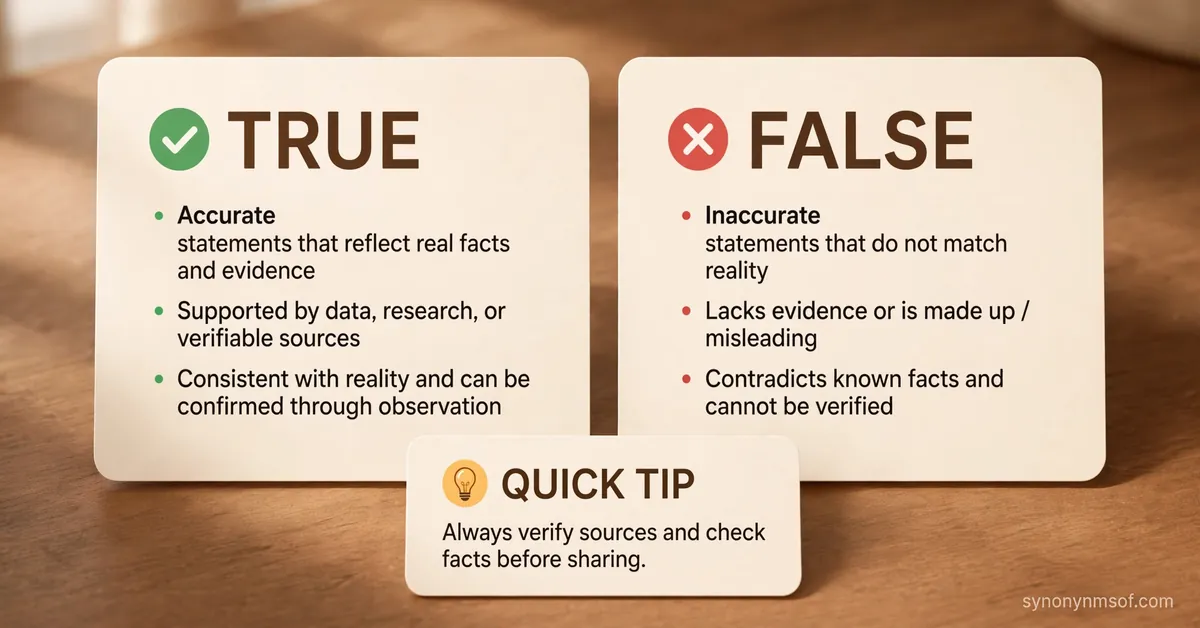
True means correct, factual, or in agreement with reality. When a statement is true, what it claims matches what actually is. “Water freezes at 0 degrees Celsius” is true. “Paris is the capital of France” is true. “You are reading this sentence right now” is true. In each case, the words describe the world the way the world actually is, and that match is what “true” means.
The word carries a few related senses beyond factual correctness. Something true can be genuine, as in “a true friend” or “true love.” It can mean faithful: “true to your word” means keeping your promises. But in the true-or-false context, “true” always means the statement checks out against the facts.
Part of speech: adjective. Pronunciation: “troo.”
Example sentences using “true”:
- It is true that the Pacific is the largest ocean on Earth.
- Her prediction about the election turned out to be true.
- “Dogs are mammals” — true or false? True.
- The rumor was true after all.
- A true statement can be proven with evidence.
- “Two plus two equals four” is true in every number system we use.
What Does “False” Mean?
False means not true — incorrect, untrue, or failing to match reality. When a statement is false, what it claims does not line up with the facts. “The Moon is made of cheese” is false. “Sharks are mammals” is false (they are fish). “You are currently on Mars” is, for almost everyone reading this, false. Notice the key point: false does not require anyone to be lying. A false statement is simply one that gets the facts wrong, whether by honest mistake, outdated information, or deliberate deception.
Like “true,” the word “false” has related senses worth knowing. Something false can be fake or artificial: “false teeth,” “a false alarm.” It can mean insincere or deceptive: “a false smile,” “false promises.” And in music, a “false note” is one played off-pitch. In the true-or-false judgment, though, “false” has one job: marking a statement as incorrect.
Part of speech: adjective. Pronunciation: “fawls.”
Example sentences using “false”:
- The claim that the company was bankrupt turned out to be false.
- “Lightning never strikes the same place twice” is false — it often does.
- She gave a false name at the hotel.
- The fire alarm was false; there was no fire.
- “Humans only use 10 percent of their brains” is a false myth.
- “Bats are blind” is false — most bats see quite well.
True or False: Quick Answer
| Question | Answer |
|---|---|
| What does “true or false” mean? | A judgment of whether a statement is correct (true) or incorrect (false). |
| What does “true” mean? | Correct, factual, matching reality. |
| What does “false” mean? | Not true — incorrect or failing to match reality. |
| Can a question be true or false? | No — only statements (claims) can be judged true or false. |
| Can an opinion be true or false? | No — opinions express preference, not facts; they are neither. |
| What is a true or false quiz? | A test where each question is a statement you mark as true or false. |
| Is “false” the same as “a lie”? | Not always — a false statement can be an honest mistake; a lie is deliberately false. |
How True or False Statements Work
Not every sentence can be judged true or false. Logicians call a judgeable sentence a proposition: a complete statement that makes a claim about the world, and is therefore either true or false. “Snow is white” is a proposition; “the meeting starts at 3 p.m.” is one too.
What Counts as a Statement
A statement is a declarative sentence: it declares something, and that something can be checked. The test is simple — ask yourself, “Could this be right or wrong?” If yes, it is a statement.
Sentences that ARE statements (judgeable):
- “The Amazon River is the longest river in the world.” (Debatable, but a genuine claim.)
- “Elephants are the only animals that cannot jump.” (True, as far as zoologists can tell.)
- “My keys are on the kitchen table.” (Check the table and you will know.)
Sentences that are NOT statements (not judgeable):
- “What time is it?” — a question asks for information; it cannot be true or false.
- “Please close the door.” — a command tells someone to act; it has no truth value.
- “Wow, what a beautiful sunset!” — an exclamation expresses feeling, not a claim.
- “Hello.” — a greeting makes no claim at all.
This is why the classic classroom example matters: “What is the difference between inequalities and equations?” is not a statement, so asking “true or false?” about it makes no sense. A question can be good or bad, clear or confusing — but never true or false.
The Two Rules of a Good True-or-False Statement
Rule 1: It must make one clear, complete claim. “Water boils at 100°C at sea level” is judgeable. “Water boils and ice melts and steam rises” jams three claims together — if one is wrong, the whole thing is false. Keep it to one idea per statement.
Rule 2: It must be checkable against facts, not feelings. “The Eiffel Tower is in Paris” can be verified — true. “The Eiffel Tower is beautiful” cannot be proven or disproven — it is an opinion, neither true nor false. This is the single most important rule: true-or-false only works on facts.
True or False in Real Life: Examples Across Contexts
The true-or-false judgment shows up far beyond the classroom — in quizzes, logic, computing, games, and everyday thinking.
Quizzes and Exams
The true-or-false quiz is a staple of education because it is fast to answer and fast to grade. Each question presents a statement, and the student agrees or disagrees: “The Great Wall of China is visible from the Moon — true or false?” (False, despite the popular myth.) Teachers use the format to test basic knowledge quickly, especially with large classes or automated grading.
Test-takers should know the format’s quirks. Because there are only two options, a pure guess has a 50 percent chance of being right — which is why teachers mix true/false items with other question types. Wording matters enormously: good test statements are short, positive, and precise. Statements packed with absolute words like “always,” “never,” “all,” or “none” tend to be false, because the real world rarely deals in absolutes — “All birds can fly” is false (penguins and ostriches would like a word). Statements with softer qualifiers like “often” or “usually” lean true.
Logic, Math, and Computing
In logic and mathematics, true and false are the two truth values — the only possible verdicts for any proposition. This binary foundation, developed in the 1800s by mathematician George Boole (whose name lives on in “Boolean logic”), underpins modern computing. Every computer chip ultimately reduces decisions to true/false: a condition is either met or it is not, a switch is on or off, represented as 1 or 0.
Programmers work with Boolean values daily. In most programming languages, `true` and `false` are built-in: `2 + 2 == 4` evaluates to `true`, while `2 + 2 == 5` evaluates to `false`. Conditions like “if the user is logged in” are true-or-false judgments the machine makes millions of times per second. The simplicity is the point — complex software is built from vast chains of tiny true/false decisions.
Everyday Decisions
You make true-or-false judgments constantly without noticing. “It is raining outside” — glance out the window and the verdict is in. “The store is open until 9” — check the sign. Each is a small claim tested against evidence, and the habit of checking claims before believing them is one of the most useful skills a person can develop.
This is also the engine of fact-checking. When a news headline claims something dramatic, a fact-checker treats it as a true-or-false statement: what exactly is being claimed, what evidence supports it, and does the evidence match? Headlines that turn out to be exaggerated or outdated earn a “false” — because the claim failed the evidence test.
Games and Trivia
Party games, pub quizzes, and trivia nights love the true-or-false round because anyone can play. “A group of flamingos is called a flamboyance — true or false?” (True.) “Humans and giraffes have the same number of neck vertebrae — true or false?” (True — seven each.) The format turns knowledge into a snap decision, and the reveal delivers a little jolt of surprise either way.
True vs False: Comparison Table
| Feature | True | False |
|---|---|---|
| Core meaning | Correct; matches reality | Incorrect; does not match reality |
| Opposite | False | True |
| In a quiz | The statement is accurate | The statement is inaccurate |
| In logic / computing | Truth value 1; Boolean `true` | Truth value 0; Boolean `false` |
| Example statement | “The Pacific is Earth’s largest ocean.” | “The Atlantic is Earth’s largest ocean.” |
| Requires intent to deceive? | No | No — an honest mistake can still be false |
| Applies to questions? | No | No — questions are never true or false |
| Applies to opinions? | No | No — opinions are neither true nor false |
| Pronunciation | “troo” | “fawls” |
| Related words | Correct, factual, accurate, genuine | Incorrect, untrue, wrong, mistaken |
Common Mistakes and Confusions to Avoid
Mistake: Treating opinions as true-or-false statements.
“Chocolate ice cream is the best flavor — true or false?” There is no correct answer, because “best” is a matter of taste. The format only works on facts. If a statement cannot be checked against evidence, it does not belong in a true-or-false question — in a quiz or in an argument.
Mistake: Letting one wrong detail slide in a half-true statement.
A statement with a single false detail is false as a whole. “The Eiffel Tower, built in 1889, is located in London” gets the year right but the city wrong — verdict: false. In quizzes and in real life, precision matters: a claim is only true if all of its parts check out.
Mistake: Confusing “false” with “a lie.”
A lie is a deliberately false statement, told to deceive. But most false statements are honest mistakes, outdated beliefs, or misremembered facts. Your friend who says the meeting is at 3 when it is at 4 is wrong, not lying. Reserve “lie” for intent; use “false” for the verdict on the claim.
Mistake: Confusing “true” with “the whole truth.”
A statement can be technically true yet misleading. “Our product contains real fruit” is true even if the product is 99 percent sugar. Truthfulness means more than avoiding literal falsehoods — it means not cherry-picking facts to mislead.
Mistake: Ignoring absolute words in quiz questions.
Words like “always,” “never,” “all,” “every,” and “none” make a statement extreme — and extreme claims are easy to disprove with a single counterexample. “All mammals live on land” is false because whales and dolphins exist. When you spot an absolute in a true-or-false question, slow down and hunt for the exception.
Mistake: Answering “true or false” to questions and commands.
“What is your name — true or false?” is nonsense, because a question makes no claim. Only declarative statements carry truth values. If there is no claim being made, there is nothing to judge.
Mistake: Assuming a 50/50 guess is a strategy.
Random guessing on a true-or-false test averages 50 percent — still a failing grade almost everywhere. The format rewards actual knowledge far more than guessing. Study the material; use the absolutes-and-qualifiers patterns only as a last-resort tiebreaker, never as a plan.
Tricky Cases
Vague statements that depend on context. “It is cold outside” — true or false? It depends on who is speaking and where they are. A statement needs enough specificity to be checkable: “It is below freezing in Chicago right now” can be verified. When you cannot judge a statement, the problem is usually missing detail.
Statements that used to be true. “Pluto is a planet” was true in every textbook until 2006, when astronomers reclassified it as a dwarf planet. Truth values can change when definitions change or new evidence arrives. Judge a statement by the best current evidence, and be ready to update the verdict.
Self-referential paradoxes. “This statement is false.” If it is true, then it is false; if it is false, then it is true. Logicians have chewed on this puzzle — the liar paradox — for over two thousand years. It is a genuine edge case, but it lives in philosophy classrooms, not in real quizzes.
“True enough” claims in news and advertising. “Nine out of ten dentists recommend our toothpaste” sounds factual, but the truth value hides in the fine print — which dentists, asked how, paid by whom? Treat slick statistics as guilty until proven innocent: look for the source before you render a verdict.
Opinions wearing factual clothing. “Everyone knows the new policy is a disaster” smuggles an opinion (“a disaster”) inside a factual-sounding frame (“everyone knows”). Strip the packaging: “the new policy is a disaster” is an evaluation, not a fact — neither true nor false.
Predictions about the future. “It will rain tomorrow” cannot be judged true or false today — it is a forecast, not a fact. Tomorrow, after the fact, the verdict becomes available. This is why weather forecasts give probabilities instead of true-or-false verdicts: some claims are only judgeable after the event.
Frequently Asked Questions
What is the difference between true and false?
True means correct, factual, and matching reality; false means not true — incorrect or failing to match reality. If a statement’s claim checks out against the evidence, it is true; if not, it is false. They are exact opposites.
Can a statement be both true and false?
No — not in the ordinary sense. A clear, specific factual claim is either true or false, never both. Apparent exceptions come from vague wording (“it is cold” — cold for whom?), changing definitions (“Pluto is a planet” — true before 2006, false after), or paradoxes like “this statement is false.”
What is a true or false question?
A true or false question is a test or quiz item that presents a single factual statement, and you must decide whether it is accurate (true) or inaccurate (false). There are only two possible answers, which makes the format quick to answer and easy to grade. It is used in schools, exams, trivia games, and online quizzes to test basic knowledge of facts.
What is the difference between “false” and “wrong”?
They overlap, but “false” specifically judges a statement’s truth value — the claim does not match reality. “Wrong” is broader: an answer can be wrong, a decision can be wrong, a turn can be wrong. Every false statement is wrong, but not everything wrong is a false statement.
Should I guess “true” if I do not know the answer on a true-or-false test?
There is a grain of truth to this old tip: teachers writing questions from their own notes tend to produce slightly more true statements than false ones. But the effect is small and unreliable. A better last-resort strategy is to watch for absolute words — “always,” “never,” “all,” “none” — which usually signal a false statement. The real strategy is to learn the material.
Final Thoughts
True or false is far more than a quiz format — it is the basic unit of clear thinking. Every time you check a claim against evidence, separate a fact from an opinion, or ask “is that actually right?”, you are running the same tiny judgment that powers logic, science, computing, and honest conversation.
So the next time you face a true-or-false question, slow down: check that the sentence is a real statement, verify each detail, watch for opinion dressed as fact, and beware absolute words. Two options, one verdict, zero guesswork about the method. Master that, and the simplest format in the world becomes one of the most reliable tools in your mind.