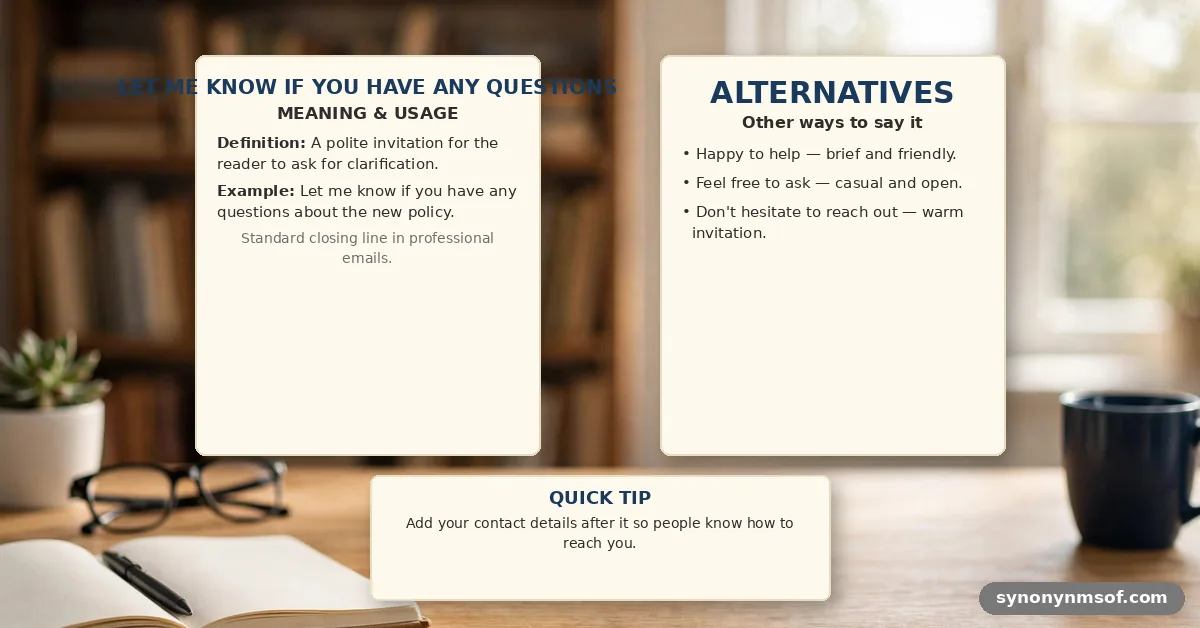

When you wrap up a professional email, you likely reach for a standard closing to invite feedback. Using the phrase “let me know if you have any questions” is a common way to signal that your communication is open-ended and that you are available for further discussion. While it is a staple in modern workplace correspondence, understanding when to deploy this specific invitation—and when to opt for a more tailored alternative—can significantly improve your professional clarity.
This article examines the nuance behind this ubiquitous sign-off and provides better ways to manage your professional interactions. By learning how to refine your language, you will ensure your emails are both polite and actionable.
The Origins and Purpose of Standard Closings
Business communication relies on predictable patterns to save time and reduce ambiguity. Phrases like “let me know if you have any questions” serve as a social lubricant, signaling that the sender is not shutting down the conversation after providing information. It acts as a safety net, ensuring the recipient feels comfortable reaching out if the details provided were insufficient or confusing.
Why We Use Generic Invitations

Most professionals use these phrases because they are safe and universally understood. They function as a polite buffer that transitions the reader from the core information to the end of the message. In high-volume environments, these linguistic shortcuts allow for quick processing without requiring the sender to reinvent the wheel for every single interaction.
The Risk of Over-Reliance
The primary drawback of relying on a standard closing is that it can become invisible. When a recipient sees the same phrase in every email, they may gloss over it entirely.
If you truly need feedback on a critical project, a generic invitation might fail to elicit the specific response you want. You risk appearing disengaged or robotic when you default to the same tired expressions.
When to Use Standard Phrases Effectively
There are specific scenarios where a standard sign-off is perfectly appropriate. If you are sending routine updates, weekly reports, or general informational packets, you do not need to overthink your closing. In these cases, the recipient expects a standard, professional tone that respects their time.
Consider using these variations to keep your communication fresh:
- “I am happy to clarify any of these points if you need more information.”
- “Please reach out if you would like to discuss these figures in greater detail.”
- “Let me know if you require any further documentation to proceed.”
- “I am available to walk you through these steps if you have any trouble.”
Alternatives for High-Stakes Communication
When the stakes are high, such as during contract negotiations or sensitive client updates, generic phrases can seem dismissive. Instead of asking if they have questions, try to anticipate what they might need. This proactive approach demonstrates that you have thought deeply about the project and care about the recipient’s success.
For instance, if you are sending a complex proposal, you might say, “I have outlined the budget here, and I am available at 2 PM tomorrow if you want to review the line items together.” This replaces an open-ended invitation with a concrete offer of assistance. It narrows the scope of the request and makes it easier for the recipient to say yes to a conversation.
Analyzing Tone and Formality in Emails
The tone of your email should always match the relationship you have with the recipient. If you have worked with a colleague for years, “let me know if you have any questions” might feel stiff or unnecessarily formal. In these instances, you can use more casual language that fits your established rapport.
Conversely, when writing to a new client or a senior executive, you want to maintain a high level of professionalism. You should avoid being overly familiar while still being helpful. The goal is to strike a balance where you offer help without sounding like you are filling space.
| Context | Recommended Phrasing | Level of Formality |
|---|---|---|
| Internal Team Update | “Ping me if anything is unclear.” | Low |
| General Client Query | “Let me know if you have any questions.” | Medium |
| High-Stakes Proposal | “I am available to discuss these terms at your convenience.” | High |
| Urgent Technical Issue | “Please contact me immediately if you encounter any errors.” | High |
Managing Expectations Regarding Availability
One of the biggest pitfalls of inviting questions is that it implies you are perpetually available. If you send an email late on a Friday afternoon, the reader might assume you are ready to jump on a call immediately. You must manage these expectations by setting boundaries around your time.
Setting Clear Boundaries

You can combine your invitation for questions with a brief mention of your schedule. For example, “Please let me know if you have any questions; I will be away from my desk until Monday morning, but I will respond as soon as I return.” This gives the recipient permission to ask without creating an emergency for you.
Directing Traffic to Other Resources
Sometimes, the best way to handle questions is to provide the answers before they are asked. If you are sending a document, include a link to an official style guide or FAQ page that addresses common concerns. By pointing the reader toward existing resources, you provide better assistance than a generic offer of help ever could.
The Psychology of the “Call to Action”
Every closing sentence is a call to action. When you write “let me know,” you are asking the recipient to perform a mental check of their understanding.
If they are busy, they will likely skip this check, assuming they have understood everything well enough. If you want a genuine engagement, you must make the call to action specific.
Instead of a vague invitation, ask a specific question. Try, “Which part of the implementation plan would you like to review first?” or “Do you need any more data regarding the projected costs?” By focusing their attention, you are much more likely to get a helpful, thoughtful response back.
Cultural Nuances and Professional Globalism
In a globalized workforce, language barriers can affect how your emails are perceived. In some cultures, “let me know if you have any questions” is interpreted as a genuine request for feedback. In others, it may be seen as a polite way to end a conversation that the sender does not actually want to continue.
Be mindful of the cultural background of your recipient. If you are communicating with someone who prefers directness, skip the fluff and simply ask for their approval or feedback. Being aware of these differences is a hallmark of an effective communicator who understands that language is not one-size-fits-all.
Avoiding Common Communication Traps
Many writers fall into the trap of using “please” or “kindly” to soften their requests, which can sometimes backfire. Over-using these words can make you sound hesitant or unsure of your position. Similarly, phrases like “please do not hesitate to contact me” are often seen as filler that adds no actual value to the message.
Focus on being concise. If you want someone to reach out, just say, “I am available for a call,” or “Send me your thoughts by Wednesday.”
Clear instructions are always more professional than polite, empty invitations. Your goal is to move the work forward, not to fill your email with social pleasantries.
FAQ
Is it grammatically correct to say “please let me know if you have any questions”?
Yes, it is perfectly correct. It is a standard, polite English expression used in professional settings. While some find it repetitive, it remains a grammatically sound way to offer assistance.
What is a more professional alternative to “let me know if you have any questions”?
A better alternative is to be specific about your availability. Phrases like “I am available to discuss these details at your convenience” or “Please share your thoughts on the proposal by Thursday” are more actionable and professional.
Should I use “please do not hesitate to contact me”?
This phrase is widely considered a cliché. It is often used as filler at the end of emails. Unless you are writing an extremely formal letter, you are better off using a simpler, more direct invitation for contact.
How do I stop using the same closing in every email?
Create a small list of variations based on the urgency and content of your emails. By rotating through different ways to offer help, you keep your communication engaging and ensure that your recipients actually pay attention to your sign-offs.
Conclusion
Mastering the art of email closings requires you to move past generic templates. While it is easy to default to “let me know if you have any questions,” doing so often misses an opportunity to provide real value or guidance to your recipient. By replacing these standard phrases with specific offers of help or clear next steps, you demonstrate that you are a thoughtful and proactive communicator.
The next time you draft an email, take a moment to consider what you actually need from the reader. Use the space at the end of your message to invite exactly the kind of response that will move your work forward. By refining your approach to these common expressions, you will build stronger professional relationships and ensure your intent is always clear.